







Note: The most recent government fee schedules cited in this article are from HUD's 2024–2026 regional memos and USDA's FY2026 guidance. Private-market data reflects industry benchmarks current through early 2025.
Property management fees typically range from 8% to 12% of monthly rent collected, with 10% serving as the most commonly cited industry benchmark. The actual cost varies significantly by state, property type, and the scope of services included in the management agreement.
This breakdown covers state-by-state fee benchmarks, the factors that drive pricing differences, common add-on charges beyond the monthly management fee, and when hiring a property manager makes financial sense compared to self-managing with software.
Key Takeaways
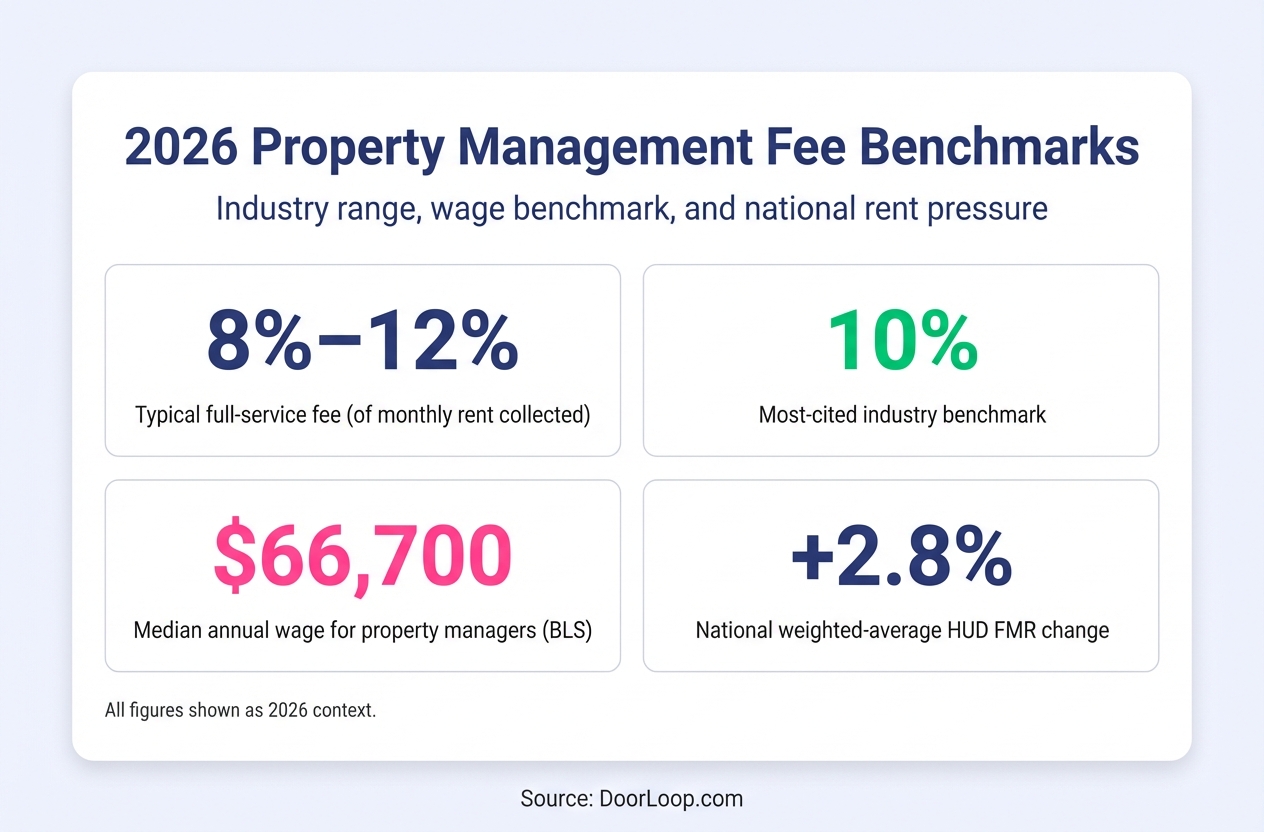
- Full-service property management fees typically range from 8% to 12% of monthly rent collected, with 10% often cited as the industry standard.
- Government fee schedules (HUD and USDA) publish state-by-state management fee ranges expressed as per unit per month (PUPM), offering credible benchmarks for comparison.
- Labor costs factor into pricing: the median annual wage for property managers was $66,700 as of May 2024, according to the Bureau of Labor Statistics.
- Rent benchmarks shifted in 2026, with HUD's Fair Market Rent analysis showing a 2.8% weighted-average change nationally and dramatic increases in states like Maine (+19.69%) and New Hampshire (+18.61%).
- Beyond monthly management fees, expect add-on charges for tenant placement (often 50% to 100% of one month's rent), lease renewals, inspections, maintenance coordination, and other services.
- Fee structures fall into two main categories: percentage-based (tied to rent collected or rent due) and flat monthly fees (PUPM).
- High-cost states and metros—particularly in the Northeast and West—typically command higher management fees due to elevated labor costs, stricter regulations, and competitive rental markets.
Average Property Management Fees by State
Property management costs vary widely depending on where your properties sit. While the national benchmark hovers around 8% to 12% of collected rent, geography plays a significant role in actual pricing. Higher cost-of-living markets typically see elevated fees, driven by labor costs, regulatory complexity, and market competition.
The best credible data comes from government fee schedules. HUD publishes residential management fee ranges for multifamily properties by state and region. While these schedules apply to HUD-insured or HUD-assisted properties, they offer a transparent, auditable baseline for comparison.
The tables below show HUD's average fee yield (PUPM) for the Northeast region, covering the 2024–2026 cycle.
State Fee Table (Government Benchmarks You Can Cite)
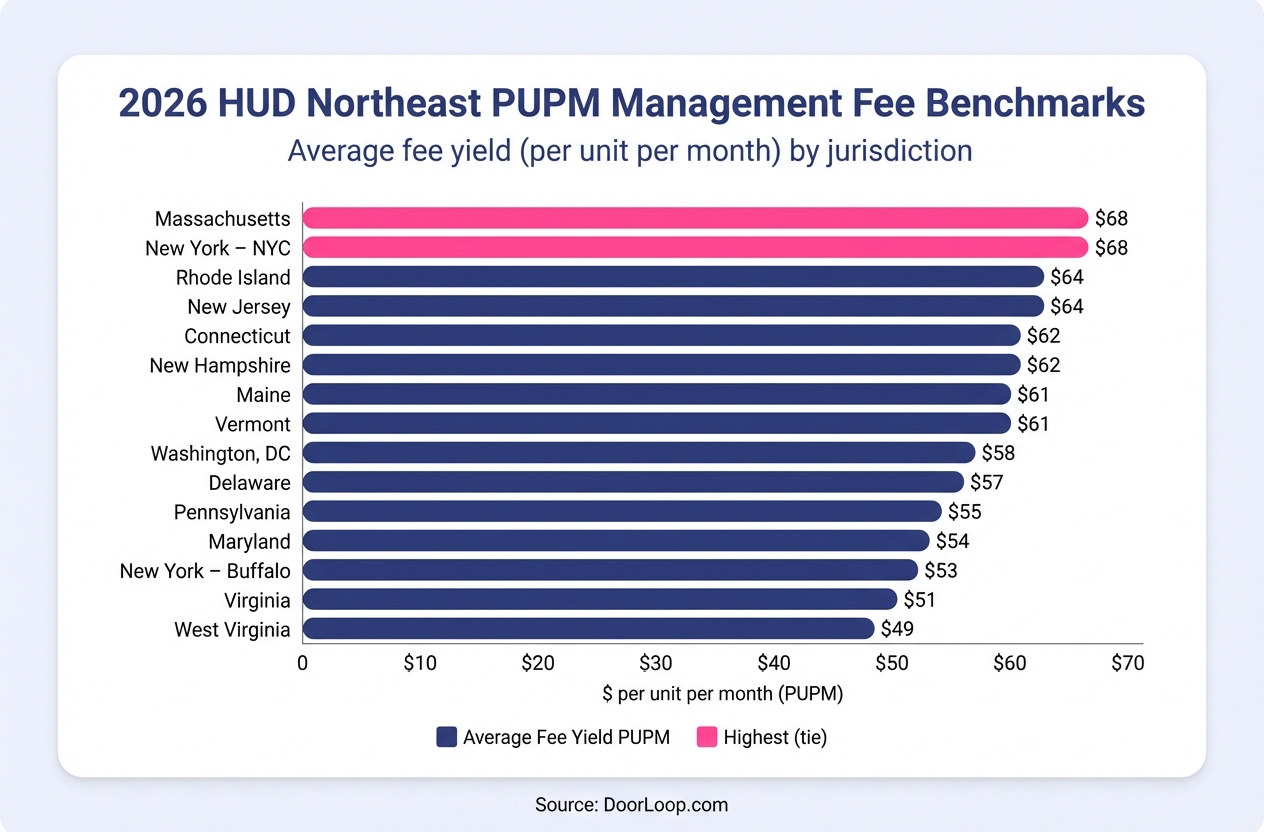
HUD Baltimore Satellite Office (DC, MD, PA, VA, WV)
HUD Boston Satellite Office (CT, ME, MA, NH, RI, VT)
HUD New York Regional Center (DE, NJ, NY)
Notice how Massachusetts and New York City both average $68 PUPM. High cost-of-living markets push labor costs, compliance burdens, and competitive pressures higher, all of which flow into management fees.
Five-Year Fee Change Table
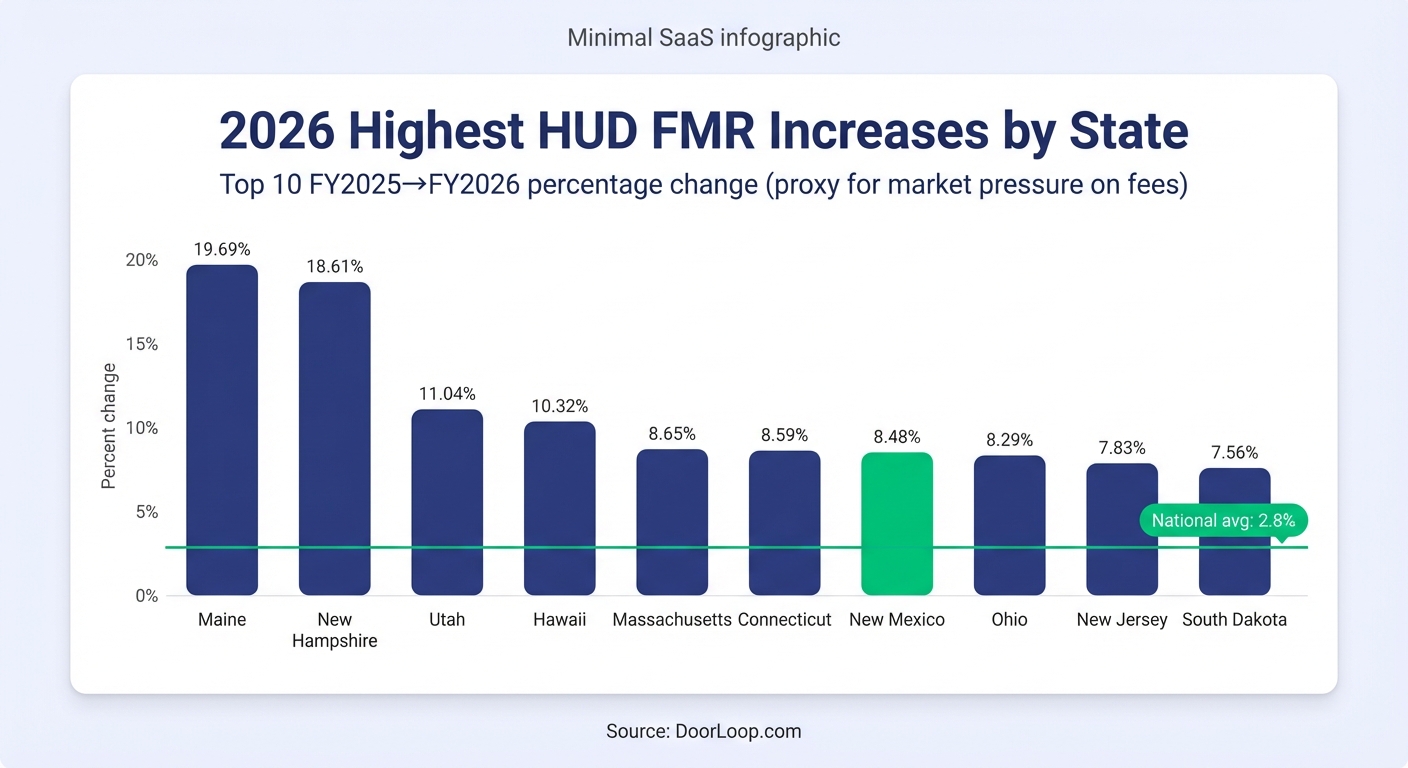
Tracking how fees move over time helps property managers price competitively and justify rate adjustments to owners. Comprehensive five-year fee change data by state isn't published in a single source. Instead, two credible proxies offer insight: HUD Fair Market Rent (FMR) changes and BLS wage trends for property managers.
HUD's FY2026 FMR analysis shows a 2.8% weighted-average change nationally. However, state-level movement varied dramatically. Some states saw double-digit rent benchmark increases, which directly signal market pressure on management fees. Higher rents mean higher percentage-based fees and also reflect supply-demand imbalances that raise operational complexity.
States With the Highest Increases
The top 10 states by FMR increase from FY2025 to FY2026 show where rent benchmarks jumped most significantly:
- Maine: +19.69%
- New Hampshire: +18.61%
- Utah: +11.04%
- Hawaii: +10.32%
- Massachusetts: +8.65%
- Connecticut: +8.59%
- New Mexico: +8.48%
- Ohio: +8.29%
- New Jersey: +7.83%
- South Dakota: +7.56%
These represent rent benchmark increases, not direct property management fee increases. However, they signal that local markets tightened, which typically justifies higher management fees through either percentage growth or flat-fee adjustments to match market conditions.
States With the Lowest Increases
On the other end, some states saw minimal or even negative FMR movement. Markets with weaker demand or greater supply stability tend to offer less pricing power for property managers, which keeps fee growth in check.
With this geographic context in place, the question becomes: what actually drives those price differences beyond just location?
Factors That Change Property Management Fees
Not all properties cost the same to manage. A 200-unit garden-style complex in suburban Texas and a scattered-site portfolio of single-family homes in Boston will have wildly different fee structures. Several specific factors account for this variation.
Property Type and Unit Count
Single-family homes typically command the highest percentage fees (often 10% to 12%) because each property sits on its own parcel, requires separate vendor coordination, and lacks economies of scale—especially without single-family property management software.
Multifamily properties, especially those with 20+ units in one location, often see fees drop to 4% to 7%.
Rent Level and Local Market Competition
Higher rents don't just mean higher percentage-based fees. They also reflect tighter markets with more competition, which drives up labor costs and operational complexity.
HUD's FY2026 FMR data showed a 2.8% national average increase, but Maine jumped 19.69% and New Hampshire rose 18.61%. These aren't random fluctuations. They signal supply constraints, population shifts, and competitive pressure that make tenant placement harder, lease enforcement more complex, and owner expectations higher. When rents rise fast, management fees often follow—either through natural percentage growth or through justifiable flat-fee adjustments.
Property Condition and Maintenance Load
A well-maintained property with minimal deferred maintenance costs less to manage than a neglected one. HUD's Baltimore Satellite Office memo includes an "adverse neighborhood conditions" add-on of $1.10 PUPM, which reflects the extra effort required when properties sit in higher-risk or higher-complexity areas.
In private-market terms, this translates to higher fees (or maintenance markups) when dealing with older buildings, frequent tenant turnover, or properties that require constant vendor coordination.
Service Level and Reporting Requirements
Full-service property management—rent collection, maintenance coordination, tenant screening, lease enforcement, owner reporting, and compliance—costs more than a basic "collect and forward" model. BLS data shows the median annual wage for property managers at $66,700 (May 2024), which reflects specialized knowledge, systems, and accountability rather than entry-level labor.
Owners who want monthly financials, quarterly inspections, and proactive lease renewals are paying for a higher service level, and fees reflect that scope of work. These service expectations lead directly into how fees get structured in the first place.
Flat Fee vs Percentage Property Management Fees
Property management fees fall into two main buckets: percentage-based and flat monthly fees (PUPM). Both work, but they fit different portfolio types and owner expectations.
Percentage of Rent Model
This is the most common structure in residential property management software and residential property management. You charge 8% to 12% of monthly rent collected (sometimes rent due, depending on the contract). It's straightforward, scales naturally with rent increases, and aligns the manager's revenue with the property's income.
The downside becomes visible with lower-rent properties. A 10% fee on a $1,200/month single-family home is $120, which might barely cover the administrative work—especially if tenant turnover runs high.
Most percentage-based contracts specify "rent collected" rather than "rent due," which means payment occurs only when the tenant pays. This protects owners from paying fees on unpaid rent, but it also means cash flow takes a hit during collection issues.
Flat Monthly Fee Model
A flat fee structure charges a fixed dollar amount per unit per month, regardless of rent level. HUD's Northeast Region schedules provide clear examples: $68 PUPM in Massachusetts or $51 PUPM in Virginia.
Flat fees work well for portfolios with consistent rent levels and predictable workloads. They also protect managers from getting squeezed on lower-rent properties, since the fee doesn't drop just because rents fall below market. The challenge is that flat fees don't automatically adjust for rent increases, so clear contract language around annual adjustments or indexing becomes necessary to maintain profitability over time.
Rent Collected vs Rent Due Contracts
This distinction carries more weight than many owners or managers initially recognize.
- Rent collected: Payment occurs only when the tenant pays. This is owner-friendly, but the manager absorbs the cost of collections and enforcement work without compensation.
- Rent due: Payment is based on the lease amount, regardless of whether the tenant pays. This is manager-friendly, but owners sometimes push back because they're paying for something they didn't receive.
Most managers use "rent collected" to avoid disputes. However, in markets with chronic collection issues, "rent due" might be worth negotiating—especially if the contract includes strong enforcement language. Beyond the monthly fee structure, additional charges often add up to more than the base fee itself.
Common Property Management Fees Beyond Monthly Management
Monthly management fees serve as the baseline. The real cost (or revenue, depending on which side of the table you're on) comes from the add-ons. Here's what typically appears on top of the monthly fee.
Tenant Placement and Leasing Fees
This is usually the biggest single add-on, often 50% to 100% of one month's rent, especially when you’re managing leasing volume without dedicated property management leasing software. It covers:
- Marketing and listing syndication
- Property showings and scheduling
- Rental applications and tenant screening (credit, criminal, eviction checks)
Some managers unbundle this into separate charges (marketing fee, application fee, lease prep fee), but most lump it into one leasing fee. Either way, it represents a significant revenue stream—and it's also the most labor-intensive part of property management.
Lease Renewal Fees
Renewing an existing tenant costs less than placing a new one, but it's not free. Typical renewal fees range from $200 to $500 (or more in high-cost markets). This covers lease drafting, rent adjustment analysis, lease signing coordination, and any minor negotiations.
Some managers don't charge renewal fees at all, folding the cost into the monthly management fee. However, renewals take time, and owners often see the value when a good tenant stays in place rather than creating a vacancy and turnover cycle.
Setup and Onboarding Fees
Getting a new property into a portfolio takes work: property assessment, initial inspections, financial account setup, lease review, and system configuration. Setup fees typically range from $200 to $500 per property.
HUD's schedules don't use the term "setup fee," but they do recognize property complexity with add-ons for factors like scattered sites and specialized property types, which acknowledge that initial configuration work carries a cost.
Inspection Fees
Annual or move-out inspections typically cost $100 to $300 per property. Some managers include one annual inspection in the base fee and charge for additional visits. Others bill every inspection separately.
HUD's schedules include "annual unit inspections" as part of the base fee, but private-market managers often itemize this to keep pricing transparent and avoid disputes over what's included.
Maintenance Markups and Repair Coordination
This is where pricing gets murky. Some managers charge a 10% to 15% markup on all repair costs, arguing that it covers vendor coordination, quality control, and payment processing. Others charge a flat coordination fee per work order (e.g., $25 to $50). And some don't mark up repairs at all, treating coordination as part of the monthly fee.
HUD's Southwest Region schedule includes a separate line item for "maintenance fee" or "repair coordination," which ranges from $3 to $5 PUPM depending on property size and complexity. Whatever model gets used, transparency matters. Owners dislike surprise markups, and tenants get frustrated when repair costs seem inflated.
Vacancy Fees
Some managers charge a flat monthly fee (often $50 to $150) to maintain vacant properties: periodic inspections, utility monitoring, lawn care coordination, and marketing. Others waive the monthly management fee during vacancies but keep charging for specific services.
HUD's schedules don't typically include vacancy fees because HUD-assisted properties rarely sit vacant long-term. In private markets, though, vacancy fees are common and defensible, since vacant properties still require oversight.
Eviction Handling Fees
Evictions are expensive and time-consuming. Most managers charge $300 to $1,000 (or more) to handle the entire process: notices, court filings, attorney coordination, and lockout supervision. This fee is separate from legal fees, which the owner typically pays directly.
Some managers build eviction handling into the base fee for the first eviction per year, then charge for additional cases. Others bill every eviction separately. Either way, clear contract language prevents disputes when an eviction becomes necessary.
Late Payment Fees
Late fees charged to tenants (e.g., $50 to $100 or 5% of rent) usually go to the owner, not the manager. However, some management agreements let the manager keep late fees as compensation for collections work. This is worth negotiating clearly in your contract—owners often assume late fees flow to them, and disputes arise when they don't.
Early Termination Fees
If an owner terminates the management agreement early (before a specified term), many managers charge an early termination fee equal to one to three months' management fees. This compensates for the setup costs and lost revenue.
Some managers also charge a "cancellation fee" if the property sells mid-contract, though this varies widely by market and contract terms. With all these fees and structures in mind, the fundamental question remains: when does paying for property management actually make sense?
Should You Hire a Property Manager or Self-Manage With Software?
This is the question every property owner wrestles with at some point. And if you're a property manager reading this, it's the question your owners are quietly asking themselves every time a fee shows up on their statement. The answer isn't one-size-fits-all. It depends on portfolio size, owner proximity, systems, and—most importantly—whether the owner has the time and temperament to handle tenant issues at 9 p.m. on a Saturday.
When Hiring a Property Manager Pays Off
Hiring a property manager makes sense when the cost of your time exceeds the cost of the fee. More specifically, it works when:
- You own properties in a market where you don't live. Remote ownership adds layers of complexity. Inspections, maintenance coordination, and lease enforcement all become harder when you're 500 miles away.
- You own 10+ units or a mix of property types. At this scale, the administrative burden stacks up fast. Rent collection, lease renewals, maintenance requests, owner reporting, and document storage can all be automated with the right tools.
- You value your time at more than $50/hour. If you're billing $150/hour in your day job, spending five hours a month chasing rent or coordinating repairs costs you $750 in opportunity cost—far more than a 10% management fee on a $1,500/month property.
- Compliance and legal risk create stress. Property management is heavily regulated. Fair housing laws, security deposit rules, eviction procedures, and lease enforcement requirements vary by state—and mistakes are expensive.
The BLS lists the median wage for property managers at $66,700 annually. This isn't entry-level labor. You're paying for specialized knowledge, established vendor networks, and systems that prevent small problems from becoming expensive ones.
When Self-Management Works With Systems
Self-management works when you have strong systems, a manageable portfolio, and the temperament to handle tenant issues without letting them derail your week, often with small landlord property management software. It makes sense when:
- You own fewer than 10 units in one geographic area. At this scale, you can handle inspections, maintenance coordination, and tenant communication without it becoming a full-time job.
- You live near your properties. Proximity matters. If you can drive by a property in 15 minutes or show up for an emergency repair without rearranging your day, self-management becomes much more viable.
- You have software that automates the repetitive tasks. Rent collection, lease renewals, maintenance requests, owner reporting, and document storage can all be automated with the right tools, including tenant management software. Without software, self-management means drowning in spreadsheets and missed deadlines, especially without a QuickBooks integration.
- You tolerate (or enjoy) landlord responsibilities. Some owners love the control and hands-on involvement. Others hate it. If you dread tenant calls and find lease enforcement exhausting, burnout happens fast.
How Property Management Software Protects Profit Margins
Software doesn't replace property managers—it protects margins and allows scaling without hiring proportionally more staff. DoorLoop automates the time-consuming, low-value work:
- Rent collection runs automatically via ACH, debit, or credit card through a rent payment system. Tenants get reminders, payments hit your account, and manual check-chasing stops.
- Maintenance tracking lets tenants submit requests with photos directly through their portal using a tenant management suite. You assign work orders, track vendor progress, and close tickets without phone calls.
- Owner reporting generates automatically with property management accounting software. Financial statements, rent rolls, and compliance documents stay up to date and accessible on demand.
- Lease renewals and expirations trigger automatic reminders, so nothing slips through the cracks.
For self-managing owners, software makes it possible to run a portfolio without giving up nights and weekends. For property managers, it means managing 50 doors as efficiently as you used to manage 20—without hiring another full-time employee.
The math is straightforward: if automation saves five hours per property per month, and your time is worth $50/hour, that's $250/month in recovered value per door. Multiply that across a 50-unit portfolio and you're looking at $12,500/month in time savings—or the cost of one full-time employee.
Whether you're paying property management fees or charging them, the real question isn't "Can I avoid the cost?" It's "What's the cost of doing this manually?"
Property management costs vary by market, property type, and service level. However, the real cost isn't the fee itself. It's what happens when you don't have systems in place to track rent, renewals, maintenance, and owner reporting efficiently.
Whether you're a self-managing owner trying to protect your margins or a property manager building a scalable business, strong systems eliminate the guesswork and protect your time. DoorLoop gives you full visibility across your portfolio—rent collection, lease tracking, maintenance coordination, and financial reporting—all in one place. You'll know exactly what you're spending, what you're collecting, and what's coming due before it becomes a problem with bank sync.
See how DoorLoop helps you manage smarter. Request a demo today.
Sources
- Bureau of Labor Statistics – Property, Real Estate, and Community Association Managers: Occupational Outlook Handbook
- CARH – RD Management Fees Published for FY 2026
- HUD – Multifamily Northeast Region: 2024-2026 Residential Management Fees and Add-On Fees for the Baltimore Satellite Office
- HUD – Multifamily Northeast Region: 2024 Residential Management Fees and Add-On Fees for the Northeast Region – Boston Satellite Office
- HUD – Multifamily Northeast Region: 2024 Residential Management Fees and Add-On Fees for the Northeast Region – New York Regional Center
- HUD – Multifamily Housing Regions
- LetHub – Key Property Management Fees to Track
- Novogradac – HUD FY 2026 FMRs: Weighted-Average Change is 2.8%
Frequently Asked Questions