







The best rental markets in 2026 are concentrated in the Sun Belt, Southeast, and Midwest—metros where population growth, job stability, and affordability create consistent tenant demand. Dallas–Fort Worth, Atlanta, Charlotte, Phoenix, Nashville, Jacksonville, Indianapolis, Cleveland, and Tampa stand out for balancing cash flow potential with operational manageability.
This guide covers which markets offer the strongest fundamentals, what metrics separate sustainable demand from hype, and how to evaluate rental opportunities when rent growth has normalized after the 2021–2022 surge.
The latest data in this article is from Q3 2025 (Census vacancy data) and December 2025 (rental market trends from Realtor.com).
Key Takeaways
- The best rental markets in 2026 are mostly in the Sun Belt, Southeast, and Midwest—where job growth and migration patterns continue to drive tenant demand
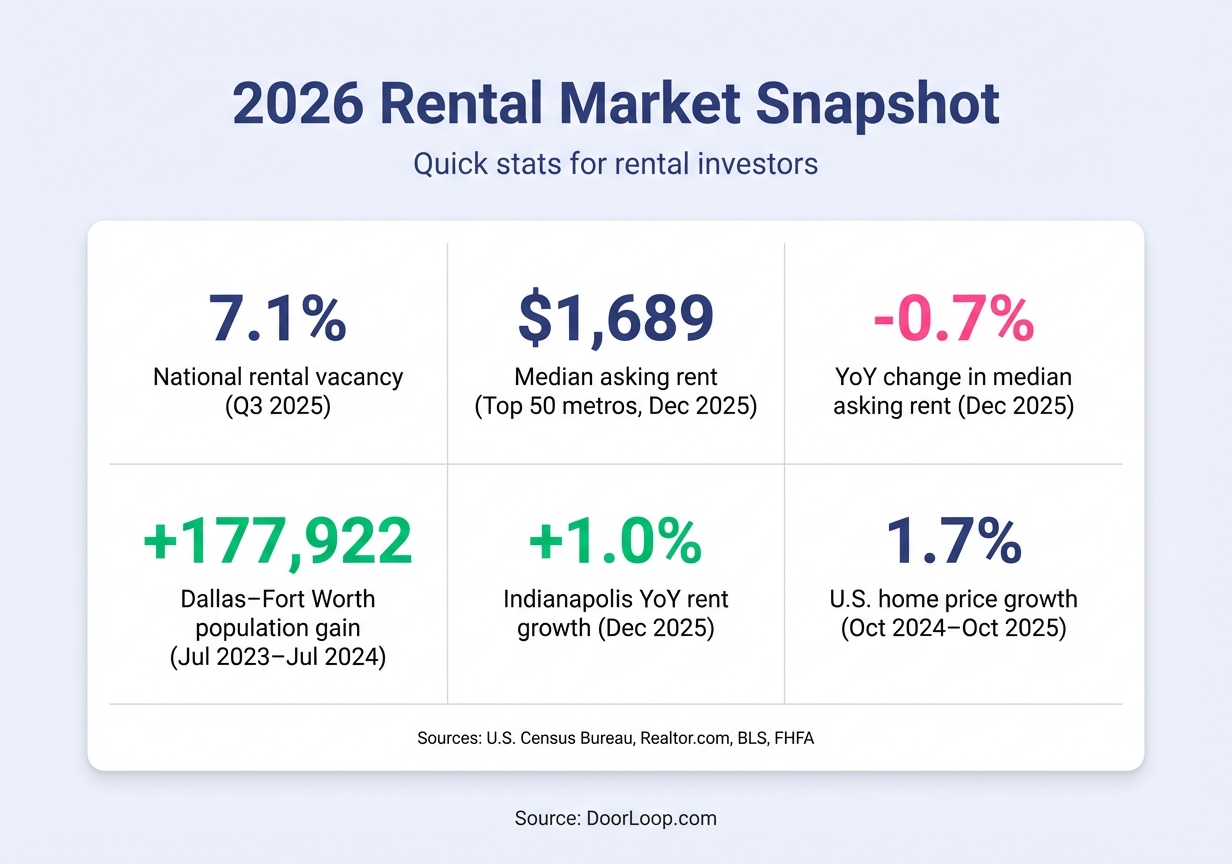
- Dallas–Fort Worth added +177,922 residents from July 2023 to July 2024, making it the third-fastest-growing metro in the U.S.
- National rental vacancy sits at 7.1% (Q3 2025), indicating supply has normalized after the pandemic-era squeeze
- Median asking rent across the top 50 metros was $1,689 in December 2025, down 0.7% year-over-year—a sign the rent surge is behind us
- The strongest markets combine three things: population growth, healthy labor markets (unemployment below 4.5%), and rents that still support cash flow
- Indianapolis stands out with +1.0% year-over-year rent growth in December 2025, while most Sun Belt metros posted negative rent changes
- Price appreciation has cooled nationally—U.S. house prices rose just 1.7% from October 2024 to October 2025, down from the double-digit gains of 2021–2022
Best Locations to Invest in Real Estate Rentals

Rental markets in 2026 look different than they did in 2021. The double-digit rent spikes are gone. Multifamily supply has caught up in most high-growth metros. Vacancy rates have normalized.
What hasn't changed: migration to affordable, job-rich metros continues. The cities pulling in the most new residents are still the ones where rental fundamentals make sense.
The table below shows where rents and unemployment stood at the end of 2025 for our top picks. These are metros where population growth is real, labor markets are stable, and the price-to-rent ratio still leaves room for cash flow.
The markets below balance demand (people moving in), stability (jobs), and operational efficiency (easier to find tenants, vendors, and comps). Let's break down why each one makes the list.
Dallas–Fort Worth, TX
This is our top pick for 2026, and the reasons are straightforward. Dallas–Fort Worth added +177,922 people between July 2023 and July 2024—the third-largest numeric population gain in the country.
The metro spans multiple submarkets, from Fort Worth's industrial core to Frisco's tech campuses. You're not betting on one employer or one neighborhood. The diversification lowers risk.
Unemployment sat at 4.0% in July 2025, meaning most tenants can afford rent. No state income tax makes Texas attractive for relocating workers, and the cost of living is still manageable compared to coastal metros. The caution here is competition—institutional investors are active, and multifamily construction has been aggressive.
Atlanta, GA
Atlanta combines size, diversity, and infrastructure. It's a tech hub, a film production center, and a logistics powerhouse thanks to Hartsfield-Jackson Airport. The metro added +75,134 residents from July 2023 to July 2024.
Median asking rent was $1,533 in December 2025, down 2.6% year-over-year. New supply came online, rents adjusted, and the market is finding its floor.
Unemployment was 3.5% in July 2025, one of the lowest on this list. Tenant quality tends to be solid, and rent collection is predictable. Atlanta's challenges are operational—the metro is sprawling, traffic is real, and property taxes vary significantly by county.
Charlotte, NC
Charlotte is a banking and finance hub with a stable, white-collar tenant base. The metro's growth has been steady for years, and it's attracted corporate relocations from higher-cost markets.
Median asking rent was $1,491 in December 2025, down 2.0% year-over-year. Unemployment was 3.9% in July 2025. North Carolina has no state income tax, which makes it appealing for both tenants and investors. Charlotte's advantage is predictability—rent growth isn't explosive, but vacancy risk is low, and tenants tend to stay longer.
Phoenix, AZ
Phoenix added +84,938 people between July 2023 and July 2024, benefiting from California out-migration, remote work flexibility, and a diversifying economy beyond construction and tourism.
Median asking rent was $1,453 in December 2025, down 2.7% year-over-year. Phoenix's challenge is climate. Cooling costs are real, and insurance premiums have climbed. Water policy is another long-term consideration—the metro is managing supply carefully, but it's worth monitoring if you're holding for 10-plus years.
Nashville, TN
Nashville's economy runs on healthcare, entertainment, and corporate relocations. The metro has no state income tax and a reputation for quality of life, which drives steady in-migration.
Median asking rent was $1,481 in December 2025, down 3.6% year-over-year—the steepest decline on this list, largely a function of new apartment deliveries catching up to demand. For single-family investors, Nashville offers solid cash flow potential in suburban submarkets, though oversupply is a risk in certain pockets.
Jacksonville, FL
Jacksonville benefits from Florida's tax structure (no state income tax), a growing logistics sector, and steady military employment from Naval Air Station Jacksonville.
Median asking rent was $1,468 in December 2025, down 2.9% year-over-year. Unemployment was 4.2% in July 2025. Florida's insurance market is volatile—premiums for homeowners insurance have spiked in recent years, which cuts into cash flow. Jacksonville's advantage is operational simplicity—the metro is smaller than Tampa or Orlando, so vendor coverage is better.
Indianapolis, IN
Indianapolis is the quiet winner on this list. Median asking rent was $1,298 in December 2025, up +1.0% year-over-year—one of the few metros showing positive rent growth.
Unemployment was 3.8% in July 2025. The economy is diversified across healthcare, manufacturing, and logistics. Housing is affordable, which keeps cost of living low and tenant retention high. Indianapolis delivers the classic buy-and-hold profile: steady cash flow, low vacancy, manageable expenses.
Cleveland, OH
Cleveland is a high-yield, cash-flow market. Property prices are low, and rent-to-price ratios are among the best in the country. The economy is anchored by healthcare (Cleveland Clinic) and education (Case Western Reserve).
Unemployment was 5.2% in July 2025, and it rose +0.8 percentage points from July 2024—higher than the other metros on this list. Cleveland works for investors who want immediate cash flow and are comfortable managing tenant turnover, though price appreciation is unlikely to be a significant factor.
Tampa–St. Petersburg, FL
Tampa benefits from Florida's tax environment, a strong job market in finance and healthcare, and retiree in-migration. Median asking rent was $1,660 in December 2025, down 3.1% year-over-year.
Tampa's challenge mirrors Jacksonville's: insurance. Hurricane risk is priced into premiums, and those costs are rising faster than rents in many submarkets. The upside is demand—Tampa has pulled in new residents for years, and the metro's economy is broad enough to weather downturns better than single-industry markets.
Metrics That Make a Rental Market Worth It
Once you've identified metros with strong population and job growth, the next step is confirming the numbers support cash flow. Picking a rental market isn't about following headlines—it's about matching your business model to the data that predicts tenant demand, rent stability, and operational efficiency.
Here are the metrics that separate a good story from a market that actually works:
- Population growth: This is the demand signal. If a metro is adding residents year after year, you have a tailwind for occupancy. Use the U.S. Census Bureau's Vintage population estimates to track numeric growth by metro. Dallas–Fort Worth's +177,922 gain from July 2023 to July 2024 is the kind of momentum that keeps vacancy low.
- Unemployment rate: Tenant quality correlates with employment and solid tenant screening. A metro with unemployment below 4.5% typically delivers more reliable rent collection and lower turnover, especially with solid tenant management software. Check the Bureau of Labor Statistics Local Area Unemployment Statistics for monthly updates by metro. Atlanta's 3.5% unemployment in July 2025 is a sign of labor market health.
- Median asking rent and year-over-year change: Rent direction tells you whether pricing power is intact or softening. Realtor.com publishes monthly rental reports with asking rents and year-over-year trends for the top 50 metros. Indianapolis posted +1.0% rent growth in December 2025, while most Sun Belt metros went negative—a clue about supply dynamics.
- Rental vacancy rate: National vacancy sat at 7.1% in Q3 2025, according to the U.S. Census Bureau's Housing Vacancies and Homeownership Survey. If you're evaluating a specific metro or state, compare its vacancy to the national average. Tight vacancy (below 6%) can signal strong demand, but it can also mean supply is coming.
- Price-to-rent ratio: This is your cash flow filter. Divide the median home price by the median annual rent. A ratio of 15 or lower generally supports positive cash flow after mortgage, taxes, and insurance. A ratio above 20 means you're betting on appreciation, not income.
- Home price appreciation: The FHFA House Price Index tracks price momentum by region. Nationally, prices rose just 1.7% from October 2024 to October 2025. This is a far cry from the double-digit gains of 2021–2022, and it's a reminder to underwrite conservatively on exit assumptions.
- Property taxes and insurance costs: A market with strong gross yield can turn negative once you factor in Florida insurance premiums or Texas property taxes. Always run your proforma with current tax and insurance estimates, not outdated assumptions, using property management accounting software.
The best markets score well across all of these. You're not picking based on one metric—you're triangulating demand, stability, and expenses to find the intersection where cash flow and risk align.
Why Sun Belt, Southeast, and Midwest Markets Show Up So Often
The same regions dominate rental investing lists year after year, and there's a reason for it. After you run the numbers on enough markets, patterns emerge.
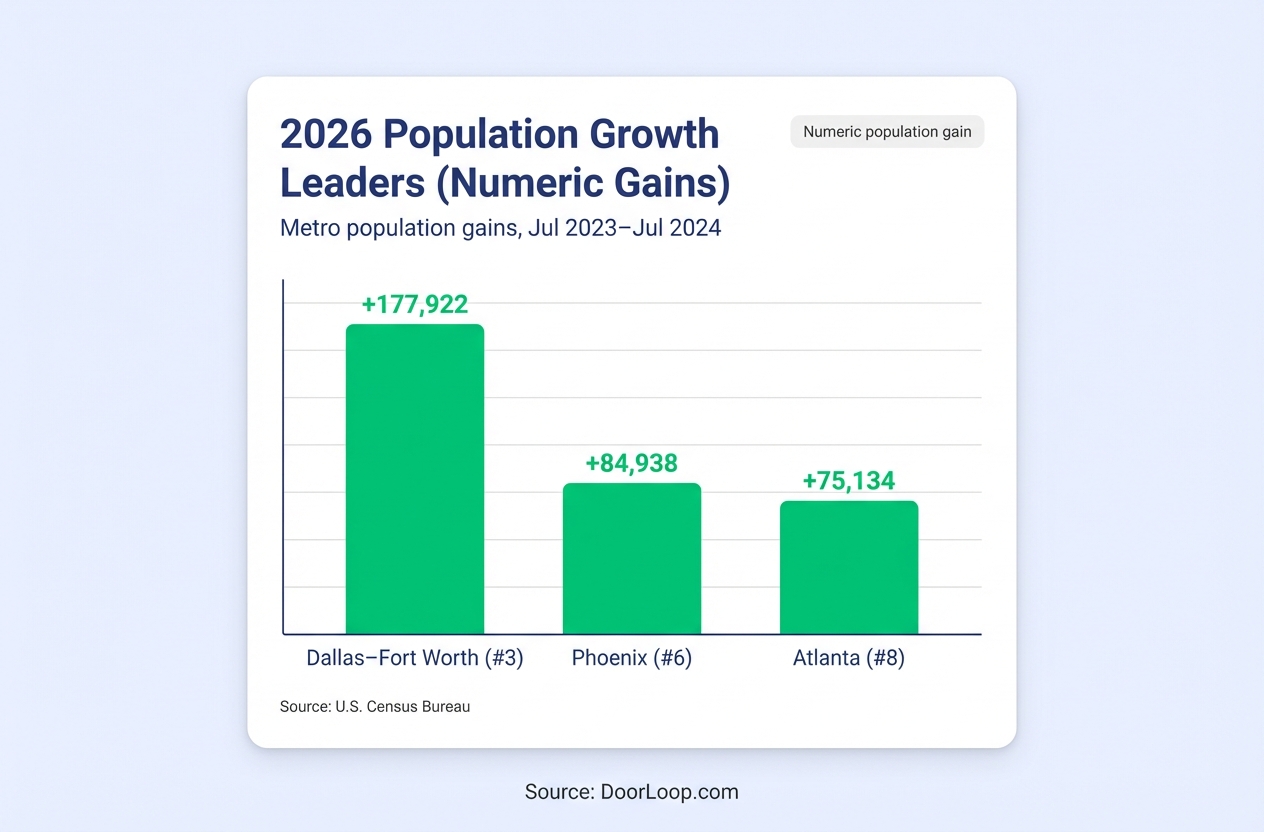
The Sun Belt, Southeast, and Midwest offer a combination of affordability, migration, and landlord-friendly policy that's hard to find elsewhere. Migration patterns explain much of this. People are moving from high-cost coastal metros to lower-cost inland cities. The U.S. Census Bureau's metro growth rankings show that multiple Sun Belt and Southeast metros rank in the top 10 for numeric population gains. Dallas–Fort Worth ranked #3, Phoenix #6, and Atlanta #8 between July 2023 and July 2024.
Tax burden plays a role as well. States with no income tax—Texas, Florida, Tennessee, Nevada—attract both workers and retirees, which drives housing demand and keeps renter pools large. North Carolina's zero state income tax adds to Charlotte's appeal for corporate relocations.
Supply constraints and rent normalization are the flip side. The rent surge of 2021–2022 triggered a multifamily construction boom. By late 2025, supply started hitting the market, which is why asking rents across the top 50 metros were down 0.7% year-over-year in December 2025. The Sun Belt saw the biggest rent declines because it added the most supply.
This normalization isn't bad—it means the market is functioning. Rent growth will moderate, but vacancy stabilizes and cash flow becomes more predictable.
Landlord-friendly laws matter operationally. The Midwest and Southeast tend to have faster eviction processes and fewer rent control restrictions than coastal markets. These regions also offer operational advantages—markets like Indianapolis and Cleveland have deep vendor pools, established property management infrastructure, and stable comps.
How We Picked These Rental Markets
We built this list by prioritizing the metrics property managers actually use to scale portfolios: demand, stability, and manageability.
We started with population growth data from the U.S. Census Bureau to identify metros with sustained in-migration. Then we layered in labor market health using the Bureau of Labor Statistics metro unemployment rates. A metro can grow fast, but if unemployment is climbing, tenant quality suffers.
Next, we pulled asking rent data from Realtor.com's December 2025 rental report to confirm rents support cash flow and to track whether pricing power is holding or softening. We cross-checked this against national vacancy rates from the U.S. Census Bureau's Housing Vacancies and Homeownership Survey to gauge supply pressure.
Finally, we used the FHFA House Price Index to assess price appreciation trends. We're not chasing appreciation—we're using it as a risk check. If prices rose 30% in two years, we're cautious. If appreciation is moderate and rents are steady, that's a healthier signal.
The result is a list that balances growth, stability, and operational efficiency. These aren't the flashiest markets—they're the ones where the numbers work.
How to Choose the Right Rental Market for Your Portfolio
Picking the right market comes down to matching your strategy to the data. If you're building a cash-flow portfolio, you prioritize different metrics than someone betting on appreciation.
Start with population growth and unemployment. Use the Census Bureau's metro population estimates to confirm people are moving in, then check the Bureau of Labor Statistics' unemployment rates to confirm they can afford rent. A metro with strong population growth but rising unemployment is a red flag.
Next, compare asking rents and year-over-year changes. Realtor.com's monthly rental reports give you median rents by metro and show whether pricing power is intact. If rents are falling year-over-year, it doesn't mean the market is broken—it means supply caught up. You're just underwriting conservatively and avoiding aggressive rent-growth assumptions.
Then, run the price-to-rent ratio. Divide the median home price by the median annual rent. If the ratio is below 15, you likely have cash flow. If it's above 20, you're betting on appreciation, and you're being honest with yourself about the risk.
Factor in vacancy trends using the Census Bureau's Housing Vacancies and Homeownership Survey. If vacancy is climbing, it's a caution flag. If it's stable or falling, demand is holding.
Finally, stress-test your proforma with realistic expenses using property management accounting. Use current property tax rates, current insurance premiums, and conservative rent-growth assumptions. Markets change—the numbers you underwrite today might not hold in two years, so you're building in margin with a property management app.
If you're managing properties across multiple markets, software like DoorLoop makes the difference. You're tracking rent comps, monitoring vacancy, and running reports by market without maintaining separate spreadsheets, while also handling online rent collection, with a QuickBooks integration. The goal is to make decisions faster and scale operations without losing control with real estate accounting software, including using online rental applications. The goal is to make decisions faster and scale operations without losing control.
The Bottom Line
The best rental markets in 2026 are the ones where the fundamentals still work: people are moving in, jobs are stable, and rents support cash flow after expenses.
Don't underwrite 2026 deals as if the rent surge is still running. Median asking rents across the top 50 metros were down 0.7% year-over-year in December 2025. The metros on this list combine population growth, healthy labor markets, and operational simplicity. You're not chasing headlines—you're buying where the data supports tenant demand and where cash flow doesn't depend on aggressive appreciation.
If you're managing multiple properties or scaling across markets, DoorLoop helps you track performance, automate rent collection, and keep all your financials in one place. You're not juggling spreadsheets—you're running reports, monitoring trends, and making decisions based on real-time data tied to the rent payment system.
Ready to simplify how you manage your rental portfolio? See it in action.
Sources
- U.S. Census Bureau – Growth in Metro Areas Outpaced Nation
- U.S. Bureau of Labor Statistics – Unemployment rates up in 32 large metro areas, down in 21, over year ended July 2025
- Realtor.com – December 2025 Rental Report: Lower-Priced Rentals Have Seen the Most Rent Growth
- U.S. Census Bureau – Quarterly Residential Vacancies and Homeownership, Third Quarter 2025
- Federal Housing Finance Agency – U.S. House Price Index – December 2025
Frequently Asked Questions