



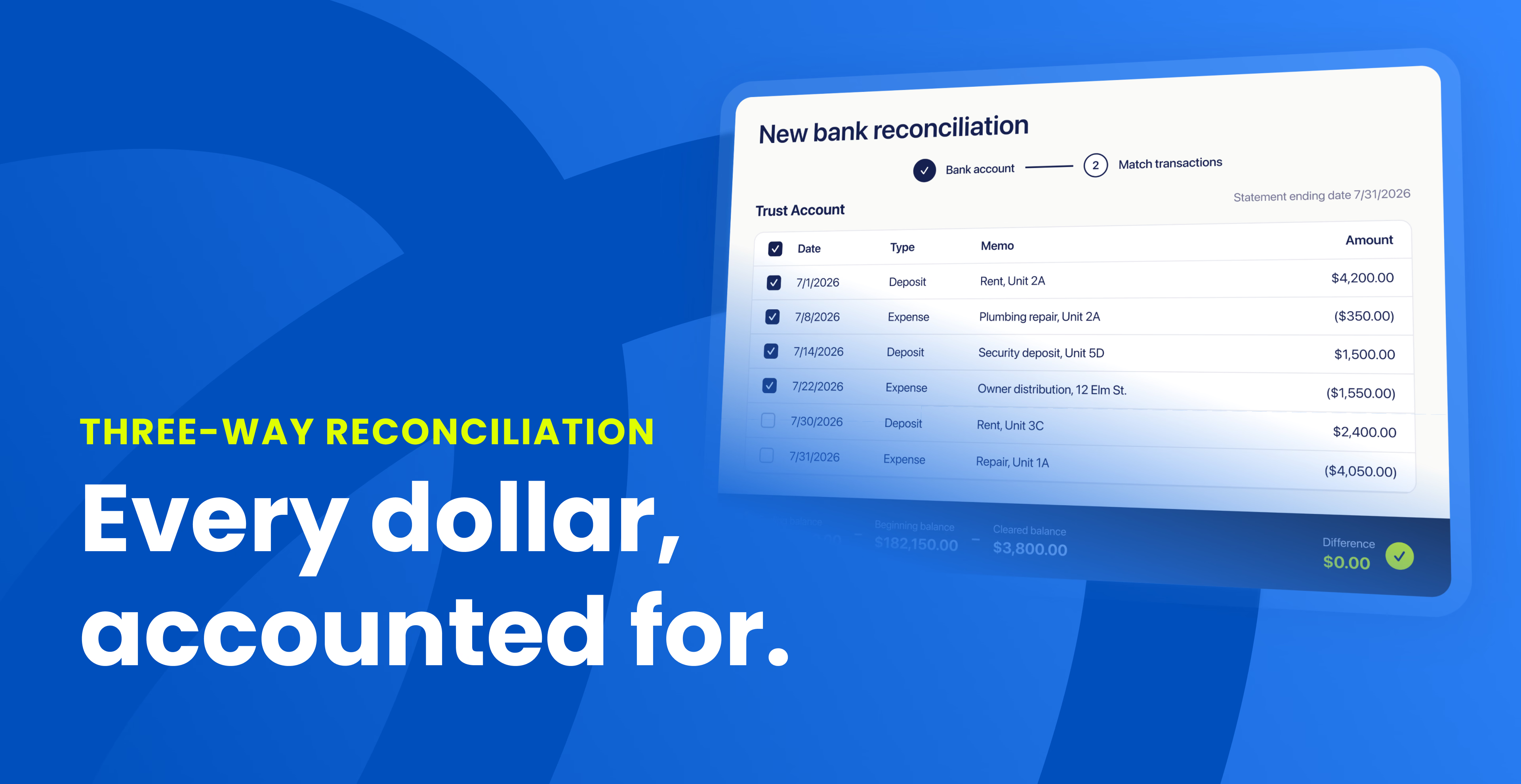

Three-way reconciliation is a monthly check that confirms a trust account’s adjusted bank balance, book balance, and the total of every tenant and owner ledger all match. It’s how property managers prove every dollar they hold belongs to a specific person.
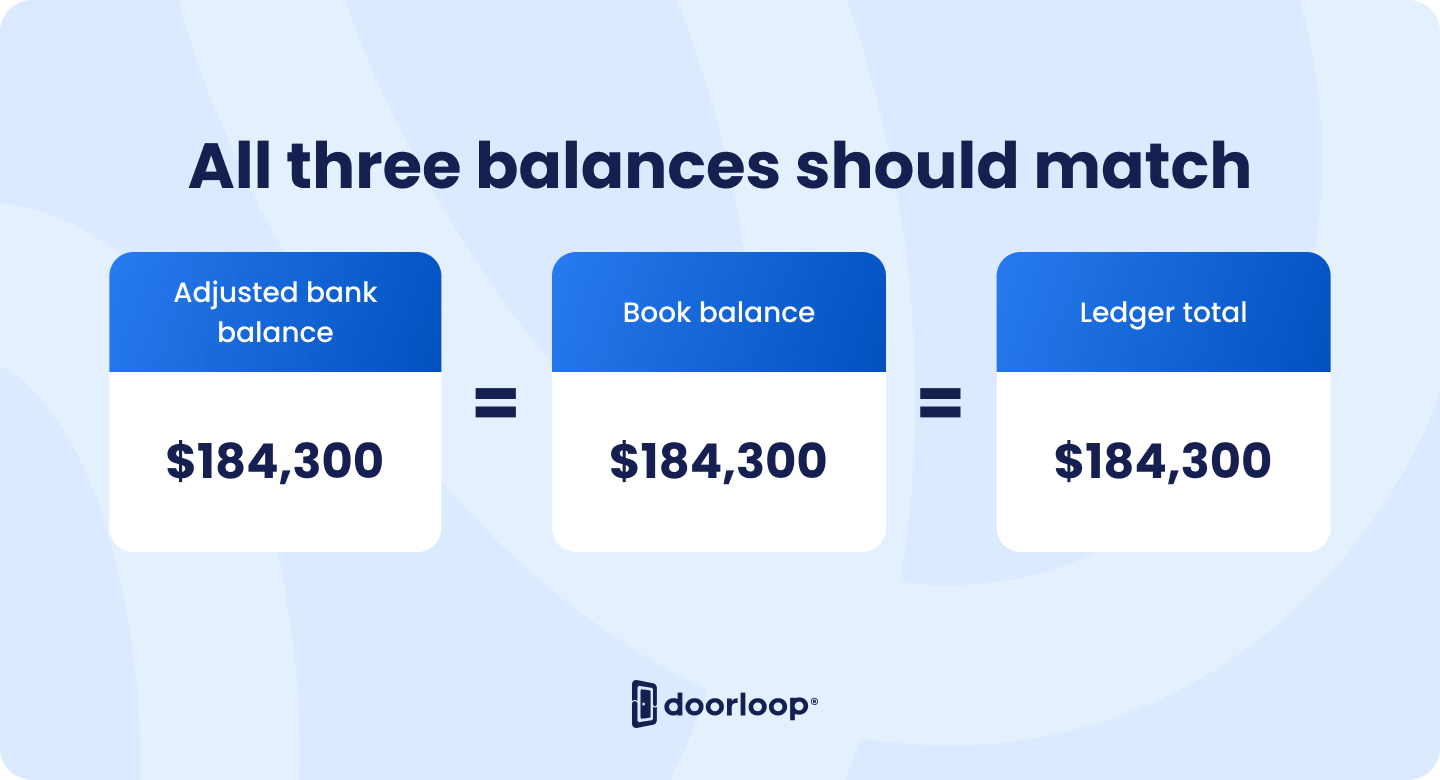
Let’s say at month-end, your bank balance shows the trust account holds $184,300. Your books say the same thing. Time to sign off?
Not quite. Back in March, a tenant’s $1,500 security deposit got posted as rent. The bank balance and the book balance still match. Since the money never left the trust account, even the total of all your ledgers adds up. But that tenant’s ledger is now $1,500 short and the owner’s is $1,500 over, and nobody finds out until the tenant moves out and asks for the deposit back.
That gap is the reason three-way reconciliation exists, and why the check has to go ledger by ledger. Here's how it works, where it usually breaks, and how to run one every month without losing a day to spreadsheets.
What is three-way reconciliation?
The check comes down to three numbers for a trust account:
- Adjusted bank balance. The ending balance on the trust account’s bank statement, plus deposits in transit, minus outstanding checks.
- Book balance. What your accounting records say the trust account holds.
- Ledger total. The sum of every individual ledger in the account: each tenant’s security deposit and prepaid rent, each owner’s funds, and your company’s own ledger for any of your money held there. No individual ledger should ever go negative. A negative balance means one person’s money is covering someone else’s.
When all three agree and every individual ledger checks out, every dollar in the account can be traced to a specific person. When they don’t, something is recorded wrong, sitting in the wrong account, or missing.
Why a regular bank reconciliation isn't enough
A bank reconciliation compares your adjusted bank balance and book balance. It proves the bank and your books agree on how much money is in the account.
However, it doesn’t prove your books are right about whose money it is. The security deposit posted as rent is one example. A move-out refund applied to the wrong lease, or a tenant deposit that lands in the operating account, slips past a two-way check the same way, because the bank and the books still match to the penny. A ledger-by-ledger review is what exposes the problem.
Why property managers take this seriously
Money in a trust account isn't yours. Security deposits belong to tenants, and owner funds belong to owners. As the manager, you're holding it for them, and state real estate regulators set rules for how that money is tracked and documented. Requirements vary by state, so check yours.
There's a business case too. Owners judge you by their statements. Tenants judge you by how fast and how accurately their deposit comes back. A clean three-way reconciliation every month means you can answer either question in minutes, and you're ready if a regulator or auditor asks to see your records.
It also gets harder as you grow. Ten units with a handful of deposits might be manageable on a spreadsheet. A couple hundred units across several trust accounts isn’t, because every new door adds more entries that can land in the wrong place.
How to do a three-way reconciliation, step by step
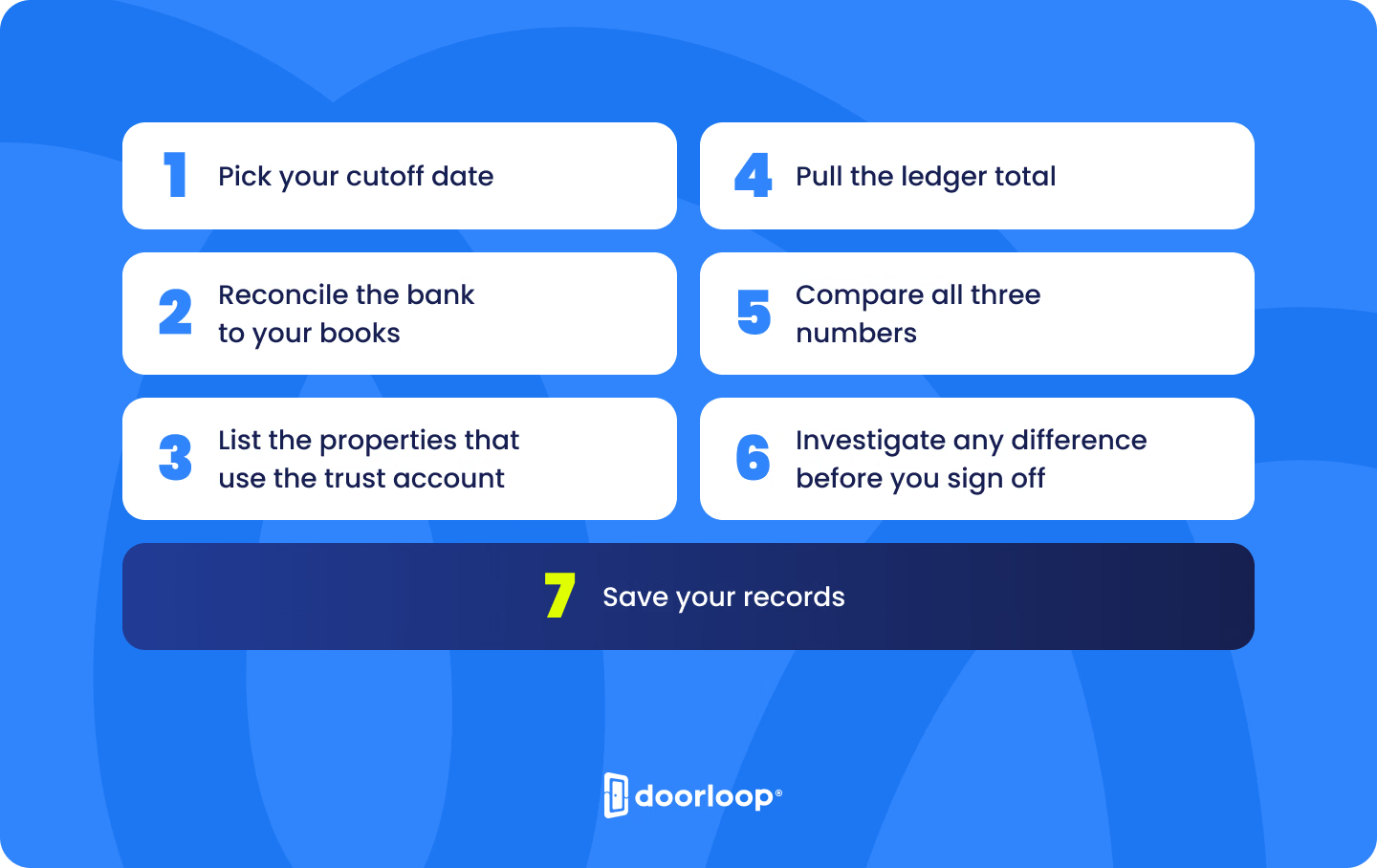
- Pick your cutoff date. Most property managers reconcile monthly, and some states set a deadline, so check yours. Use the last day of the month and run every report as of that date.
- Reconcile the bank to your books. Start with the statement’s ending balance, add deposits in transit, and subtract outstanding checks. That adjusted bank balance should match your recorded balance.
- List the properties that use the trust account. You need to know which leases and owners should be represented in it.
- Pull the ledger total. Add up every individual ledger for those properties: tenant deposits and prepaid rent, owner funds, and your company’s own ledger.
- Compare all three numbers. They should match exactly. Then go ledger by ledger: no balance should be negative, and each tenant’s deposit should match what their lease says.
- Investigate any difference before you sign off. A small variance today turns into a big cleanup project six months from now.
- Save your records. Keep the bank statement, the reconciliation report, and the supporting reports with the date you completed them.
Where the numbers usually go wrong
When the adjusted bank balance and the books don’t match, look for:
- Deposits in transit or outstanding checks left out of the adjusted bank balance
- Bank deposits grouped differently than the payments behind them
- Old refund checks that were never cashed (these may fall under your state’s unclaimed funds rules)
- Bank fees pulled from the trust account instead of your operating account
When the books and the ledgers don’t match, in total or ledger by ledger, look for:
- Security deposits recorded as rent or another charge
- Deposits recorded against the wrong bank account
- Move-out refunds or damage deductions that were never recorded against the deposit, so it still shows as held after the money is gone
- Money that doesn’t belong in that account, like rent or owner funds in an account set up only for security deposits, or more of your company’s own money than your state allows
Three-way reconciliation worksheet: a worked example
Here’s what a clean month-end looks like for the trust account from the opening example.
All three numbers match, but that's only half the check. Go ledger by ledger, and the March mistake shows up:
The totals still balance, which is why the individual ledgers matter. You can use this layout as a simple three-way reconciliation template: one block each for the bank, the books, and the ledgers, then a line-by-line check.
Running this in a spreadsheet every month? DoorLoop pulls your bank, book, and deposit numbers from the same place. Book a free demo to see how it works.
How DoorLoop handles three-way reconciliation
Most of the pain in three-way reconciliation comes from pulling three numbers out of three different places. DoorLoop keeps your leases, deposits, and accounting together, so all three come from records your team already uses every day.
Here's what the monthly routine looks like in DoorLoop:
- Match bank to books in a few clicks. Bank sync connects your trust account and pairs up transactions automatically, so you’re not reviewing statements line by line.
- See what each property holds. The Bank balance by property report shows the trust account’s total and how much of it belongs to each property.
- Tie every deposit to a lease. The Lease deposits by liability account report shows all the deposits you’re holding, grouped by type, like Security Deposit and Prepaid Rent. Filter it to the properties on that trust account, which the Property Bank Accounts report lists for you.
- Find a variance fast. The Undeposited funds, Deposit detail, and Check register reports point you to the usual culprits.
- Keep a paper trail. Completed reconciliation reports are saved in DoorLoop, so you have a record when an owner, auditor, or regulator asks.
This article is for general information and isn't legal or accounting advice. Trust account requirements vary by state.
Frequently Asked Questions