






1099's for property management is the Internal Revenue Service (IRS) information return system that requires property managers to report payments made to owners and vendors throughout the tax year. The 1099 reporting process applies to two main forms, the 1099-MISC for rent remitted to property owners and 1099-NEC for payments to independent contractors. The IRS assessed over 50 million penalty notices related to information return failures in recent years, making compliance a high-priority task for property management businesses (IRS Data Book, 2023).
1099 reporting in property management covers four core areas (who must file, which forms apply, what thresholds trigger reporting, and when deadlines fall). The $600 threshold applies to payments made during 2025, while the One Big Beautiful Bill Act (OBBBA) raised the threshold to $2,000 for payments made on or after January 1, 2026. Penalties for non-filing range from $60 to $680 per form, depending on how late the correction is made. Property managers operating software-based accounting systems, such as DoorLoop, automate the entire 1099 workflow from W-9 collection to IRS e-filing.
Key Takeaways
- Property managers operating as a trade or business must issue 1099s when payments to contractors reach $600 in 2025 or $2,000 in 2026 under the OBBBA, and when rent remitted to owners meets the same threshold during the applicable tax year.
- Two forms govern 1099 reporting in property management. 1099-NEC reports contractor payments in Box 1, and 1099-MISC reports rent remitted to property owners in Box 1 and gross proceeds paid to attorneys in Box 10.
- The deadline for 1099-NEC is January 31 for recipient copies and IRS filing. 1099-MISC follows January 31 for recipient copies, February 28 for paper IRS filing, and March 31 for electronic IRS filing.
- Penalties per form range from $60]for corrections made within 30 days of the deadline to $680 for intentional disregard, and e-filing is mandatory when 10 or more information returns are filed in a single year.
Do Property Managers Need to File 1099s?
Yes, property managers need to file 1099s. Property managers need to file 1099s in almost all cases where payments cross the applicable threshold. Two conditions trigger the filing obligation: paying a contractor $600 or more during 2025 (or $2,000 or more during 2026), and remitting $600 or more in rent to a property owner during 2025 (or $2,000 or more during 2026). Failing to file results in tiered penalties, the potential loss of deductible business expenses under the IRS Automated Underreporter (AUR) program, and a risk of losing the trade or business classification that qualifies the rental activity for the qualified business income (QBI) deduction.
A common point of confusion centers on who issues versus who receives a 1099 in property management. Property managers are exempt from receiving 1099s on rental income collected on behalf of owners, but they are required to issue 1099-MISC to owners for rent remitted during the year. The IRS draws the line at the intermediary function: a property manager collecting rent is acting as an agent, not a recipient, so no 1099 flows to the manager for that activity.
The trade or business classification is the foundational requirement. A casual investor renting a single vacation property falls below the threshold for trade or business status, reducing the 1099 obligation in some circumstances. A professional property management company managing multiple units for multiple owners meets the standard and carries the full filing obligation. Filing is the lower-risk choice because the penalty for a missed filing is certain, while the penalty for an unnecessary filing is nonexistent when the classification is uncertain.
Who Gets a 1099 from a Property Manager?
Property owners who receive rent remittances, independent contractors and vendors who perform services, and attorneys (regardless of their business entity type) get a 1099 from a property manager. Each recipient category maps to a specific form and box number, and the exemptions that apply to one category do not always carry over to another.
Property Owners (Rent Remitted)
Property owners receive a 1099-MISC when a property manager remits $600 or more in gross rent collected during 2025, or $2,000 or more during 2026. The full amount of rent remitted to the owner during the year is reported in 1099-MISC Box 1 (Rents), not just the net amount after management fees are deducted.
The corporate exemption applies to owner payments. Rent remitted to a property owner operating as a C-corporation or S-corporation does not require a 1099-MISC. Owners operating as LLCs taxed as partnerships or sole proprietorships do require a 1099-MISC, because entity types are treated as pass-through entities for reporting purposes. The W-9 collected from the owner before the first payment determines the entity classification and drives the 1099 decision. A property manager who skips the W-9 collection step at onboarding loses the information needed to make the correct exemption determination at year's end.
Independent Contractors and Vendors
Independent contractors and vendors who perform services for a managed property receive a 1099-NEC when total payments reach $600 or more during 2025, or $2,000 or more during 2026. The vendor category in property management is broad and covers plumbers, electricians, landscapers, cleaners, and HVAC technicians, among other trade workers.
The threshold calculation includes labor and materials when a contractor provides both. A plumber who charges $800 for parts and $400 for labor on a single job generates a $1,200 total payment, which clears the 2025 threshold and requires a 1099-NEC. Payments made across multiple jobs during the same year aggregate toward the threshold, so three separate $250 visits from the same electrician total $750 and require a 1099-NEC.
The C-corporation and S-corporation exemption applies to vendor payments as well. Payments to incorporated businesses are not reportable on 1099-NEC or 1099-MISC. The LLC caveat applies to an LLC taxed as a corporation, which is exempt, whereas an LLC taxed as a partnership or sole proprietorship is not. The entity type on the vendor's W-9 governs the determination.
Attorneys (Always, Even Corporations)
Attorney payments represent the one major exception to the corporate exemption in 1099 reporting. Attorneys receive a 1099 regardless of whether the law firm operates as a corporation, LLC, partnership, or sole proprietorship. The exception applies to the individual or firm receiving legal payment, not to the type of legal work performed.
Attorney fees for services are reported on 1099-NEC Box 1. A property manager who pays a real estate attorney $1,500 to draft lease agreements during the year reports the full $1,500 on a 1099-NEC, regardless of the law firm's corporate status.
Gross proceeds paid to an attorney are reported on 1099-MISC, Box 10. A property manager who disburses $10,000 from a tenant settlement through an attorney's trust account reports the $10,000 on a 1099-MISC, Box 10, even if the attorney retains none of the funds personally. The attorney receives the 1099-MISC because the proceeds passed through the attorney's hands, and the IRS requires reporting at the point of disbursement rather than at the point of final receipt by the claimant.
What Is the Difference Between 1099-MISC and 1099-NEC?
The difference from a property management perspective is the function. 1099-NEC reports payments for services rendered by contractors, and 1099-MISC reports rent remitted to property owners and gross proceeds paid to attorneys.
The difference between 1099-MISC and 1099-NEC is shown in the table below.
<table><tr><td>Form</td><td>What It Reports</td><td>Common PM Use</td><td>Key Box</td><td>Filing Deadline</td></tr><tr><td>1099-MISC</td><td>Rent, miscellaneous income, attorney proceeds</td><td>Rent remitted to owners. Settlement disbursements</td><td>Box 1 (Rent), Box 10 (Attorney Proceeds)</td><td>Jan 31 (recipient). Feb 28 paper / Mar 31 e-file (IRS)</td></tr><tr><td>1099-NEC</td><td>Nonemployee compensation</td><td>Contractor and vendor service payments. Attorney fees</td><td>Box 1 (Nonemployee Compensation)</td><td>Jan 31 (recipient and IRS)</td></tr></table>
1099-NEC covers service payments, and 1099-MISC covers rent remittances and attorney gross proceeds.
Can the same vendor get both a 1099-NEC and a 1099-MISC? A vendor receiving service payments and rent-related proceeds in the same year from the same property manager gets both forms. The forms report different types of payments and are filed separately, so receiving two 1099s from one payer in the same year is compliant and expected when payment types are present.
What Is Form 1099-MISC?
Form 1099-MISC is an IRS information return used to report specific categories of payments that fall outside the nonemployee compensation definition, officially titled Miscellaneous Information. 1099-MISC covers three main uses in a property management context. The three main uses are rent remitted to property owners reported in Box 1 (Rents), medical and healthcare payments reported in Box 6, and gross proceeds paid to attorneys reported in Box 10.
A frequent source of confusion is the historical overlap from a property management perspective. Contractor payments appeared in 1099-MISC Box 7 (Nonemployee Compensation) before 2020. The IRS reintroduced Form 1099-NEC in 2020, moving all nonemployee compensation to the new form and reserving 1099-MISC strictly for rent, miscellaneous income types, and attorney gross proceeds. Property managers who trained on pre-2020 filing practices default to 1099-MISC for vendor payments, which creates a mismatch that triggers IRS notices. Rent paid to an owner belongs on 1099-MISC, and service payments to contractors always belong on 1099-NEC, regardless of past practice.
What Is Form 1099-NEC?
Form 1099-NEC is the IRS information return used to report payments for services provided by individuals and businesses that are not on the property manager's payroll, which stands for Nonemployee Compensation. The IRS reintroduced 1099-NEC in tax year 2020, pulling nonemployee compensation out of the former 1099-MISC Box 7 and giving it a dedicated form with a January 31 filing deadline aligned for both recipient copies and IRS submission.
1099-NEC applies to every service vendor who crosses the payment threshold during the year and is not exempt under the corporate entity rule in a property management context. Plumbers, electricians, landscapers, cleaners, and any other trade or service vendor paid $600 or more during 2025 (or $2,000 or more during 2026) receive a 1099-NEC with the total payment amount in Box 1 (Nonemployee Compensation). The form reports the gross amount paid, not the net after any job-specific deductions, and covers all payments made to the same vendor across the full calendar year.
1099-NEC vs 1099-K for Property Management
The key difference between 1099-NEC vs 1099-K for Property Management is the payment method. 1099-NEC is issued by the property manager for direct payments to contractors, and 1099-K is issued by the payment processor for transactions routed through third-party networks. Property managers do not issue a 1099-NEC for payments processed through credit cards, PayPal, Venmo, Stripe, or any other third-party settlement organization, because the processor carries the reporting obligation through a 1099-K.
For example, a plumber paid $500 by check and another $300 by credit card in the same year receives a 1099-NEC from the property manager for the $500]check payment only. The processor issues the 1099-K for the $300 credit card transaction separately. Issuing a 1099-NEC that includes the credit card portion creates a duplicate report, which generates an IRS notice to the contractor for overstated income.
The 1099-K threshold reverted to $20,000 and 200 transactions for 2026 filings, following multiple years of lower threshold proposals that were delayed. Payments below that threshold processed through third-party networks do not require a 1099-NEC from the property manager.
Why Property Managers Need a W-9 from Every Owner and Vendor
Property managers need a W-9 (titled Request for Taxpayer Identification Number and Certification) from every owner and vendor because it collects the legal name, business entity type, and taxpayer identification number (TIN) before the first payment is issued. Property managers must have a completed W-9 on file for every owner and vendor because the information on the W-9 determines whether a 1099 is required, which form applies, and whether the corporate exemption is valid.
Two groups (property owners and service vendors) require W-9 collection before payment. Property owners receiving rent remittances and service vendors receiving compensation for work performed on managed properties. Collecting the W-9 before the first payment is the only way to have complete information at year-end filing.
A vendor who refuses to provide a W-9 triggers backup withholding at 24% on all subsequent payments. The property manager is required to withhold 24 cents of every dollar paid and remit the withheld amount to the IRS on a quarterly basis using Form 945. Backup withholding continues until the vendor supplies a valid TIN.
Foreign owners present a separate requirement. A property owner who is a foreign person or foreign entity submits Form W-8ECI (Certificate of Foreign Person's Claim That Income Is Effectively Connected With the Conduct of a Trade or Business in the United States) instead of a W-9. The W-8ECI carries different withholding rules and is not interchangeable with the domestic W-9 for IRS reporting purposes.
1099 Reporting Thresholds for Property Managers
The payment threshold is the single most important number in 1099 compliance because no payment below the threshold requires reporting, and every qualifying payment at or above it does. The threshold changed in 2026 under the One Big Beautiful Bill Act (OBBBA), creating two distinct compliance periods that property managers must track separately depending on when payments were made. The two applicable thresholds are covered individually below.
The $600 Threshold for 2025
The $600 threshold applies to all 1099-NEC and 1099-MISC payments made during the 2025 calendar year, reported on forms filed in January 2026. Three categories of payments count toward the threshold. The three categories are labor and materials combined when a contractor provides multiple payments across the year that aggregate to $600 or more to the same payee, and payments made from any account type (trust accounts, operating accounts, or personal accounts), where all payments flow to the same vendor or owner.
A concrete example illustrates the aggregation rule. Three separate plumbing visits billed at $250 each during the year total $750, which clears the $600 threshold and requires a 1099-NEC for the full $750. The number of invoices or payment dates does not reduce the total; only the cumulative dollar amount to the same payee during the calendar year determines whether the threshold is crossed.
Payments are split across different trust accounts for different property owners, but sent to the same plumber aggregate at the payee level. The IRS counts total payments to the payee, not payments from any single account, so account separation does not reduce the 1099 obligation.
The $2,000 Threshold for 2026 (OBBBA Change)
The $2,000 threshold applies to all 1099-NEC and 1099-MISC payments made on or after January 1, 2026, reported on forms filed in January 2027. The source of the change is the One Big Beautiful Bill Act (OBBBA), signed into law in July 2025. The OBBBA raised the base threshold from $600 to $2,000 and introduced an annual inflation adjustment in $100 increments starting in 2027, meaning the threshold is expected to rise each year going forward based on inflation measures.
Property managers tracking the threshold change need to apply it to payment dates, not tax filing dates. A payment made on December 31, 2025, is subject to the $600 threshold. A payment made on January 1, 2026, is subject to the $2,000 threshold. The cutover date is the payment date, and property managers with year-end payments need to confirm which calendar year each transaction falls in.
Stopping payment tracking below $2,000 carries two risks. First, vendors approaching the threshold throughout the year need to be monitored so the 1099 is prepared when the total crosses $2,000. Second, IRS audit substantiation requires a complete payment history regardless of whether a 1099 was required. State-level thresholds are a third consideration. Several states have not adopted the federal $2,000 threshold and continue requiring 1099 reporting at $600 or lower for state purposes.
Who Is Exempt from 1099 Reporting in Property Management?
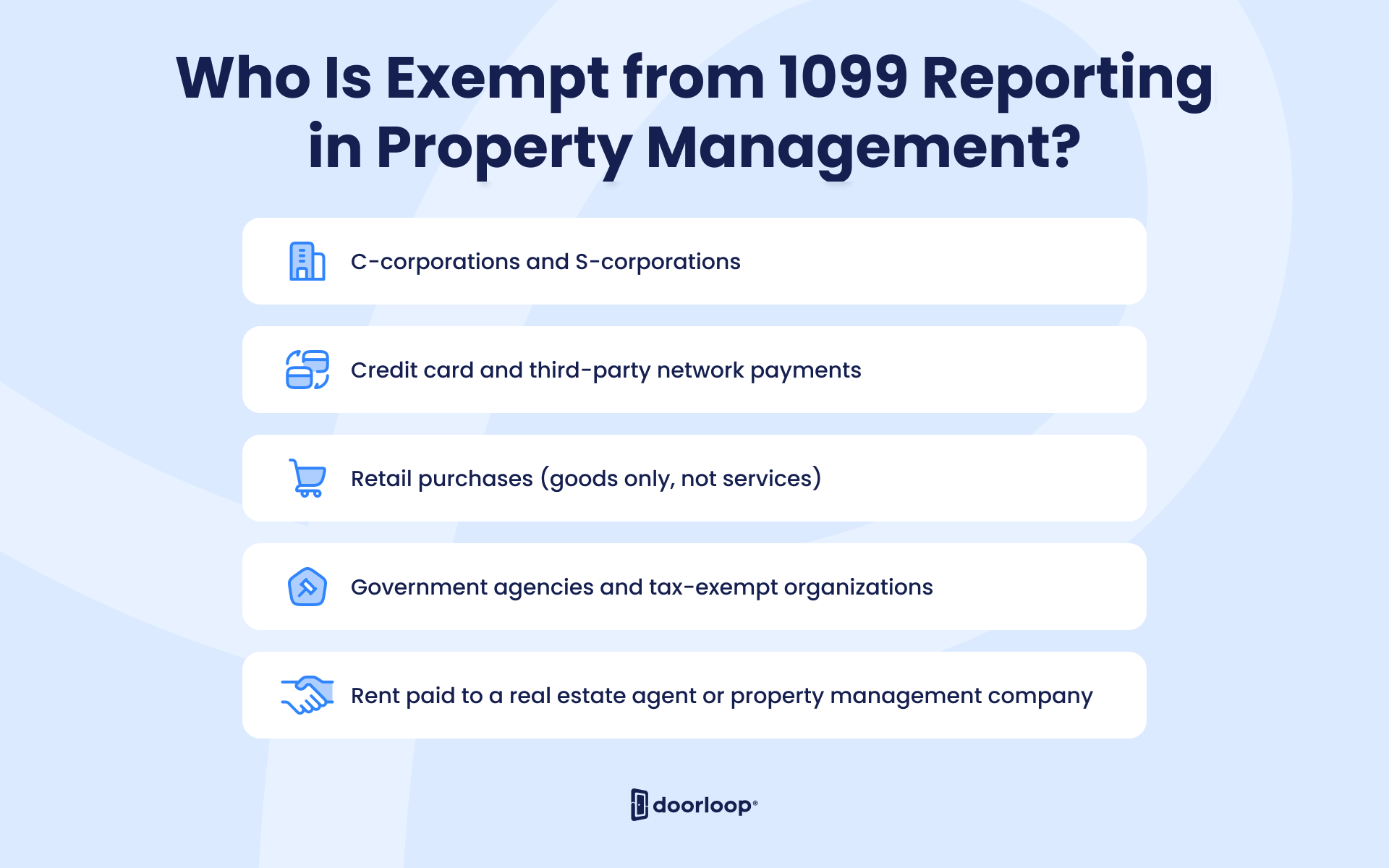
Several categories (C-corporations and S-corporations, credit card and third-party network payments, and retail purchases) of payees are exempt from 1099 reporting in property management, and each exemption has specific conditions that determine whether it applies. The exemptions cover entity types, payment methods, payment purposes, and recipient categories. A payee that does not match any of the categories below, and whose payments cross the applicable threshold, requires a 1099.
C-corporations and S-corporations
Payments to incorporated vendors are exempt from both 1099-NEC and 1099-MISC reporting. One critical exception overrides the corporate exemption: attorneys receive a 1099 regardless of entity type, whether the law firm is incorporated or not. LLCs taxed as corporations qualify for the exemption, but LLCs taxed as partnerships or sole proprietorships do not and remain subject to 1099 reporting at the applicable threshold.
Credit card and third-party network payments
Payments made through credit cards, PayPal, Venmo, Stripe, or any other third-party settlement organization are reported by the processor on a 1099-K. The property manager is not required to issue a 1099-NEC or 1099-MISC for the same transactions. Double-reporting the same payment on a 1099-NEC and a 1099-K creates a duplicate income record for the recipient and generates an IRS notice for overstated income.
Retail purchases (goods only, not services)
Purchases of goods or supplies from a retailer are not reportable because 1099 obligations attach to service payments, not product purchases. Buying paint from a hardware store is not reportable. Paying a painter to apply that paint is reportable if the total crosses the threshold. The distinction is the nature of the transaction: goods versus services.
Government agencies and tax-exempt organizations
Payments to federal, state, or local government entities and most 501(c)(3) nonprofits are exempt from 1099 reporting. A property manager paying a municipal water utility for water service at a managed property does not issue a 1099 for those payments, regardless of the total amount paid during the year.
Rent paid to a real estate agent or property management company
A tenant or business paying rent to a property management company as an intermediary does not issue a 1099-MISC to the property management company for rent collected. The property manager, acting as an intermediary agent, is not the reportable recipient of the rental income under IRS Regulations section 1.6041-3(d). The property manager does, however, issue a 1099-MISC to the property owner for rent remitted after collection.
A payee that does not match any of the exemptions listed above, and whose total payments cross the applicable threshold, requires a 1099. The next section walks through the step-by-step process for preparing and filing those forms.
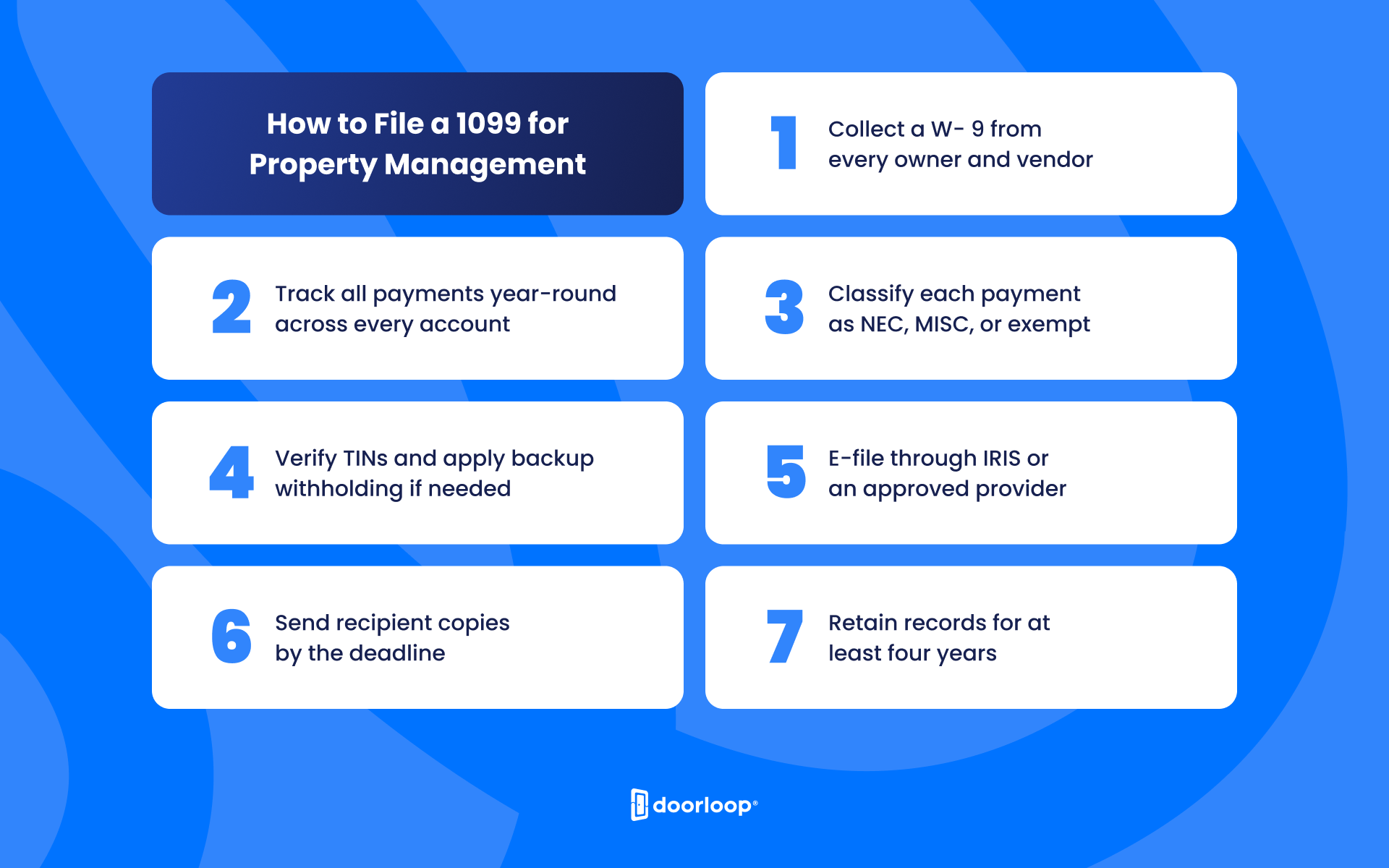
How to File a 1099 for Property Management (Step-by-Step)
To file a 1099 for Property Management, it requires completing seven sequential steps, each of which builds the documentation base for the next. Skipping or delaying any step creates gaps that are difficult and time-consuming to reconstruct at year-end. The process below applies to 1099-NEC for contractor payments and 1099-MISC for rent remittances.
Step 1: Collect a W-9 from every owner and vendor
The W-9 captures three pieces of information required for every 1099: the legal name, the entity type, and the taxpayer identification number (TIN). The request goes out before the first payment is issued, not after. A vendor who refuses to provide a W-9 triggers mandatory backup withholding at 24% on all subsequent payments, which is remitted to the IRS on Form 945. Making a completed W-9 a condition of payment is a reliable way to eliminate refusals before work begins.
Step 2: Track all payments year-round across every account
Payments to the same vendor made from multiple accounts (trust accounts for different property owners and the property manager's own operating account) all count toward a single 1099 at the payee level. A vendor paid $300 from one trust account and $400 from another trust account in the same year, and received one 1099-NEC for $700, not two separate forms. Quarterly reviews of vendor payment totals across all accounts prevent year-end surprises and flag vendors approaching the threshold before the calendar year closes.
Step 3: Classify each payment as NEC, MISC, or exempt
A straightforward decision tree governs classification. Service payments go on 1099-NEC. Rent remittances to owners go on 1099-MISC Box 1. Attorney fees for legal services go on 1099-NEC Box 1. Gross proceeds disbursed through an attorney go on 1099-MISC Box 10. Payments that meet an exemption condition stop at the classification step with no form required. The most frequent misclassification in property management is reporting handyman or contractor payments on 1099-MISC instead of 1099-NEC, which generates an IRS mismatch notice.
Step 4: Verify TINs and apply backup withholding if needed
TIN verification through the IRS TIN Matching program, available free through IRS e-Services, confirms that the name and TIN combination on the W-9 matches IRS records before the 1099 is filed. A mismatch between the filed 1099 and IRS records generates a CP2100 or CP2100A notice, which requires the property manager to begin backup withholding at 24% on future payments to that vendor. Retaining a copy of every TIN verification confirmation creates an audit trail that demonstrates due diligence in the event of a later mismatch notice.
Step 5: E-file through IRIS or an approved provider
E-filing becomes mandatory when the total number of information returns filed in a calendar year reaches 10 or more, counting across all 1099 types combined, rather than per form type. The IRS offers two free e-filing websites. The Information Returns Intake System (IRIS), which is the current primary system, and the legacy FIRE (Filing Information Returns Electronically) system. Require a Transmitter Control Code (TCC), which must be requested in advance from the IRS before the first e-file submission. Property managers with large portfolios route filing through their property management software or a third-party service provider that integrates directly with IRIS.
Step 6: Send recipient copies by the deadline
Recipient copies must be postmarked or delivered by January 31 for both 1099-NEC and 1099-MISC. Electronic delivery is permitted but requires written consent from the recipient in advance of sending. A recipient who has not consented to electronic delivery must receive a paper copy postmarked by January 31. Retaining proof of delivery, whether a USPS certificate of mailing or a delivery confirmation from an electronic delivery system, protects against a late-filing penalty if the recipient claims the copy was never received.
Step 7: Retain records for at least four years
The IRS minimum retention period for information return records is three years, but four years is the safer standard for property managers because backup withholding records carry a longer audit window. The specific records to retain. The records are completed W-9s for every owner and vendor, copies of all filed 1099 forms, payment logs showing the date, amount, and account for every payment, and proof of delivery for all recipient copies.
Following all seven steps produces a compliant, audit-ready 1099 filing that covers both the IRS submission deadline and the recipient delivery requirement. The next section details the specific deadline dates that govern each filing type.
1099 Filing Deadlines for Property Managers
Deadlines for 1099 filing vary by form type and whether the submission is paper or electronic. 1099 Filing Deadlines for Property Managers are shown in the table below.
<table><tbody><tr><td>Form</td><td>Recipient Deadline</td><td>IRS Deadline</td></tr><tr><td>1099-NEC</td><td>January 31</td><td>January 31</td></tr><tr><td>1099-MISC (paper)</td><td>January 31</td><td>February 28</td></tr><tr><td>1099-MISC (electronic)</td><td>January 31</td><td>March 31</td></tr></tbody></table>
The tightest deadline belongs to 1099-NEC, which requires both the recipient copy and the IRS submission to be complete by January 31 with no additional time for electronic filing.
What happens if you miss the January 31 deadline? Late filing triggers a tiered penalty structure that starts at $60 per form for corrections made within 30 days of the deadline and rises to $130 per form for corrections made between 31 days after the deadline and August 1. Forms filed after August 1 or not filed at all carry a penalty of $330 per form. Intentional disregard of the filing requirement raises the penalty to $680 per form with no maximum cap on total penalties assessed.
Common 1099 Mistakes Property Managers Make
The most common 1099 filing errors in property management fall into six categories, and the frequency of each is driven by the complexity of the property management structure (multiple accounts per client, multi-owner properties requiring separate reporting, and seasonal or rotating vendors who are easy to miss at year-end). Software-based workflows address most of the errors automatically, but understanding where the errors occur is necessary to configure those systems correctly.
Mixing up 1099-NEC and 1099-MISC
Putting rent payments on a 1099-NEC or service payments on a 1099-MISC is the most frequent misfile in property management. The IRS matching system compares filed 1099s against the recipient's tax return, and a form type mismatch triggers a notice requiring an explanation or an amended filing. The correction requires voiding the incorrectly filed form and submitting a corrected form with the right box and form type. For a property manager with 50 or more units, a systematic misclassification creates a large correction workload in February and March when filing windows for other forms are also open.
Missing attorney payments (the corporate exception)
Property managers frequently skip 1099s for law firms because the corporate exemption appears to cover all incorporated businesses. Attorneys are explicitly carved out of the corporate exemption under IRS rules, and payments to any attorney for legal services or gross proceeds disbursed through an attorney require a 1099 regardless of entity type. The attorney section earlier in the article details the specific form and box for each payment scenario.
Failing to consolidate trust and operating account payments
Paying the same vendor from multiple accounts (one trust account per property owner) creates the risk of filing multiple 1099s for the same vendor when the IRS requires one consolidated form. A plumber paid $400 from each of three separate trust accounts in the same year receives a single 1099-NEC for $1,200, not three separate forms for $400 each. Filing three separate forms overstates the vendor's income by $800 and generates a discrepancy on the vendor's tax return.
Splitting multi-owner property income incorrectly
Two methods exist for reporting rental income on a multi-owner property. The methods are reporting the full gross rent to each owner (with the owners adjusting on their individual returns) or splitting by ownership percentage and issuing each owner a 1099-MISC for their share. Property management software defaults to the ownership-percentage split. A mismatch between the method used in the software and the method expected by the owner's CPA creates a reconciliation problem that surfaces at tax filing time.
Using the wrong TIN or name combination
The IRS issues a CP2100 notice and requires the property manager to begin backup withholding on future payments to that vendor when the name on the filed 1099 does not match the name associated with the TIN in IRS records. The prevention step is straightforward: use the exact legal name from the W-9 without abbreviation or alteration, and run the name-TIN pair through the IRS TIN Matching program before submitting the filing.
Missing the January 31 deadline
Late filing triggers the penalty tier structure starting at $60 per form for corrections filed within 30 days. The penalty rises to $130 per form from 31 days after the deadline through August 1, then to $330 per form for forms filed after August 1. Intentional disregard carries a $680 per-form penalty with no annual cap. A property manager filing 100 late forms at the intentional disregard rate faces a minimum $68,000 penalty exposure.
The mistakes listed are preventable with a consistent workflow applied at onboarding, throughout the payment year, and during the December-to-January filing window. The next section covers the full penalty structure in detail.
Penalties for Not Filing a 1099 as a Property Manager
Penalties for Not Filing a 1099 as a property manager increase based on how far past the filing deadline the correction is made, rewarding early corrections with lower penalty amounts. The table below covers the four penalty tiers applicable to 2026 filings.
<table><tbody><tr><td>Timing</td><td>Penalty Per Form (2026)</td><td>Notes</td></tr><tr><td>Within 30 days of deadline</td><td>$60</td><td>Lowest tier; correction must be filed and postmarked within 30 days</td></tr><tr><td>31 days to August 1</td><td>$130</td><td>Mid-tier; applies to corrections filed during the extended window</td></tr><tr><td>After August 1 or not filed</td><td>$330</td><td>High tier; applies to all forms still outstanding after August 1</td></tr><tr><td>Intentional disregard</td><td>$680</td><td>No annual cap; applies when the IRS determines non-filing was deliberate</td></tr></tbody></table>
The cost of late filing scales quickly across a portfolio. A property manager with 50 unfiled forms at the August 1 or later tier faces a minimum of $16,500 in penalties before the intentional disregard determination is even made.
Can deductions be disallowed if you don't file 1099s? The IRS Automated Underreporter (AUR) program cross-references contractor payments claimed as deductions on Schedule E against 1099s filed for those same contractors. A Schedule E deduction for a plumber who never received a 1099 creates a discrepancy that the AUR program flags for review. The IRS takes the position that expenses paid in a trade or business require proper information return filing to be deductible, and a missing 1099 is grounds for disallowing the deduction.
How DoorLoop Simplifies 1099 Filing for Property Managers
The seven-step manual workflow described is accurate, but property managers running more than a handful of units rarely complete it by hand anymore. Purpose-built property management software consolidates every payment, every owner, and every vendor into a single 1099 workflow that reduces the December-to-January filing crunch to a review-and-submit task rather than a data-collection exercise. DoorLoop's 1099 e-filing feature pulls payment data directly from the accounting ledger, stores W-9s per payee record, validates TINs before submission, e-files directly with the IRS, and delivers recipient copies automatically, eliminating the paper handling and manual aggregation steps that create errors in manual workflows. The sections below cover each component of DoorLoop's 1099 workflow in detail.
Automatic Payment Tracking Across Owners and Vendors
The distinction between DoorLoop's automated tracking and a manual spreadsheet approach is point-of-entry tagging. DoorLoop's accounting ledger assigns every payment a payee designation, an account type (trust or operating), and a transaction category at the time the payment is recorded, rather than at year-end when memory and documentation are less reliable. The result is that year-end 1099 preparation becomes a verification task rather than a reconstruction task: the data is already organized, aggregated by payee, and sorted by form type before the January filing window opens.
A practical feature in the system flags payees approaching the $2,000 threshold throughout the year, alerting the property manager when cumulative payments to a single vendor are nearing the reportable amount. The alert creates an action item for W-9 collection before the threshold is crossed, rather than after the filing deadline has already passed, which is when missing documentation becomes a compliance liability.
Built-In W-9 Collection and TIN Validation
DoorLoop's W-9 collection process sends a digital request to the payee directly from the website, stores the completed form in the payee's record within DoorLoop's document management system, and links the TIN from the W-9 to the payee's payment history for 1099 generation. The storage is tied to the payee record, not to a separate file folder, so the W-9 is accessible at the point of filing without a separate retrieval step.
TIN validation runs against IRS records before the 1099 is filed, checking that the name and TIN combination on the W-9 matches the IRS database. A mismatch is flagged inside DoorLoop before submission, giving the property manager the opportunity to correct the record rather than discover the error through a CP2100 notice after filing. Foreign owners who submit a W-8ECI instead of a W-9 complete the document through the same digital workflow, with DoorLoop routing the document type based on the payee's residency status.
One-Click 1099-NEC and 1099-MISC E-Filing
DoorLoop generates draft 1099-NEC and 1099-MISC forms directly from the accounting ledger at the start of the filing window. Each draft shows the payee's legal name, TIN, entity type, and payment total broken down by box number, allowing the property manager to review and adjust specific amounts before submission rather than reviewing raw transaction data. The review step is the primary point of human judgment in the workflow (everything before and after it is handled by the system).
DoorLoop e-files the approved forms directly with the IRS through the IRIS system and sends recipient copies to each payee automatically, with delivery confirmation recorded in the payee's record after the review is complete. Filing preparation in DoorLoop begins in December, ahead of the IRS January opening date for information return submissions, allowing property managers to complete the review-and-submit step before the January 31 deadline pressure arrives rather than during it.
Why DoorLoop is Built for Property Managers' 1099 Filing
DoorLoop is built for property managers' 1099 filing because generic accounting tools handle basic income and expense tracking, but they lack the structural features that make 1099 filing accurate at scale for property management. QuickBooks and similar websites do not natively separate trust accounts from operating accounts at the payee level, do not tag payments by property, and do not automatically route rent remittances to 1099-MISC and contractor payments to 1099-NEC based on payment category. The result is that property managers using generic accounting software spend significant time at year-end manually sorting and reclassifying data before filing begins.
DoorLoop is structured around the multi-owner, multi-property model that defines professional property management. Each payment is tagged to a property and an owner at the time of entry, and the system rolls up per-property payments into per-owner 1099-MISC forms automatically. Trust-versus-operating account separation is built into the ledger structure, not added as a manual workaround. The corporate exemption logic, including the attorney carve-out, is applied at the payee classification level based on the entity type captured in the W-9 on file.
Property managers interested in seeing the full 1099 workflow in action, from W-9 collection through IRS e-filing, can book a live demo through the DoorLoop website to review how the system handles their specific portfolio structure and owner mix before committing to a plan. This advanced approach to 1099 filing is a key benefit of using property management accounting software.
Frequently Asked Questions About 1099 for Property Management
The questions below address the most common points of confusion about 1099 obligations in property management, covering who files, who receives, where to obtain forms, how to correct errors, and what happens when filing is skipped.
Do I need to 1099 my property manager?
No, you don’t need to 1099 your property manager. The property owner does not need to issue a 1099 to an incorporated property management company. The corporate exemption covers payments to C-corporations and S-corporations, and most professional property management companies operate as incorporated entities. The property owner's obligation ends at the corporate exemption when the management company qualifies.
The flow runs in the opposite direction for rent reporting. The property management company issues a 1099-MISC to the property owner for rent remitted during the year, not the other way around. The owner is the recipient of the 1099-MISC, not the issuer.
A property manager who operates as a sole proprietor or an LLC taxed as a sole proprietorship may require a 1099-NEC from the property owner for management fees paid above the applicable threshold, but the majority of professional property managers are incorporated and exempt from that requirement.
Does a property manager get a 1099?
No, a property manager does not get a 1099. A property manager does not get a 1099-MISC for rent collected on behalf of an owner. IRS Regulations section 1.6041-3(d) establishes the intermediary rule. A property manager collecting rent as an agent for the property owner is not the recipient of that rent for reporting purposes, so no 1099 flows from the tenant or the owner to the property manager for rent collection activity.
The exception applies when the property owner pays management fees directly to the property manager for services rendered. The property owner issues a 1099-NEC to the management company for management fees if the property management company is not incorporated and the fees paid exceed the applicable threshold ($600 in 2025 or $2,000 in 2026). The 1099-NEC covers service payments, and management fees are a service payment from the property owner's perspective, distinct from the rent collected and remitted by the manager.
Where do I get 1099 forms?
Get 1099 forms from three sources. First, the IRS provides free paper forms through its website at IRS.gov/orderforms, where property managers request Copy A in the official red-ink format required for paper IRS submission. Photocopies of Copy A are not accepted by the IRS, so only officially printed forms meet the paper submission requirement.
Second, office supply retailers (Staples and Office Depot) carry compliant 1099 form sets that include the red-ink Copy A, the black-ink recipient copies, and the related mailing envelopes. The sets are sold in packages sized for small to mid-size filing volumes.
Third, property management software including DoorLoop generates and e-files 1099 forms directly from the website's accounting ledger, eliminating the need to order, print, or mail paper forms entirely. The e-filed forms satisfy both the IRS submission requirement and the recipient delivery requirement through a single digital workflow.
How do I correct a 1099 I already filed?
Correct a 1099 you already filed by following one of two processes, depending on the type of error. Type 1 corrections apply to errors in the dollar amount, specific box, or checkbox selection. A single corrected form is submitted to the IRS with the "CORRECTED" box checked, and a corrected copy is sent to the recipient. The corrected form replaces the original in the IRS system without voiding the prior submission.
Type 2 corrections apply to errors in the payee's TIN or legal name. The correction requires two separate forms: the first voids the original filing by marking the "CORRECTED" box and setting all amounts to zero, and the second is a new form filed with the correct name and TIN combination. The forms go to the IRS, and corrected copies go to the recipient for both steps.
Property management software handles correction types through a correction workflow that generates the appropriate form structure automatically, reducing the risk of filing a correction with the wrong format for the error type involved.
What happens if you don't file a 1099?
Three consequences in increasing order of severity happen if you file a 1099. First, tiered penalties apply per missing form, starting at $60 per form for corrections made within 30 days of the deadline and rising to $680 per form for intentional disregard, with no annual cap at the highest tier. A property manager with a large portfolio who misses filing for multiple vendors faces cumulative penalties that exceed the cost of the filing service many times over.
Second, deductions are at risk through the IRS Automated Underreporter (AUR) program, which cross-references Schedule E expense deductions against 1099s filed for the same contractors. A contractor payment claimed as a deduction without a corresponding 1099 creates a discrepancy that the AUR flags for review, and the IRS takes the position that the deduction is unsubstantiated.
Third, the trade or business classification supporting the rental activity is at risk. Losing that classification eliminates eligibility for the qualified business income (QBI) deduction, which is a tax benefit for property managers operating qualifying rental businesses.
Frequently Asked Questions