






Multifamily property management is the end-to-end management of multifamily real estate assets to improve occupancy, tenant satisfaction, operational efficiency, regulatory compliance, and long-term return on investment. Multifamily property management involves leasing, tenant screening, rent collection, renewals, maintenance scheduling, preventive repairs, accounting, budgeting, vendor coordination, legal compliance, resident retention, and property performance reporting responsibilities.
Types of multifamily property management are residential apartment management, condominium management, affordable housing management, student housing management, senior living management, and mixed-use multifamily management. Challenges, responsibilities, and benefits differ according to the property type, management structure, tenant profile, and operational model. For example, while affordable housing property management requires subsidy compliance, documentation accuracy, and regulatory reporting, luxury apartment property management requires premium resident services, amenity management, brand reputation control, and high-touch tenant experience strategies.
The main benefit of using multifamily property management software is that it increases ROI by improving efficiency, occupancy, and tenant retention.
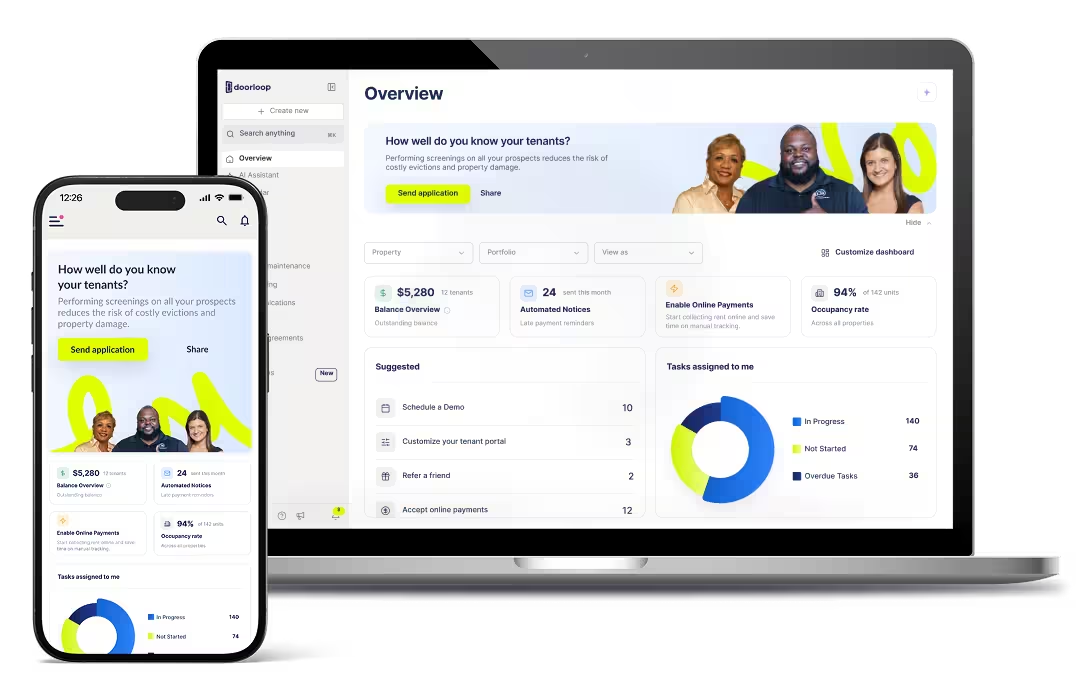
With the right multifamily property management software, you can manage daily operations easily and make faster decisions without losing track of tenants, leases, or maintenance tasks. You also get a clearer view of property performance, so you can spot problems earlier and improve revenue opportunities more confidently.
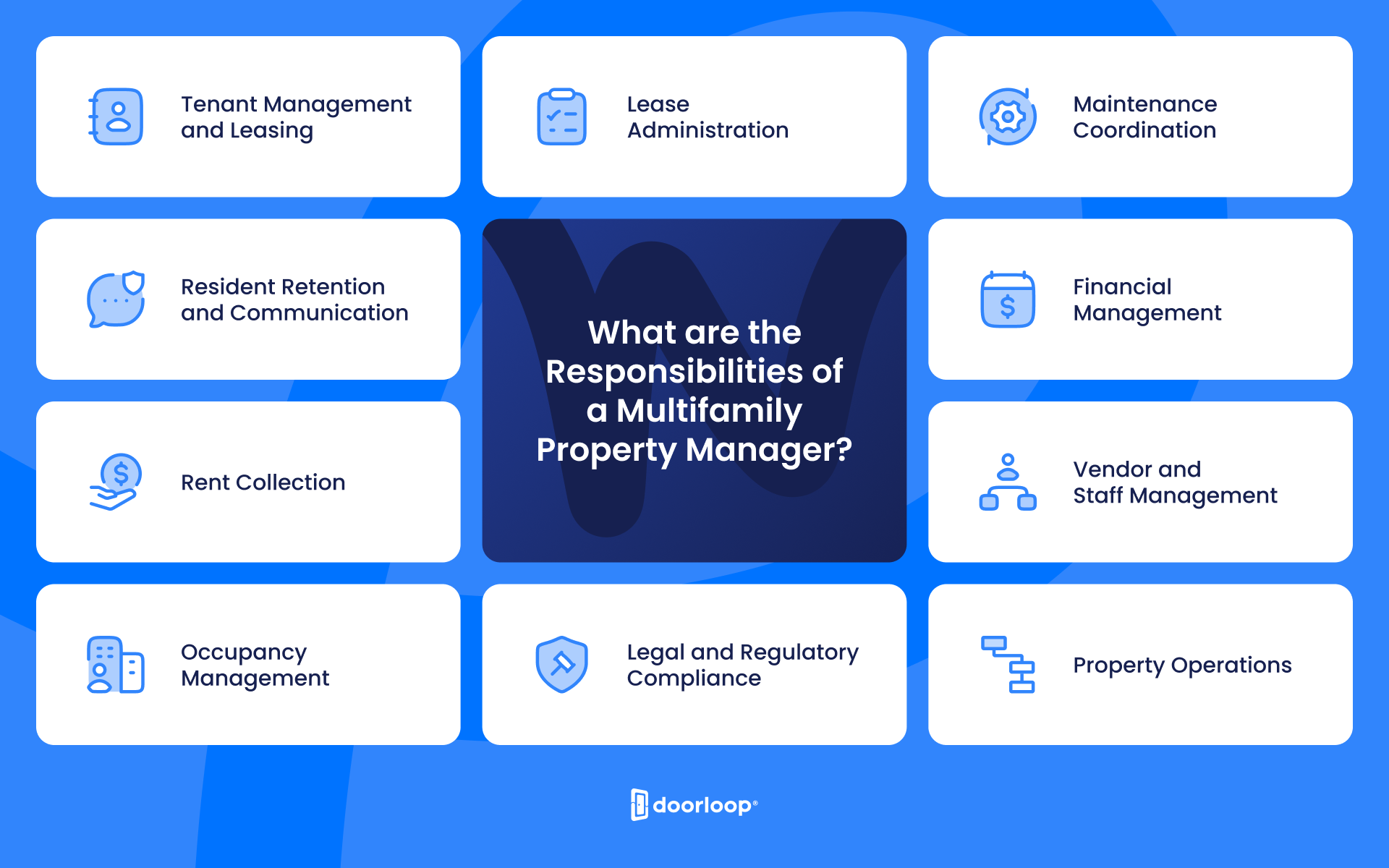
What are the Responsibilities of a Multifamily Property Manager?
The responsibility of a Multifamily property manager is leasing, tenant screening, rent collection, lease renewals, maintenance coordination, budget control, vendor management, occupancy tracking, resident communication, and fair housing compliance are the main responsibilities of a multifamily property manager. To choose the right tool or software to perform these responsibilities, consider accounting integration, maintenance automation, tenant portal quality, reporting depth, mobile access, pricing model, unit scalability, data security, and support quality.
The responsibilities of a multifamily property manager are listed below.
- Tenant Management and Leasing: Tenant Management and Leasing are important because Tenant Management and Leasing keep units filled and tenants managed properly. Demand increases for market-rate apartments and student housing. Tenant screening and leasing decisions must comply with the Fair Housing Act and the Fair Credit Reporting Act.
- Rent Collection: Rent Collection is Important because steady rent payments support cash flow and property income. Needed in large apartment communities and workforce housing. Tenant debt collection is affected by consumer protection rules.
- Lease Administration: Lease Administration is Important because renewals, notices, and lease records reduce disputes and errors. Needed affordable housing and senior housing. Leasing requires lead-based paint disclosures for many pre-1978 properties.
- Maintenance Coordination: Maintenance Coordination is important because repairs protect habitability, retention, and property value. Needed in older multifamily buildings and garden-style communities. Maintenance Coordination is tied to safety, habitability, and operational risk.
- Property Operations: Property operations are important because daily operations affect cleanliness, safety, and resident experience. Needed in large multifamily communities and mixed-use properties. Accessibility matters under the ADA depending on the property and shared-use areas.
- Financial Management: Financial management is important because budgeting and reporting affect NOI, expense control, and owner decisions. Needed in institutional portfolios and third-party managed assets. Financial management is a major software selection factor because accounting and reporting quality affect control.
- Occupancy Management: Occupancy management is important because vacancy and turnover directly affect revenue and ROI. Needed in student housing, urban apartments, and lease-up properties. Marketing and application handling still must follow the Fair Housing Act.
- Legal and Regulatory Compliance: Legal and regulatory compliance is important because violations lead to complaints, fines, and lawsuits. Needed affordable housing, HUD-assisted housing, and new multifamily developments. Main compliance areas include the Fair Housing Act and accessibility rules for covered multifamily housing.
- Vendor and Staff Management: Vendor and staff management is important because service quality, repair speed, and cost control depend on people and contractors. Needed in large apartment communities, senior housing, and mixed-use properties. Vendor and staff management is closely tied to operational accountability and service consistency.
- Resident Retention and Communication: Residential retention and communication are important because better communication improves retention and lowers turnover costs. Needed in luxury apartments, senior housing, and family-oriented communities. Fair treatment and accommodation duties matter here under fair housing rules.
In DoorLoop property management principles, the most important responsibility of the multifamily property manager is occupancy management, because lease renewals, vacancy control, and unit turn speed have the biggest impact on revenue, and the U.S. rental vacancy rate was 6.9% in Q4 2024 according to the Census Bureau, Housing Vacancies and Homeownership, showing how directly vacancy pressure affects ROI.
1. Tenant Screening and Leasing
Tenant screening and leasing in multifamily property management, check identity, income, employment, credit history, rental history, eviction records, criminal history where legally allowed, occupancy limits, and application completeness.
Screening criteria are written, consistent, property-wide, and applied equally across all applicants to support fair multifamily leasing decisions. The main compliance requirements include the Fair Housing Act for non-discrimination, the FCRA for consumer reports and adverse action notices, and, for covered properties, HUD occupancy and tenant selection rules. After approval, the usual multifamily leasing flow is approval notice, document collection, security deposit and fees, lease review, required disclosures, lease signing, move-in scheduling, and resident onboarding.
Using multifamily property management software helps because multifamily property management software standardizes screening criteria, stores applicant records, tracks compliance steps, automates notices, reduces manual errors, and connects leasing with rent collection, maintenance, and resident communication in one workflow. That matters in multifamily property management because higher unit counts create applications, renewals, documentation, and compliance risk across the same property or portfolio.
The U.S. completed 608,000 multifamily units in 2024, according to the U.S. Census Bureau, which increases leasing competition and tenant screening volume across apartment properties. A software for multifamily property management decreases the work burden on the property managers.
2. Rent Collection and Financial Management
Financial management for multifamily properties requires accurate rent collection, delinquency tracking, security deposit accounting, budget control, owner reporting, vendor payment management, and compliance with the Fair Housing Act, the Fair Credit Reporting Act, the Fair Debt Collection Practices Act, and state landlord-tenant and security-deposit laws across market-rate apartments, affordable housing, student housing, senior housing, mixed-use communities, and condominium portfolios. DoorLoop, AppFolio, Yardi, and Buildium help property managers track receivables, reconcile ledgers, automate notices, and protect NOI, while 49.7% of U.S. renter households were cost-burdened in 2023, the U.S. completed 608,000 multifamily units in 2024, and median renter housing costs reached $1,406 in 2023, which makes cash-flow control and financial reporting more important in multifamily asset management.
3. Property Maintenance and Repairs
Property maintenance and repairs for multifamily properties require work order tracking (repair requests, service logs), preventive maintenance (HVAC checks, plumbing inspections), vendor coordination (contractor scheduling, follow up), inspection records (unit inspections, move in checks), habitability control (water leak response, safety fixes), and compliance with the Fair Housing Act, local housing codes, ADA rules, and lead based paint disclosure rules across market rate apartments, affordable housing, student housing, senior housing, mixed use communities, and condominium portfolios. DoorLoop helps multifamily property managers organize repair requests, maintenance records, and vendor follow-up in one system, which matters as scale grows because the U.S. Census Bureau said 19,000 multifamily buildings were completed in 2024, and 96 percent of those buildings had air conditioning.
Get work order tracking, preventive maintenance scheduling, and vendor coordination if you want maintenance to stop feeling reactive and disorganized. You can improve emergency, routine, and preventive repairs more easily in market-rate apartments, affordable housing, and senior housing properties with a more structured system.
4. Legal Compliance and Lease Administration
Legal compliance and lease administration for multifamily properties require lease drafting (new lease creation, clause updates), renewal tracking (renewal notices, expiration monitoring), notice management (late rent notices, entry notices), disclosure delivery (lead paint forms, policy disclosures), accommodation handling (service animal requests, disability adjustments), and compliance with the Fair Housing Act, FCRA, and state landlord tenant laws across market rate apartments, affordable housing, public housing, student housing, senior housing, and mixed use multifamily properties. DoorLoop helps multifamily property managers keep leases, notices, and tenant records consistent, which is important because the U.S. Census Bureau reported 42.5 million renter households in 2023 and 49.7 percent of renter households were cost-burdened in 2023.
5. Vacancy Management and Marketing
Vacancy management and marketing for multifamily properties require listing control (listing updates, syndication checks), lead tracking (inquiry follow up, tour scheduling), tenant screening (income checks, rental history review), unit turn coordination (cleaning, repainting), pricing updates (rent changes, concession updates), and fair housing compliant advertising (equal opportunity wording, non discriminatory listing practices). The main laws and compliance areas here are the Fair Housing Act and FCRA for advertising, screening, and applicant handling. Urban apartments, suburban apartment communities, affordable housing, student housing, senior housing, and lease-up multifamily properties require a strong vacancy management and marketing process because the property types face higher turnover, stricter affordability or compliance limits, seasonal leasing cycles, service-sensitive tenant needs, or faster lease-up pressure. DoorLoop helps multifamily property managers connect leasing activity with applications and occupancy tracking. You should take vacancy control seriously because the U.S. Census Bureau reported a 6.9 percent rental vacancy rate in Q4 2024 and said 608,000 multifamily units were completed in 2024.
6. Financial Reporting and Budgeting
Financial reporting and budgeting for multifamily properties require rent roll accuracy (tenant balances, charge records), delinquency tracking (late payments, collections follow up), budget forecasting (expense planning, revenue projections), owner reporting (monthly statements, performance summaries), reserve planning (capital repairs, replacement funds), and accounts payable control (vendor invoices, utility payments). The main legal areas here are state landlord-tenant laws, security deposit rules, and lease-based financial obligations tied to rent, fees, and accounting records. Financial reporting and budgeting are important for market-rate apartments, affordable housing, condominium portfolios, student housing, senior housing, and mixed-use communities because the property types involve different rent structures, reporting needs, compliance burdens, ownership models, and resident payment patterns. DoorLoop helps multifamily property managers track rent, expenses, and reporting in one place. You should keep financial reporting tight because the U.S. Census Bureau reported 42.5 million renter households, 49.7 percent were cost burdened, and the median renter income to housing cost ratio was 31 percent in 2023.
What are the Types of Multifamily Properties?
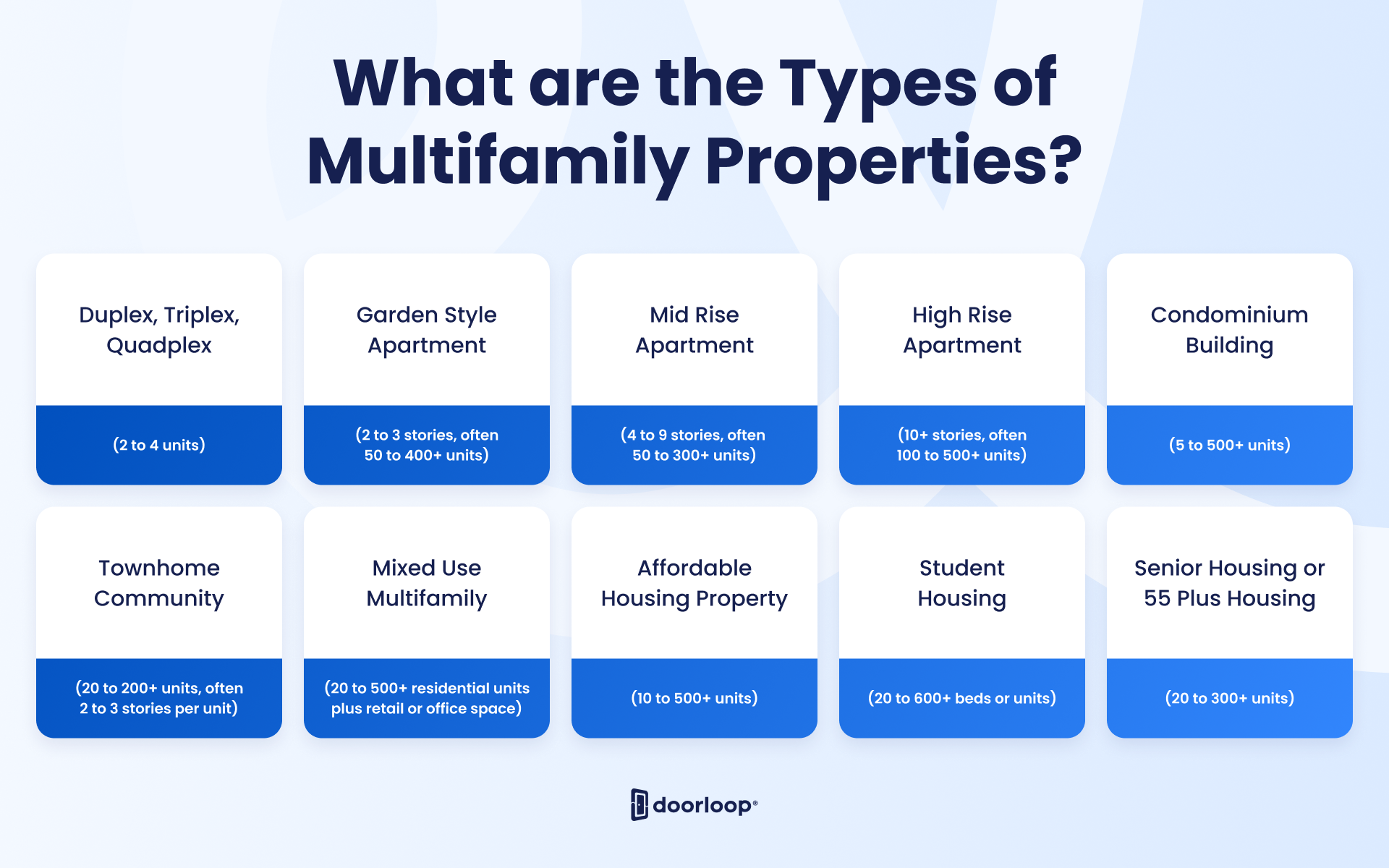
The main types of multifamily properties are duplexes, triplexes, quadplexes, garden-style apartments, low-rise and mid-rise apartments, high-rise apartments, townhome communities, condominium buildings, affordable housing properties, student housing, and senior housing. The multifamily properties range from 2 to 4 units in smaller multifamily properties to 100+ units in apartment communities, and in larger cases, especially high-rise, student housing, or mixed-use multifamily properties, the size exceeds 500 units.
The types of multifamily properties are listed below.
- Duplex, Triplex, Quadplex: Size (2 to 4 units).
- The purpose is small-scale rental housing or owner-occupied income property. Main laws include the Fair Housing Act and state landlord-tenant laws. Main management priority is leasing and basic maintenance control.
- Main requirements are tenant screening, rent collection, and repair follow-up.
- Common challenges are limited staffing and inconsistent maintenance response. Main responsibilities are lease handling and vendor coordination. DoorLoop can help if you want a simpler way to track leases, rent, and repairs without overcomplicating a smaller property.
- Garden Style Apartment: Size (2 to 3 stories, often 50 to 400+ units).
- Purpose is lower-density multifamily living with shared outdoor space. Main laws include the Fair Housing Act and federal accessibility design rules for many covered buildings with 4 or more units first occupied after March 13, 1991.
- The main management priority is curb appeal and occupancy stability. Main requirements are common area upkeep, parking control, and preventive maintenance.
- Common challenges are landscaping costs and slower maintenance across spread-out buildings. Main responsibilities are grounds maintenance and resident communication.
- Mid Rise Apartment: Size (4 to 9 stories, often 50 to 300+ units).
- The purpose is higher-density rental housing in urban or suburban locations. Main laws include the Fair Housing Act and federal accessibility rules that generally cover all units in elevator buildings with 4 or more units after the 1991 federal trigger.
- The main management priority is building operations and resident retention. Main requirements are elevator coordination, access control, and maintenance tracking. Common challenges are shared system failures and higher turnover pressure.
- Main responsibilities are amenity operations and service request control. DoorLoop can help here because once the unit count grows, manual tracking usually starts breaking down faster.
- High Rise Apartment: Size (10+ stories, often 100 to 500+ units).
- The purpose is dense urban multifamily housing with elevators and amenities. Main laws include the Fair Housing Act and ADA Title III for leasing offices and other public-facing areas. The main management priority is life safety and system uptime.
- Main requirements are formal staffing, emergency planning, and tighter maintenance workflows. Common challenges are elevator downtime and more expensive repairs.
- Main responsibilities are building system oversight and resident service coordination.
- Condominium Building: Size (5 to 500+ units).
- Purpose is individually owned housing with shared common elements. Main laws include the Fair Housing Act, plus state condominium and association laws. Main management priority is common area control and owner reporting.
- Main requirements are board coordination, reserve planning, and rule enforcement. Common challenges are owner communication delays and reserve funding pressure.
- Main responsibilities are financial reporting and vendor oversight. DoorLoop may help for rentals inside condo portfolios, but association-heavy operations often depend on how the ownership structure is set up.
- Townhome Community: Size (20 to 200+ units, often 2 to 3 stories per unit).
- The purpose is multifamily style housing with private entries and more vertical living space. Main laws include the Fair Housing Act, while accessibility coverage depends on building layout and whether elevators exist. The main management priority is shared exterior upkeep and rule compliance.
- Main requirements are parking control, exterior maintenance, and responsibility mapping. Common challenges are owner-tenant responsibility confusion and inconsistent exterior standards.
- Main responsibilities are common area maintenance and lease enforcement.
- Mixed Use Multifamily: Size (20 to 500+ residential units plus retail or office space).
- The purpose is to combine residential use with commercial activity. Main laws include the Fair Housing Act for housing and the ADA Title III for public accommodations. The main management priority is separating residential and commercial operations.
- Main requirements are access management, insurance coordination, and noise control. Common challenges are commercial tenant conflicts and complex maintenance scheduling.
- Main responsibilities are shared area operations and vendor coordination. DoorLoop help with the residential side, but mixed-use properties need stronger operational discipline because the moving parts are heavier.
- Affordable Housing Property: Size (10 to 500+ units).
- The purpose is housing for lower-income households under rent and income restrictions. Main laws are the Fair Housing Act, HUD program rules, and LIHTC requirements, which HUD calls an important resource for creating affordable housing in the United States today. The main management priority is compliance and documentation accuracy.
- Main requirements are income verification, recertification, and regulated rent tracking. Common challenges are paperwork burden and higher compliance risk.
- Main responsibilities are file management and occupancy compliance.
- Student Housing: Size (20 to 800+ beds or units).
- The purpose is to house students near colleges and universities. Main laws are the Fair Housing Act and state leasing laws. Main management priority is fast leasing and turnover control.
- Main requirements are guarantor handling, roommate coordination, and seasonal marketing. Common challenges are short leasing windows and heavy move-in move-out volume.
- Main responsibilities are to lead follow-up and unit turn coordination. DoorLoop helps if you want better control over fast-cycle leasing, when the same tasks repeat every season.
- Senior Housing or 55 Plus Housing: Size (20 to 300+ units).
- The purpose is housing older adults with age-focused policies or services. Main laws are the Fair Housing Act and Housing for Older Persons Act rules, including the 80 percent occupied unit threshold with at least one resident age 55 or older. The main management priority is accessibility and service responsiveness.
- Main requirements are occupancy verification, accommodation handling, and safer communication processes. Common challenges are higher service expectations and faster response needs for repairs.
- Main responsibilities are maintenance, follow-up, and resident support coordination.
1. Duplexes and Small Multifamily Properties (2 - 4 Units)
A duplex is a multifamily property with 2 residential units, and this group are triplexes and fourplexes. Multifamily property management at duplex size is handled by the owner, a small local property manager, or a lean third-party operator because the income rarely supports a full onsite team. Daily management involves leasing, rent collection, maintenance follow-up, vendor scheduling, and tenant communication. Shared amenities are basic (parking, laundry, trash areas, storage, or a yard). The main challenge is concentration risk because one vacancy in a duplex removes 50 percent of occupied units, and one vacancy in a fourplex removes 25 percent. DoorLoop helps with rent tracking, lease dates, maintenance requests, and tenant records once 3 to 4 units start creating repeated admin work.
2. Mid-Size Apartment Buildings (5 - 49 Units)
A mid-size apartment building is a multifamily property large enough to create a repeatable operational load without always needing a full dedicated onsite team. Management at this scale runs through one property manager, shared leasing support, and either one maintenance technician or a regular vendor network. Responsibilities expand into occupancy control, work order tracking, common area upkeep, delinquency follow-up, tenant screening, turn coordination, and resident communication. Shared amenities become important here (hallways, parking lots, courtyards, laundry rooms, controlled entry, and small fitness rooms) because shared amenities generate service requests and concurrent tenant needs. Investors measure performance through occupancy, collections, turnover, and NOI. A 20-unit property at [$1,500] average monthly rent produces [$28,500] at 95 percent occupancy and [$27,000] at 90 percent occupancy, so a 5-point drop creates a [$1,500] monthly gap before other fees or renewals. DoorLoop helps by connecting leasing, payments, notices, and maintenance activity when the tasks start overlapping every week.
3. Large Apartment Complexes and Communities (50+ Units)
A large apartment complex is a full-scale multifamily operation where management shifts from a single manager workflow to a team-based operating model. The structure is a community manager, leasing staff, maintenance technicians, a maintenance supervisor, and sometimes regional or asset management above the site. Core responsibilities are resident retention, preventive maintenance, lease renewals, amenity operations, budgeting, vendor contracts, compliance, and performance reporting. Amenities are much heavier at this scale (pools, fitness centers, clubhouses, package rooms, elevators, garages, dog parks, playgrounds, and security systems). Main challenges are service volume, staff coordination, response speed, amenity downtime, and controlling expenses without losing occupancy. DoorLoop helps organize high-volume leasing, work orders, rent tracking, and reporting, which becomes useful when many units, vendors, and resident issues must be handled at the same time.
4. Condominiums and Townhouse Communities
Condominiums and townhouse communities sit inside the multifamily property management world, but the ownership structure is different from that of rental apartments. The property manager serves the owner, operator, or investor and focuses on rent, occupancy, expenses, and NOI in apartment management. The manager in condo and townhouse management serves the HOA or condominium association board. Responsibilities focus on common element maintenance, assessments, reserve planning, board communication, owner communication, vendor contracts, meeting support, and rule enforcement than on leasing. Shared amenities are clubhouses, pools, roofs, sidewalks, gates, landscaping, parking areas, and exterior walls. The main challenge is governance complexity because the manager must separate what belongs to the association from what belongs to the unit owner, while budgets and vendor decisions depend on board approval. DoorLoop helps with records, owner communication, maintenance tracking, and financial organization when the association needs a clearer operational system.
For more information on Multifamily Properties, see our full article: What is a Multifamily Property.
What Are the Challenges of Managing Multifamily Properties?
The challenges of managing multi-family properties are that managing multifamily is more complex than single-family, and complexity grows with unit count. Leasing volume creates continuous pressure across marketing, tenant screening, and turnover cycles. Rent collection requires strict tracking, consistent follow-up, and enforcement across multiple tenants. Maintenance coordination increases workload through frequent service requests, repairs, and shared building systems. Tenant management involves communication, conflict resolution, and consistent policy enforcement across different households. Expense control becomes difficult as operating costs increase across staffing, utilities, and vendor services. Financial reporting demands accuracy across income streams, expenses, and occupancy data. Regulatory compliance increases administrative workload and legal exposure.
The challenges of managing multifamily properties are listed below.
- Managing multifamily is more complex than single-family, and complexity grows with unit count.
- Leasing volume creates continuous pressure across marketing, tenant screening, and turnover cycles.
- Rent collection requires strict tracking, consistent follow-up, and enforcement across multiple tenants.
- Maintenance coordination increases workload through frequent service requests, repairs, and shared building systems.
- Tenant management involves communication, conflict resolution, and consistent policy enforcement across different households.
- Expense control becomes difficult as operating costs increase across staffing, utilities, and vendor services.
- Financial reporting demands accuracy across income streams, expenses, and occupancy data.
- Regulatory compliance increases administrative workload and legal exposure.
1. High Tenant Turnover Rates
High tenant turnover rates refer to frequent tenant move-outs within a multifamily property over a defined period. Multifamily properties experience higher turnover than single-family properties because lease terms are shorter, tenant profiles are more transient, and unit density increases the probability of non-renewals across multiple leases at the same time. Each turnover triggers operational tasks (unit inspection, cleaning, repairs, marketing, showings, screening, lease execution) and financial impacts (vacancy loss, make-ready costs, leasing commissions, administrative expenses).
High tenant turnover rates create direct revenue gaps during vacancy periods and increase operating costs through repeated turnover cycles. Property managers track turnover frequency to protect occupancy levels and stabilize income. Retention strategies reduce churn by improving tenant satisfaction, maintaining property conditions, responding quickly to maintenance requests, offering renewal incentives (rent discounts, lease flexibility), and maintaining clear communication. Lower turnover rates improve occupancy stability, reduce costs, and strengthen long-term financial performance.
For more information see DoorLoop’s full guide on Tenant Turnover and how to reduce it.
2. Maintenance Coordination Across Multiple Units
Maintenance coordination across multiple units refers to the process of managing, scheduling, and completing repair and service requests across many occupied units within a multifamily property. Maintenance becomes complex at scale because request volume increases, priorities compete, and shared systems (plumbing lines, electrical circuits, HVAC networks) affect multiple units at once. Work order tracking, technician scheduling, vendor coordination, and inventory control require constant oversight to prevent delays and service gaps.
Maintenance coordination breaks down without a centralized system because requests get lost, response times increase, duplicate work orders occur, and communication between tenants, staff, and vendors becomes inconsistent. Delays create tenant dissatisfaction and extend downtime for critical systems. Digital maintenance portals solve the problem by centralizing requests into a single dashboard, assigning tasks in real time, tracking progress, storing service history, and enabling direct communication between tenants and maintenance teams. Structured tracking improves response time, reduces errors, and maintains service consistency across all units.
3. Navigating Legal and Regulatory Compliance
Navigating legal and regulatory compliance refers to the process of meeting all applicable laws, rules, and documentation standards that govern multifamily property operations. Multifamily properties operate under overlapping regulatory layers that include federal laws (Fair Housing Act, Fair Credit Reporting Act), state landlord-tenant statutes, and local ordinances covering rent control, safety codes, eviction procedures, and property standards. Each layer imposes specific requirements on leasing practices, tenant screening, notices, recordkeeping, and property conditions.
Non-compliance creates legal and financial risks that include fines, lawsuits, delayed evictions, lease disputes, and reputational damage. Errors in screening, discrimination claims, improper notices, or failure to meet safety codes expose property managers to enforcement actions and liability. The burden of staying current increases across jurisdictions because laws change frequently, vary by location, and require consistent updates to policies, documents, and procedures. Property managers must monitor regulatory changes, maintain accurate records, and apply rules correctly across all units to reduce exposure and maintain operational stability.
4. Managing Vacancies and Maintaining Occupancy
Managing vacancies and maintaining occupancy refer to the process of minimizing empty units and keeping a high percentage of units leased at all times. Vacancies reduce rental income immediately because each unoccupied unit produces zero revenue while fixed costs (mortgage, utilities, staffing) continue. A drop in occupancy directly lowers net operating income and affects overall property performance.
Maintaining 90 percent or higher occupancy requires consistent leasing operations, fast turnaround of vacant units, accurate tenant screening, and continuous marketing to keep a steady pipeline of applicants. Property managers must track lease expirations, respond quickly to inquiries, and reduce downtime between move-out and move-in. Dynamic pricing fits into occupancy management by adjusting rental rates based on demand, seasonality, market trends, and unit availability. Data-driven pricing allows managers to balance occupancy levels and revenue by increasing rates during high-demand periods and adjusting prices to fill vacancies faster during slower periods.
What Are the Benefits of Multifamily Property Management?
The benefits of multifamily property management are improved rent collection efficiency, higher occupancy rates, reduced maintenance delays, stronger financial reporting accuracy, improved tenant retention, reduced compliance risk, and increased operational efficiency. Multifamily property management stabilizes cash flow through automated billing and consistent payment tracking. Multifamily property management increases occupancy by supporting faster leasing cycles and reducing vacancy periods. Multifamily property management reduces maintenance delays through organized work order tracking and vendor coordination.
Multifamily property management strengthens financial control through accurate reporting of income, expenses, and net operating income. Multifamily property management improves tenant retention through consistent communication and faster response to service requests. Multifamily property management reduces compliance risk through standardized documentation and adherence to housing regulations. Multifamily property management increases operational efficiency by centralizing leasing, payments, notices, and maintenance workflows into a single system.
1. Economies of Scale and Cost Efficiency
Economies of scale mean spreading fixed operating costs across more units, vendors, and recurring workflows. In multifamily operations, one maintenance team, one leasing workflow, and one software system can support dozens or hundreds of units at once instead of repeating the same work unit by unit. In 2024, the average annual rent reached $21,502 per unit, which shows why tighter cost control per unit materially affects property performance. Multifamily property management improves cost efficiency by centralizing billing, maintenance, leasing, and reporting into one repeatable operating structure.
Property management achieves cost efficiency by standardizing processes across units, which reduces duplication of work and improves resource allocation. Centralized systems streamline leasing, rent collection, maintenance coordination, and financial reporting, which reduces time and labor per task. Larger portfolios allow dedicated staff roles, which improve productivity and reduce operational inefficiencies. Economies of scale improve profit margins by lowering expenses while maintaining consistent service quality across all units.
2. Stabilized Cash Flow and Lower Vacancy Risk
Stabilized cash flow and lower vacancy risk refer to consistent rental income with reduced income fluctuations caused by empty units or delayed payments. Multifamily property management achieves stabilized cash flow because structured rent collection systems enforce due dates, automate billing, and track payments across all tenants, which reduces missed or late payments. Diversified income across multiple units reduces reliance on a single tenant, which limits the impact of individual move-outs on total revenue.
Multifamily property management achieves lower vacancy risk through continuous leasing operations that include active marketing, applicant screening, and fast unit turnover. Lease tracking ensures timely renewals and reduces unexpected vacancies. Data-driven pricing aligns rental rates with market demand, which supports occupancy levels. Coordinated leasing and retention strategies maintain steady occupancy, which protects revenue and improves overall financial stability.
3. Professional Operational Efficiency
Professional operational efficiency refers to the ability to manage property operations with consistent processes, minimal delays, and optimized use of resources across all units. Multifamily property management achieves professional operational efficiency through standardized workflows that structure leasing, rent collection, maintenance coordination, and tenant communication. Defined roles and procedures reduce errors, improve response times, and maintain consistent service delivery across the property.
Multifamily property management achieves professional operational efficiency by centralizing operations into unified systems that track tasks, automate routine processes, and provide real-time visibility into performance. Automation reduces manual work in billing, reporting, and communication, which increases accuracy and speed. Coordinated workflows prevent task overlap and missed actions, which improves control as unit count increases. Professional operational efficiency reduces costs, improves tenant satisfaction, and supports stable property performance.
According to U.S BUREAU of Labor Statistics, the occupation of property, real estate, and community association managers is projected to grow 4% from 2024 to 2034, with about 39,000 openings per year, reflecting the scale and ongoing complexity of managed property operations.
4. Streamlined Tenant Relations
Streamlined tenant relations refer to the structured and consistent management of tenant communication, service requests, and interactions across all units. Multifamily property management achieves streamlined tenant relations through standardized communication channels that handle inquiries, notices, lease updates, and maintenance requests in an organized manner. Clear processes ensure that tenant concerns receive timely responses and consistent handling across the property.
The 2024 NMHC and Grace Hill renter survey covered 172,703 renters across 4,220 communities in 77 markets, showing how large-scale resident expectations now shape apartment operations. Multifamily property management streamlines tenant relations by centralizing messages, maintenance requests, notices, and lease-related communication in one documented workflow. Coordinated messaging reduces confusion, prevents missed requests, and supports faster resolution of issues.
How Does Property Management Software Help Multifamily Operators?
Multifamily property management software becomes necessary because managing multifamily is more complex than single-family, and operational complexity increases with unit count and overlapping tasks. Multifamily property management software addresses challenges that include high tenant turnover, maintenance coordination across multiple units, regulatory compliance, vacancy management, and financial tracking by centralizing all operations into a single system.
Multifamily property management software centralizes leasing, tenant records, rent collection, maintenance requests, financial reporting, and compliance documentation in one platform. Centralization removes fragmented workflows and reduces errors caused by manual processes or disconnected tools. Multifamily property management software automates rent invoicing, payment tracking, late fee enforcement, lease renewals, maintenance ticketing, and reporting, which improves consistency and reduces administrative workload.
Multifamily property management software improves control by connecting leasing, payments, notices, and maintenance activities in real time. Automation reduces delays, prevents missed tasks, and ensures that operations remain consistent across all units. Multifamily property management software supports data-driven decisions through real-time reporting on occupancy, income, expenses, and performance metrics, which strengthens financial management and operational efficiency.
Frequently Asked Questions