





Property management falls into four main categories: Residential, commercial, industrial, and special-purpose management. Each category has it's own distinct legal regulations and operational requirements. Understanding the distinctions helps investors select the right focus for their portfolio, evaluated property management companies, and/or property management software. Each asset type requires specific considerations to manage rent, maintenance, accounting, and others.
What Is Property Management?
Property management is the professional operation, control, and oversight of real estate assets on behalf of owners. Managers handle daily tasks such as rent collection, property maintenance, tenant screening, lease management, and other task. Managers act as the primary contact for tenants while protecting the long-term value of the assets for the owners. Professional property managers ensure that buildings remain profitable and habitable.
For more information see our full article: What is Property Management?
The Four Main Types of Property Management
Property management is categorized in four primary categories based on building use, they are residential, commercial, industrial, and special-purpose management each require specific operational workflows. The types differ in their operational requirements, tenant demographics, lease lengths, and regulatory requirements.

Residential Property Management
Residential management covers the oversight of living spaces such as single-family homes, multifamily apartments, and co-ops, and condominiums. Vacation rentals and townhomes fall under the high-volume residential category. Long-term rentals typically follow a standard twelve-month lease term to provide stability for both parties. Property managers must follow Fair Housing laws and state-specific landlord-tenant regulations to avoid legal penalties. Some examples of landlord-tenant regulations include security deposit laws and habitability standards. Residential property management clients range from individual investors with few units to large institutional multifamily operators with thousands of units.
Commercial Property Management
Commercial management involves the administration of business-focused properties like office buildings and retail centers. Mixed-use developments and medical offices require specialized oversight to handle diverse tenant needs. Lease terms usually cover five to fifteen years to provide long-term predictability for business operations. Commercial leases often include distinct structures like triple-net leases and common area maintenance (CAM) charges shift specific costs from the owner to the tenants. Special considerations for property managers include ASC 842 standards which ensures financial reporting remains accurate for commercial leases.
Industrial Property Management
Industrial management covers the oversight of properties such as warehouses, distribution centers, and manufacturing plants. Managers focus on physical building specifications like loading dock access and clear ceiling heights. Environmental compliance and high-capacity power requirements remain top operational priorities for these assets. Single-tenant net leases dominate the industrial sector to simplify the relationship between owners and occupants. Flex space provides a combination of office and warehouse areas for growing businesses. Industrial properties require a focus on logistics and safety standards rather than individual residential amenities.
Special-Purpose Property Management
Special-purpose management involves properties for one specific use that do not fit standard categories. Hotels, schools, churches, sports facilities, marinas, theaters are some examples of special-purpose property management. Successful property management requires a deep understanding of the specific industry, tenant needs, and regulatory environment.
How the Four Types of Property Management Compare
Comparison of Four Types of Property Management is shown in the table below.
<table><tbody><tr><td>Type</td><td>Typical Property</td><td>Lease Term</td><td>Common Tenant Profile</td></tr><tr><td>Residential</td><td>Apartments</td><td>12 Months</td><td>Individuals + Families</td></tr><tr><td>Commercial</td><td>Office + Retail</td><td>5-15 Years</td><td>Businesses + Brands</td></tr><tr><td>Industrial</td><td>Warehouse</td><td>10+ Years</td><td>Logistics Firms</td></tr><tr><td>Special-Purpose</td><td>Hotel + School</td><td>Variable</td><td>Varies by Use</td></tr></tbody></table>
Specialty Subtypes of Property Management
Specialty subtypes within each main category feature their own operational practices and digital requirements. Specialty divisions allow managers to focus on the unique needs of specific tenant groups and building structures. Choosing a niche helps a professional develop deep expertise in a targeted market segment. Operations change when moving from a single apartment building to a scattered-site portfolio. Every subtype requires a specific approach to lease administration and physical maintenance.
Multifamily property management
Multifamily management focuses on residential buildings with five or more individual units. High-volume operations require efficient leasing workflows and centralized rent collection digital tools. Technology helps manage large rent rolls and syndicate vacancies to multiple internet listing services.
Single-family rental (SFR) property management
SFR management involves overseeing scattered-site portfolios of homes for individual families. Properties lack shared amenities and require longer travel times between units for maintenance and inspections. Operational challenges include managing diverse physical structures and coordinating vendors across a wide geographic area. The subtype has grown through institutional investment in local neighborhoods.
Short-term (vacation) rental property management
Short-term rental management handles properties listed on booking sites for temporary stays. Daily turnovers and intensive cleaning schedules are distinct needs of the sector. Managers use dynamic pricing strategies to maximize revenue, often based on local events and seasonal demand.
HOA and community association management
HOA management involves overseeing the common areas and financial dues for owner-occupied communities. Managers provide governance support to boards and ensure compliance with community covenants and restrictions. Tasks include coordinating landscape maintenance and managing the collection of monthly association fees. Professional oversight helps maintain property values and community standards for all residents.
Retail property management
Retail management covers shopping centers, strip malls, and ground-floor commercial spaces in mixed-use buildings. Lease clauses include percentage rent and exclusive use protections for specific business types. Co-tenancy requirements ensure the property maintains a healthy mix of anchor and boutique tenants. Managers focus on foot traffic and the physical appeal of storefronts to attract shoppers.
Office property management
Office management oversees traditional workspaces, medical offices, and coworking facilities. The hybrid-work era requires strategies for managing building utilization and tenant amenities. Modern office spaces compete by offering high-end fitness centers and shared conference rooms as a competitive advantage. Managers focus on building systems like HVAC and security to provide a professional environment.
Mixed-use property management
Mixed-use management involves properties that combine residential, retail, and office spaces within a single structure. Managers face the challenge of administering multiple lease types and diverse tenant needs simultaneously. Regulatory compliance covers both housing laws and commercial building standards for the same parcel. The integration of different uses creates a vibrant community but requires operational coordination.
Senior living property management
Senior living and student housing property management serve specific demographics with unique service requirements. Senior living management includes meal services and accessibility features for older residents.
Student housing property management
Student housing involves by-the-bed leasing and high turnover rates during the academic calendar. Regulatory and demographic considerations dictate the design and management of the specialized communities.
Self-storage property management
Self-storage management handles high-volume operations with small units and simple rental terms. The sectors feature distinct revenue models based on high occupancy and low maintenance costs per unit. Self-storage property management comes with the unique challenge of high turnover where many units can change hands monthly with minimal face-to-face interaction. Important considerations include automated billing, lien enforcement, delinquency management, tight security and access controls.
Manufactured-home community management
Manufactured-home community management involves managing the land pads and communal infrastructure for mobile home residents. Manufactured-home community management is unique from other forms of property management in that operators typically own the land while residents own the homes sitting on it, creating a hybrid arrangement that complicates evictions, rent increases, and improvements. This structure also brings regulatory complications, as many states impose specialized rent-control rules, lengthy notice requirements, and tenant protections specific to manufactured-home communities.
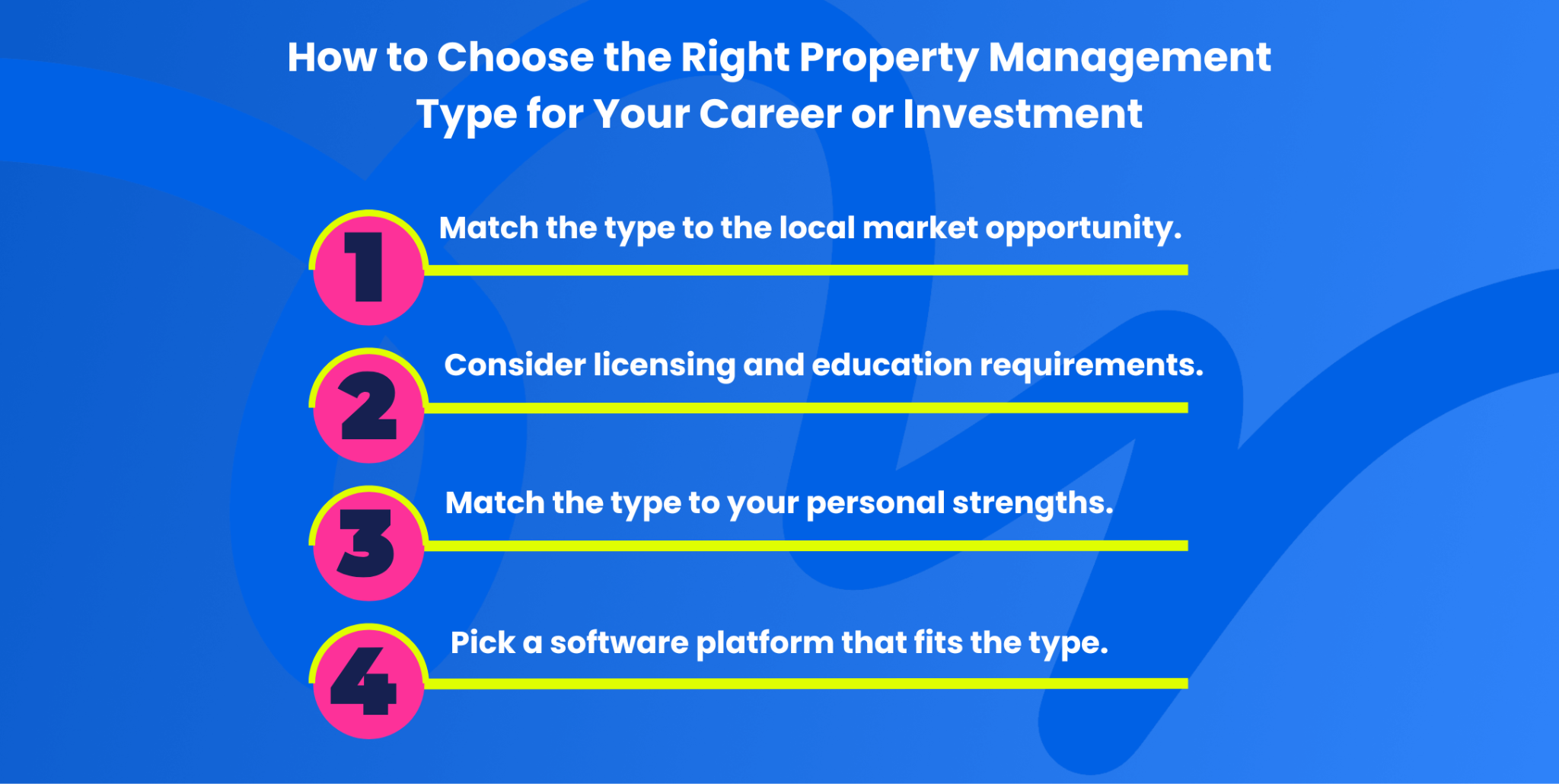
How to Choose the Right Property Management Type for Your Career or Investment
To choose the right property management type for your career or investment, analyze your professional strengths and local market opportunities. The skills, regulations, and digital tools are not necessarily interchangeable between residential, commercial, industrial, or special-purpose sectors. Investors should match their asset choice to their specific risk tolerance and management capacity.
- Match the management type to the local market opportunity. Scanning the local region for unmet demand reveals the profitable sectors for new investment. Dense urban areas favor multifamily property management while regional hubs support industrial growth. Market research helps identify which asset classes are experiencing high occupancy and rental growth.
- Consider licensing and education requirements. Residential licensing varies by state and requires specific real estate courses. Commercial roles frequently demand a real estate broker license for handling complex business transactions. Special-purpose assets require additional credentials in hospitality or community association management to operate legally.
- Match the type to your personal strengths. Residential management requires high-volume interpersonal work and a focus on community building. Commercial management appeals to those who can manage complex lease structures. Industrial and special-purpose sectors suit professionals with an interest in those specific areas (for example: logistics for warehouse operations, or hospitality for hotel operations).
- Pick a software platform that fits the type. Scaling a property management business usually requires the use of professional property management software. Different software platforms offer unique features to cater to different types of property management. Software for multifamily property management manage many things (such as rent collection, lease management, apartment listing services, owner distributions, and accounting considerations). Commercial property management software can handle things like common area maintenance, reconciliations, and tenant improvement tracking.
How Property Management Software Fits Each Type of Property Management
Software platforms will fit different types of property management according to the software features and functionality. See below for how each type of property management software address the unique needs of each sector of property management.
Software for Residential and Multifamily Property Management
Software for residential and multifamily property management prioritizes high-volume leasing and resident communication to maintain occupancy. Internet listing service publishing and online applications speed up the tenant acquisition process. Electronic leases and automated rent collection reduce the paperwork burden for the office staff. Resident portals provide a convenient way for tenants to submit work orders and view their payment history. Automated notifications keep residents informed about property updates and maintenance schedules. Successful residential oversight relies on the features provided by multifamily property management.
Software for Commercial Property Management
Software for Commercial Property Management focuses on the complex financial requirements of business-tenant relationships. Key features include lease abstracting and automated common area maintenance reconciliations. Percentage rent calculations allow managers to track and bill tenants based on their annual gross sales performance. Tracking tenant improvement allowances ensures that construction projects stay within the approved budget. Financial reporting modules provide compliance with ASC 842 standards for lease accounting. Tools help commercial managers handle long-term contracts with high precision and transparency.
Software for HOA and Community Association Management
Software for HOA and Community Association Management manages the unique financial and governance needs of homeowner communities. Dues collection and board-member portals support transparent communication within the organization. Violation tracking tools allow managers to document and resolve covenant infractions efficiently. Digital voting features encourage resident participation in important community decisions and board elections. Reserve study modules help the association plan for long-term capital improvements to shared infrastructure. Digital tools support the professional administration of common areas and community assets.
Software for Vacation and Short-Term Rentals
Software for Vacation and Short-Term Rentals focuses on rapid turnover and multi-channel booking management. Channel managers synchronize calendars across booking sites to prevent double bookings. Dynamic pricing tools adjust rates automatically based on local demand and seasonal events. Cleaning workflow modules coordinate staff for the intensive turnover requirements of the sector. Automated guest messaging ensures that visitors receive timely check-in instructions and support throughout their stay. The features allow managers to handle high-frequency transactions with minimal manual effort.
Frequently Asked Questions
What are the 4 main types of property management?
The four main categories of professional oversight in the real estate industry include residential, commercial, industrial, and special-purpose management. Residential management covers housing units like apartments and single-family homes. Commercial management handles office buildings and retail centers for business tenants. Industrial management focuses on large facilities such as warehouses and manufacturing plants. Special-purpose management involves niche assets like hotels or schools that do not fit the standard categories. Every sector follows its own set of legal regulations and operational best practices to ensure asset protection and financial growth for property owners. Proper classification ensures that lease terms and tenant screening processes align with the intended use of the property. Professional expertise in these diverse fields helps maintain the value of real estate portfolios over long periods.
What is the difference between residential and commercial property management?
Residential management oversees housing for individuals and families, while commercial management handles spaces for business operations. Residential leases last twelve months and require compliance with Fair Housing and state landlord-tenant laws. Commercial leases extend for five to fifteen years and include complex structures like triple-net charges and percentage rent. Occupants in residential units prioritize home comfort and neighborhood amenities. Commercial tenants focus on business visibility, physical foot traffic, and long-term lease predictability. Residential managers handle high-volume personal interactions, while commercial managers focus on financial detail and lease abstracting for owners. Commercial assets involve higher regulatory complexity regarding safety and environmental standards. Residential assets require a focus on quick turnover and consistent rent collection from individuals.
What are the 5 P's of property management?
The 5 P's framework includes People, Property, Pricing, Promotion, and Process to organize the daily responsibilities of the role. People represent the human relationships between residents, owners, and vendors. Property focuses on the physical stewardship and maintenance of the real estate asset. Pricing involves setting market-rate rents and managing renewal offers to maximize revenue. Promotion covers the marketing and visibility efforts needed to attract qualified prospects. The process includes the standard operating procedures and digital workflows that keep the office running efficiently every day. The 5 P's pillars provide a thorough structure for managing any real estate portfolio successfully. Managers use the framework to balance the financial goals of the owner with the daily needs of the tenants. Every pillar must remain strong to ensure the long-term success and profitability of the property investment.
What type of property management is most profitable?
There is no universal answer because profitability depends on local market conditions and the scale of the operation. Commercial management generates higher fees per individual asset but involves fewer total transactions. Multifamily management benefits from massive scale and recurring lease-up opportunities in dense urban centers. Vacation rentals carry the highest per-unit revenue potential but require intensive daily management and frequent turnovers. Industrial properties feature long-term stable income with minimal maintenance responsibilities for the owner. Choosing the most profitable sector requires an analysis of current market demand and the specific expertise of the management team. Investors diversify their portfolios across different property types to balance risk and income potential. Local zoning and economic trends play a primary role in determining which asset classes offer the best returns. Management fees reflect the complexity and time required to operate each specific property category effectively.
Frequently Asked Questions