





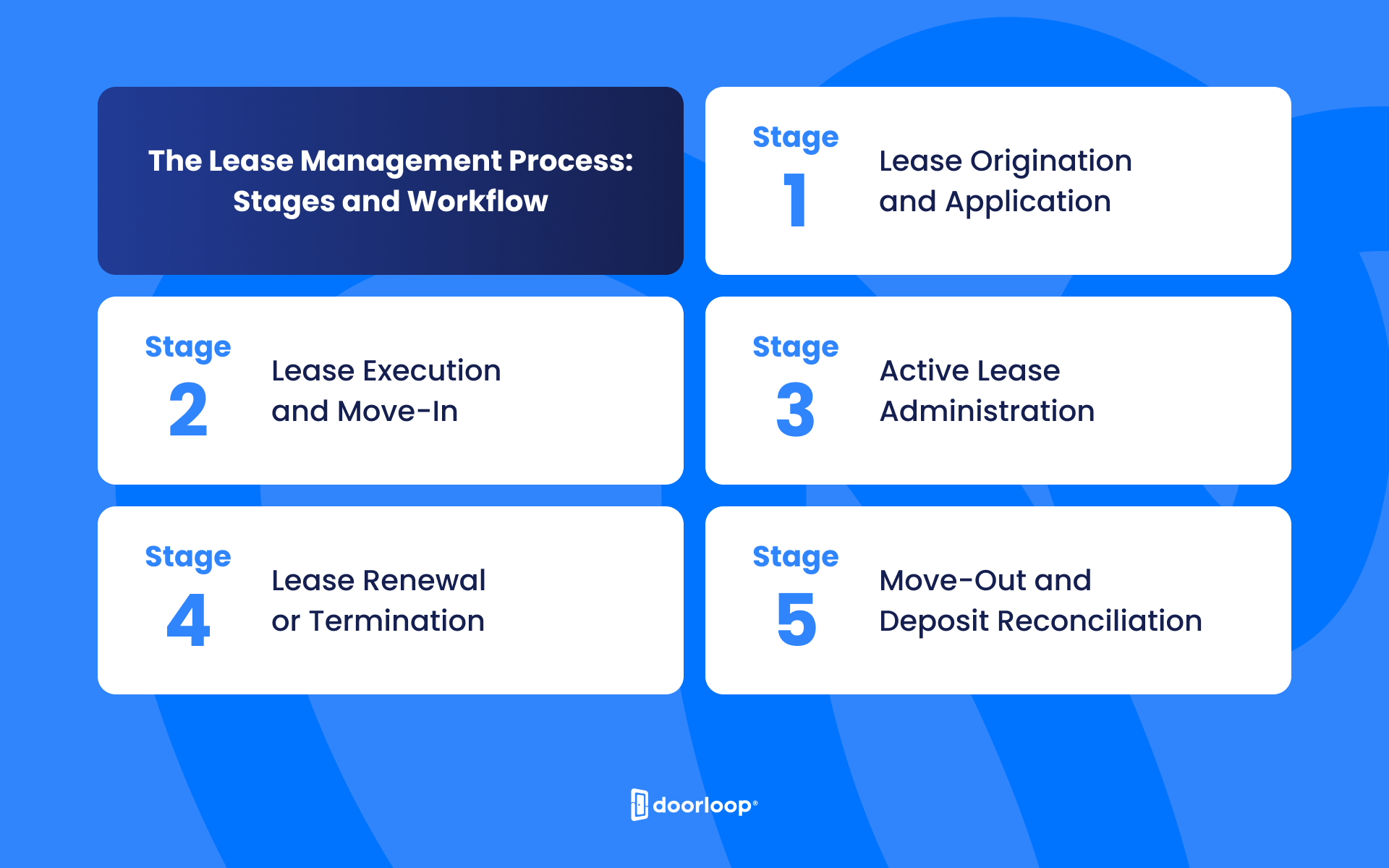
Lease management is the end-to-end process of administering rental contracts from the initial signing through the final termination. The lifecycle involves the specific stages of Lease Origination and Application, Lease Execution and Move In, Active Lease Administration, Lease Renewal or Termination, and Move Out and Deposit Reconciliation. Property managers and leasing teams use the workflows to maintain high occupancy and legal compliance. Typical residential terms last twelve months and require a fixed series of administrative tasks to ensure consistency. Accurate record keeping protects the owner from legal disputes and financial losses. The professional approach applies to landlords managing single units or large institutional portfolios.
The Lease Management Process: Stages and Workflow
Lease management runs through five stages from the initial prospect inquiry to the final resident move-out.
Stage 1: Lease Origination and Application
Lease origination and application begins with with the collection of personal information from the prospective tenant. Tenant screening reports provide data on credit history, criminal records, and previous evictions, and other information. Approval or denial letters are then sent out based upon the outcome of the tenant screening process.
Stage 2: Lease Execution and Move-In
Drafting the final contract involves including specific clauses for rent amounts and security deposit requirements. Digital e-signature workflows allow prospects to finalize the agreement remotely from digital devices. Move-in inspections document the physical state of the unit before the key handover occurs. Clear communication during the phase sets the expectations for the upcoming residency.
Stage 3: Active Lease Administration
Daily operations focus on rent collection and the assessment of late fees for missed payments. Maintenance requests arrive through tenant portals and require prompt assignment to qualified vendors. Monitoring for compliance involves checking for unauthorized activities on the property. Tenant communication during this phase keeps residents informed about building updates or policy changes and helps ensure a positive tenant experience.
Stage 4: Lease Renewal or Termination
Renewal offers arrive sixty to ninety days before the current contract expires. New lease terms can include adjustments to rent prices based on the market conditions, or local rent control laws. If a lease renewal is not desired by owner, a notice to vacate should be sent pursuant to local regulations. Handling holdover situations requires specific legal steps to regain possession of the unit.
Stage 5: Move-Out and Deposit Reconciliation
Final inspections occur once the resident removes all personal belongings from the property. Damage assessments compare the current state to the original move-in report to justify deductions or withholding of security deposit. Security deposit accounting follows strict state deadlines for returning funds to the former resident. Final statements itemize all charges for cleaning or repairs to ensure transparency. Closing out the file properly prepares the unit for the next marketing cycle.
Key Documents in Lease Management
Lease management produces and stores a defined set of documents per tenancy.
- The lease agreement: Contracts include required clauses for parties, terms, rent, and termination procedures. State-specific addenda ensure the agreement meets all local legal standards for residential property management.
- Application and screening report: Applications capture prospect data while screening reports provide credit and criminal history details. Retention policies dictate how long the property office stores the sensitive personal records.
- Move-in and move-out inspection reports: Room-by-room condition reports with photos provide evidence for security deposit deductions. Documents serve as essential protection during legal disputes over unit damages.
- Lease addenda and amendments: Common addenda cover pets, parking, smoking, and lead-based paint disclosures for the property. Amendments modify existing terms while addenda add new rules to the original agreement.
- Renewal and notice to vacate forms: Renewal templates offer new terms while notice forms document the intent to end the residency. State laws specify the timing and format required for formal communications.
- Security deposit accounting and disposition letter: Itemized letters detail all deductions and the final balance returned to the resident. Jurisdictions require the delivery of the document within fourteen to sixty days of move-out.
Types of Lease Management
Lease management practice for residential, commercial, and retail properties differs significantly based on the underlying lease structure. Residential agreements focus on consumer protection laws and short-term occupancy cycles. Commercial properties require calculations for common area maintenance and long-term financial reporting. Retail assets introduce variables like percentage rent based on the gross sales of the business. Portfolio managers adapt administrative workflows to meet the specific legal and financial requirements of each sector. Industrial leases include triple net structures where the tenant assumes responsibility for most operating expenses. Professional teams use specialized strategies to maintain compliance across diverse asset classes. Legal teams monitor local ordinances to update contract language for every individual jurisdiction.
Residential Lease Management
Residential management involves twelve-month standard terms with a heavy focus on fair housing laws. State-specific regulations dictate how owners handle security deposits and eviction procedures for tenants. Rent control markets require additional oversight to ensure all price increases follow local ordinances. Property managers or landlords supervise the daily needs of the household residents. The residential property management requires high levels of customer service to maintain high retention rates.
Commercial Lease Management
Commercial agreements feature longer terms ranging from five to fifteen years with complex structures. Common area maintenance charges and percentage rent clauses require detailed annual reconciliations. Tenant improvement allowances allow businesses to customize the space for their specific operational needs. Lease administrators ensure compliance with financial reporting standards (ASC 842 or IFRS 16). The assets demand specialized knowledge of business law and commercial accounting.
Retail and Multi-Tenant Lease Management
Retail centers use percentage rent based on the gross sales of the tenant's business. Co-tenancy and exclusive use clauses protect the market position of individual stores within the center. Managers reconcile common area expenses across multiple businesses with varying square footage. The type of management requires constant monitoring of the local economic climate and shopping trends. Successful retail assets rely on a diverse mix of stable and high-growth businesses.
Lease Management Best Practices
Strong lease management protects revenue, reduces legal risk, and improves resident retention.
- Centralize all lease documents in one system: Digital storage prevents the loss of amendments or addenda during staff transitions. A single source of truth ensures that every team member accesses the most current version.
- Automate rent collection and late fee assessment: Online payment portals increase the speed and accuracy of the monthly income stream. Automated fees apply consistently to every late payment according to the lease terms.
- Set automated renewal reminders 60 to 90 days out: Early outreach provides enough time to negotiate new terms or market a vacancy. Automated sequences ensure that no lease rolls into a month-to-month status by accident.
- Track lease compliance milestones: Insurance certificates and pet registrations require regular monitoring for expiration dates. Date-driven tracking prevents uninsured exposure or the presence of unauthorized animals.
- Document every interaction in the tenant ledger: Communication logs and maintenance records provide an audit trail for legal disputes. Detailed history supports the owner during eviction filings or resident disagreements.
- Stay current on state and local landlord-tenant law: Legal requirements for notices and deposit returns change frequently across different jurisdictions. Consulting with legal counsel ensures all forms and procedures remain valid.
- Use software to reduce manual workflow load: Digital tools replace repetitive tasks like rent reminders and document generation for better efficiency. Automating these steps saves several hours of administrative work every month.
How Property Management Software Helps With Lease Management
Lease management spans the full lifecycle from drafting and signing to renewals and move-outs, and using fragmented systems throughout that lifecycle (like file folders for PDFs, spreadsheets for date tracking) can lead to human error. Property management software consolidates these functions into one software platform for better operational control. Operators can use the property management software to store executed documents and track renewal/expiration dates. Custom lease templates can reduce human error by pulling data directly from a resident database. Integrated eSignatures accelerate contract execution by allowing residents to sign from any device. Centralized document storage ensures that all addenda and certificates remain accessible in one location. Automated workflows trigger rent reminders and move-in tasks without manual intervention. Additionally move-out tracking can help initiate the final inspection and security deposit reconciliation.
Custom Lease Templates With Auto-Filled Tenant and Property Data
Operators upload specific agreements and templatize them to include dynamic data fields. The software can pull names, addresses, and rent amounts directly from the database to populate the contract. Auto-fill technology removes the risk of typing errors during the drafting process, and remove cognitive load from the property management teams. Managing multiple property types becomes easier with different templates for every jurisdiction. This feature significantly reduces the time needed to prepare a new lease agreement.
eSignature for Lease Execution
Electronic signature (eSignature) allows residents to finalize their contracts from a smartphone or digital device in any location. Executed PDFs return to the system automatically and reside in the permanent resident record. The digital flow eliminates the need for printing, scanning, or mailing physical documents. Prospects sign faster when the process is convenient and accessible from any location. Speeding up the execution phase reduces the risk of a prospect choosing a different property.
Centralized Lease Document Storage and Retrieval
Every signed addendum and insurance certificate lives inside a secure digital file for easy access. Managers find documents in seconds without searching through physical cabinets or email inboxes. Encryption protects sensitive tenant data while ensuring the property meets all privacy regulations. Storing ID copies and pet agreements in one place simplifies the audit process. Organized records provide the necessary evidence for any future legal or financial reviews.
Lease Tracking Dashboard for Key Dates and Status
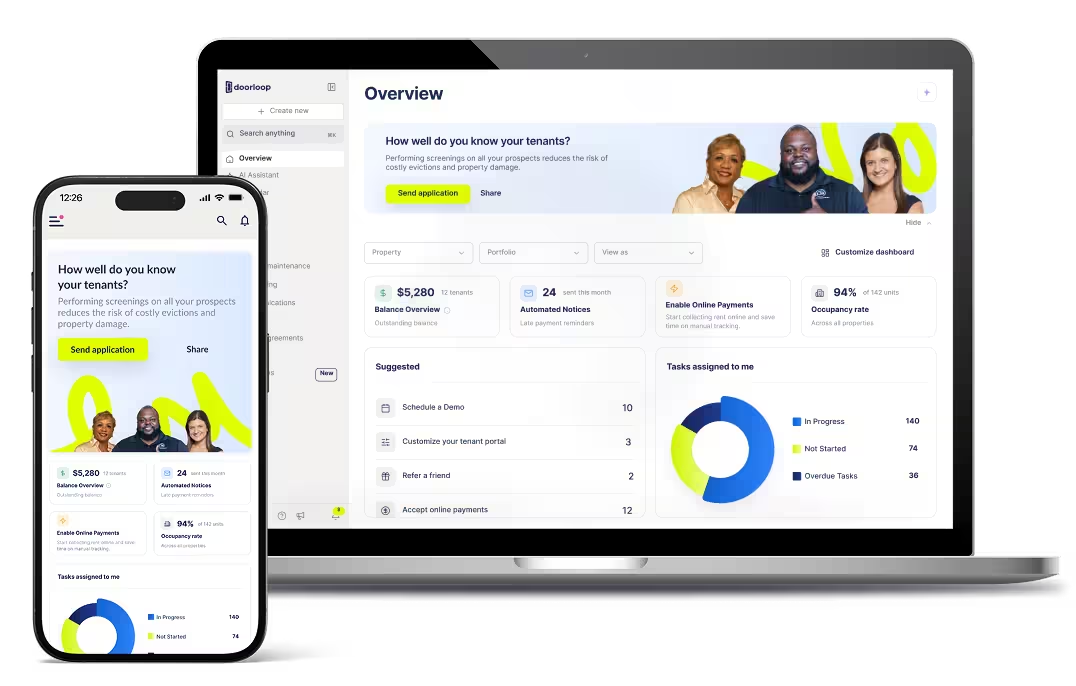
Central hubs display move-in dates and expiring insurance certificates for the entire portfolio. Dashboard views replace manual spreadsheets that are prone to errors and outdated information. Operators monitor leases ending in the next sixty days to prepare for upcoming vacancies. Tasks tied to specific lease milestones appear in a prioritized list for the staff. Visibility into the pipeline helps management forecast revenue and occupancy with more accuracy.
Upcoming Renewals and the Lease Renewal Wizard
Upcoming renewal views list every contract set to expire within a customized timeframe. Wizards guide the user through adjusting rent prices and sending the new terms for signature. Retention increases when residents receive a professional renewal offer months before their current term ends. Automated flows ensure that the office touches every expiring contract without fail. Managing hundreds of renewals becomes a simple administrative task instead of a manual burden.
Automated Workflows for Lease Reminders and Move-In Tasks
Workflows trigger rent reminders and move-in checklists based on specific dates in the system. Rules fire automatically so that no resident misses a welcome packet or a late fee notice. Automation turns institutional knowledge into a system that runs without constant manual supervision. AI assistants supplement these flows by answering tenant questions about lease terms around the clock. Consistency in these communications builds a professional reputation for the management team.
Move-Out, Termination, and Eviction Tracking
Property management software tracks the close-out side of the lifecycle, including scheduled departures and legal filings. AI-powered inspections generate detailed reports to prevent disputes over security deposit deductions. Eviction tracking monitors notice deadlines and court dates to ensure the process follows local laws. Clear documentation of all communications protects the owner if a resident challenges a charge. Systems organize the transition from one tenancy to the next for better unit turnover.
Frequently Asked Questions
What is the difference between lease management and lease administration?
Lease management covers the broad operational lifecycle of the tenancy, while lease administration focuses on the documentation and data associated with leases. Management includes physical property maintenance and daily resident interactions throughout the entire term. Administration involves the creation of reports and the tracking of financial milestones for the owner. Large organizations separate these roles to ensure specialized focus on both tenant relations and data accuracy. Lease management and lease administration functions are essential for the health of a property portfolio and overlap within the same digital system.
What does a leasing manager do?
A leasing manager oversees the origination side of the lease lifecycle, including marketing, prospecting, and application processing. The role focuses on attracting new residents and ensuring that units remain occupied at market rates. Staff members in the position conduct property tours and supervise the initial screening of all applicants. Leasing managers differ from property managers because they focus on the sales and execution phase of the contract. Success in the role requires a deep understanding of local market trends and customer service. Professionals ensure the community maintains a positive reputation among potential renters through consistent outreach.
Frequently Asked Questions