





Property management is defined as the daily oversight, operation, and maintenance of real estate assets on behalf of owners. Landlords, real estate investors, and community associations rely on property management professionals to handle the complex responsibilities of managing properties, which include tenant screening, rent collection, lease management, property maintenance. Residential, commercial, and industrial sectors each require specialized management strategies to be successful. The benefits of property management included time savings and reduced stress, improved tenant screening, improved tenant retention, Modern managers use digital tools to manage their portfolios and financial records. Purpose-built technology handles the specific needs of property management.
What Does a Property Manager Do?
Property managers act as the primary operational contact for a real estate investment. Owners delegate daily tasks to these professionals to maintain the property value. Managers answer directly to the owner or the investment group. The role serves as the functional execution of property oversight and administration. Professional software helps managers coordinate tasks across large portfolios. Managers find success in the role through a balance of administrative and interpersonal skills. The operational answer to these needs is finding what a property manager does.
Tenant Screening
Tenant screening involves background checks, credit reviews, and income verification of prospective tenants. High-quality screening reduces the risk of future evictions or damage to the building.
Rent collection
Rent collection involves processing rent payments each month, handling late payment procedures (such as sending notices, and collecting late fees).
Property maintenance
Property maintenance is a core responsibility of property managers, and it includes routine maintenance, tenant maintenance requests, emergency repairs, and building inspections. Property managers will track each maintenance work item, and delegate to specialists/vendors as necessary to ensure completion of the task. Consistent maintenance prevents small issues from becoming larger, more expensive problems in the future.
Lease management
Lease management covers the drafting, signing, and storage of legal rental agreements (leases). Managers will negotiate renewal terms with residents to maintain high occupancy levels. Owner approval remains part of the final decision for lease modifications.
Legal compliance
Managers follow fair housing laws and local rental regulations to avoid legal penalties. Dispute resolution includes handling neighbor complaints and initiating the eviction process when necessary. Compliance with safety codes ensures the building remains habitable for all residents.
Accounting
Accounting tasks for property managers include tracking all income and expenses for the property, handling security deposit accounting for according to local laws, owner distributions, monthly financial reporting, and more. Trust accounting ensures that tenant deposits and owner funds remain separate and secure. Accounting for property management is a complex and involved undertaking, for more information see our full article: Property management accounting.
For more information on the responsibilities of property managers, see our full article: What does a property manager do?
What Are the Types of Property Management?
Property management categories include residential, commercial, industrial, and special-purpose assets. The discipline splits by property type because each one has different tenant relationships and lease structures. Regulatory requirements vary between housing units and retail spaces. Managers choose a type of property management specialty based on their expertise and the needs of the local real estate market.
Residential Property Management
Residential property management involves the oversight of living spaces such as single-family rentals, multifamily apartments, and townhouses. Small landlords and multifamily owners hire managers to handle the high volume of tenant interactions. Typical lease lengths for these properties range from six months to one year. Managers focus on maintaining high occupancy and responding to maintenance requests from families. Vacation rentals and condos fall under this residential category. Successful residential oversight requires a deep understanding of fair housing laws. Real estate investors use these services to manage their properties.
Commercial Property Management
Commercial property management involves the oversight of office buildings, retail spaces, and medical offices. Commercial properties feature longer leases and triple-net lease structures that shift costs to the tenant. Managers handle more complex regulatory requirements and higher maintenance demands for public spaces. Owners of shopping centers and mixed-use developments rely on professional management to ensure profitability. Commercial oversight requires a focus on business tenant retention and lease compliance. Property managers coordinate the specific needs of diverse business occupants.
Industrial Property Management
Industrial property management covers warehouses, manufacturing plants, and distribution centers. Industrial facilities focus on logistics and manufacturing needs rather than individual residential tenants. Managers oversee operational and safety compliance demands that make this category distinct. High ceilings and specialized electrical needs require specific maintenance knowledge for these buildings. Owners of logistics facilities and industrial parks hire specialized managers to handle their assets. Industrial oversight ensures the safety and functionality of large-scale production spaces.
Special-Purpose Property Management
Special-purpose property management involves the oversight of unique real estate assets such as hotels, student housing, and senior living facilities. The category includes theaters, sports venues, and community associations that require specialized operational knowledge. Homeowners association management serves as a subcategory focused on board governance and common area maintenance. Managers in the field handle dues collection and the enforcement of community rules for residents. The management of the assets depends on the specific use case and the regulatory environment. Successful oversight requires a deep understanding of the unique tenant needs for each facility. Professional managers use these specialized skills to manage Types of Property Management.
For more information see our full article: Types of Property Management.
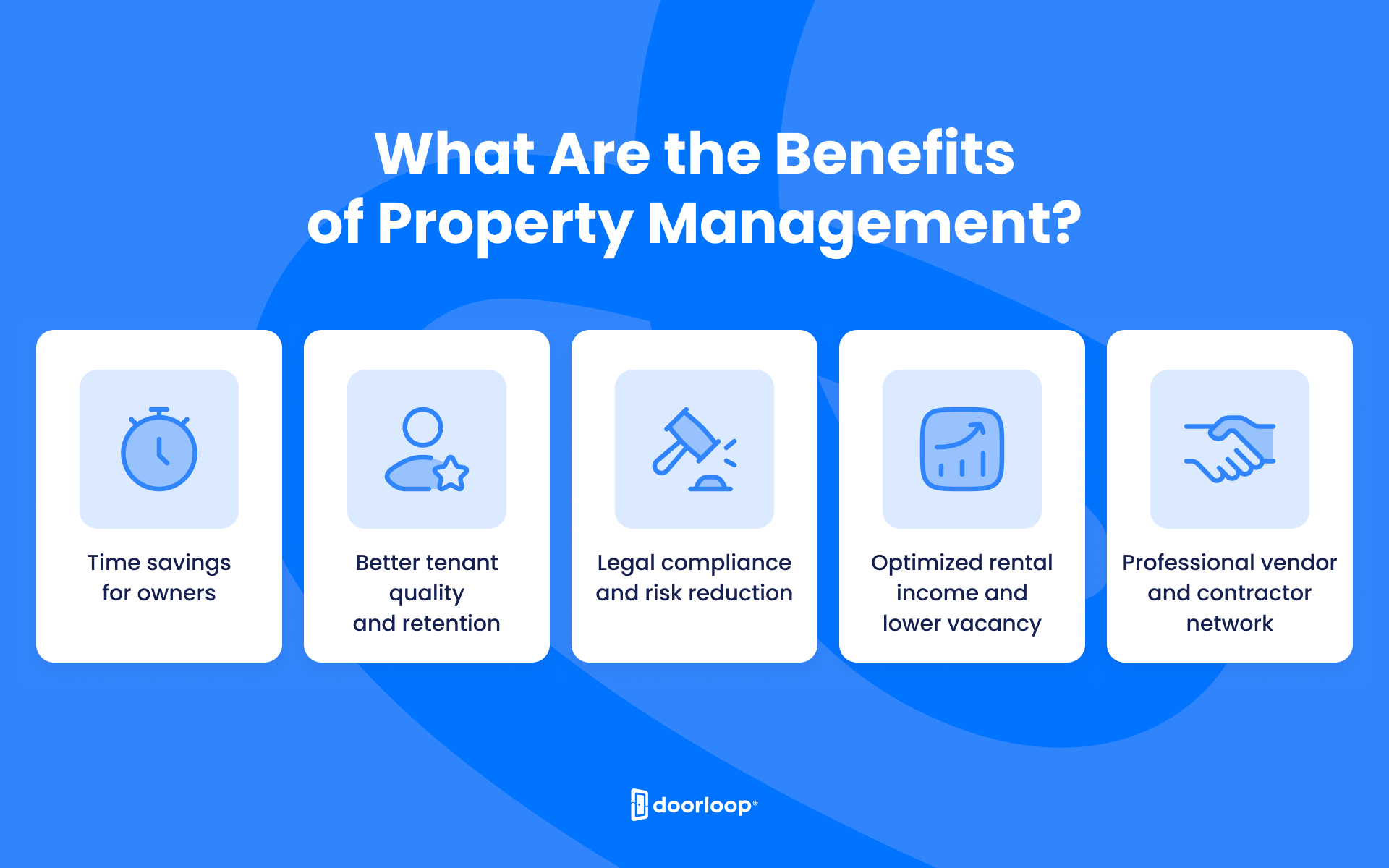
What Are the Benefits of Property Management?
Property management provides benefits to owners who manage multiple properties or out-of-state holdings. Professional services improve the efficiency and profitability of the real estate investment.
- Time savings for owners: Professional management removes the burden of tenant calls and maintenance dispatch from the investor. Owners spend less time chasing rent and coordinating vendors for their buildings.
- Better tenant quality and retention: Systematic screening procedures identify reliable renters with stable income and clean histories. Professional communication and quick repairs encourage tenants to renew their leases.
- Legal compliance and risk reduction: Managers stay updated on local rental regulations and fair housing laws to protect the owner. Compliance with safety codes reduces the risk of legal liability and government fines.
- Optimized rental income and lower vacancy: Market rate analysis ensures the property achieves the highest possible income. Marketing strategies attract prospects quickly to reduce the cost of vacant units.
- Professional vendor and contractor network: Management firms maintain relationships with preferred vendors to secure better pricing and faster service. Access to reliable contractors protects the physical condition of the property for the long term.
Owners hire managers to achieve the advantages and ensure their real estate portfolio remains successful. Investors find that professional oversight pays for itself through improved efficiency and higher income.
What Are the Challenges of Property Management?
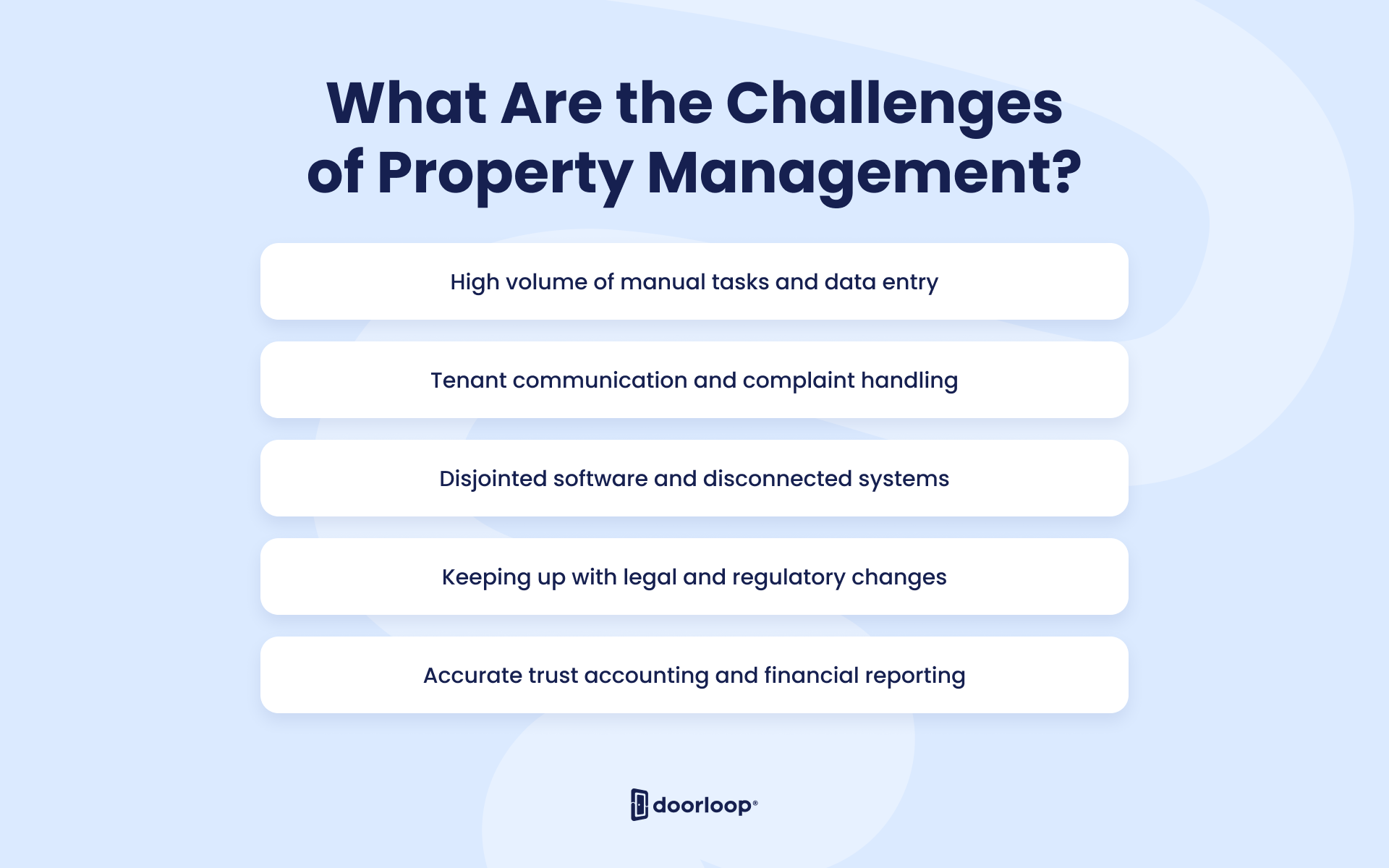
The challenges of property management include operational and financial hurdles that managers face daily. These include:
- High volume of manual tasks and data entry: Repetitive tasks like rent reminders and lease tracking consume a manager's day. Manual work increases the risk of human error in financial records and tenant communications.
- Disjointed software and disconnected systems: Using separate tools for accounting and maintenance creates data entry duplication and errors. Conflicting records between different programs make accurate reporting difficult for owners.
- Tenant communication and complaint handling: Managers carry a high emotional load from being the point of contact for tenant issues. Delays in responding to complaints damage relationships and reduce tenant retention.
- Keeping up with legal and regulatory changes: Local and federal rental laws change frequently across multiple jurisdictions. Staying current on the changes is difficult for a single manager or a small team.
- Accurate trust accounting and financial reporting: Accounting for rental properties is more complex than standard business bookkeeping. Mistakes in trust accounts or security deposits lead to legal and financial consequences.
Purpose-built software addresses most of the challenges through automation and integrated data. Managers use technology to overcome these hurdles and stay organized.
What is Property Management Software?
Property management software is a purpose-built tools to manage the daily operations of rental real estate. The tools differ from generic accounting programs because they include integrated workflows for leasing and maintenance. Purpose-built software offers trust-accounting compliance to protect the funds of the property owner. Tenant-facing portals allow residents to pay rent and submit work orders from any digital device. Managers use automation to handle recurring tasks like rent reminders and late fee assessments. Centralized databases ensure all property information remains accurate and accessible in a single location.
For more information see our full article on: What is Property Management Software.
Which Property Management Software Is Best for Me?
The best property management software for you depends on the specific property type and the size of the portfolio managed. Budget and feature count are secondary to the operational needs of the building. Residential, commercial, and short-term rentals each require different digital tools. Managers evaluate their specific goals to choose the most effective property management software.
Best Software for Residential Property Management: DoorLoop
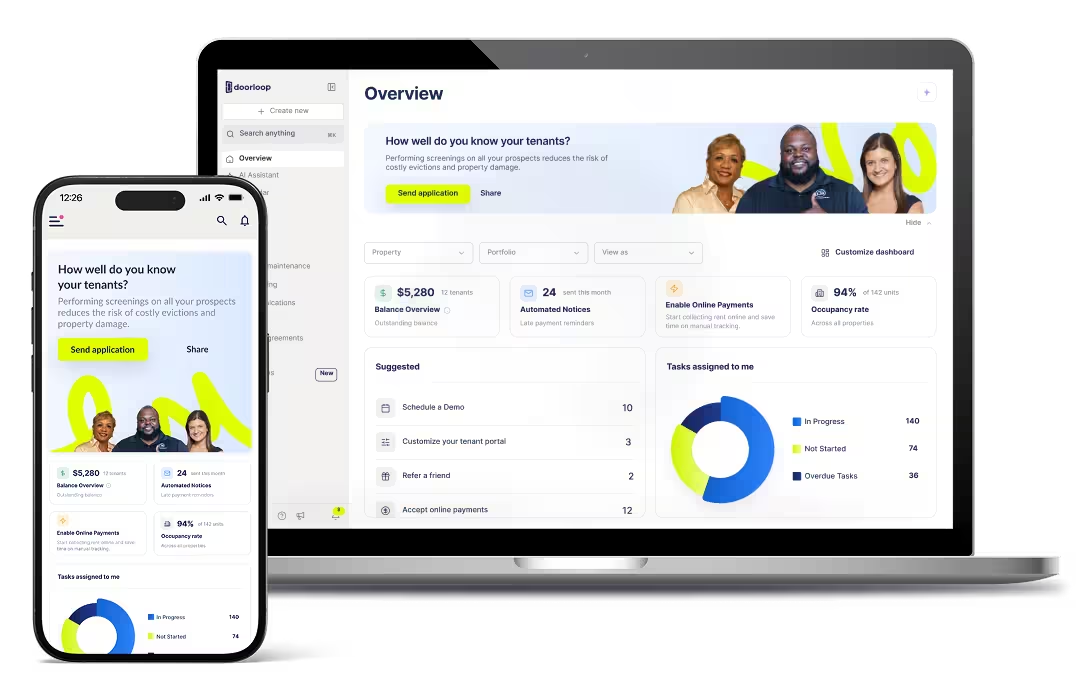
DoorLoop is the best choice for residential property management up to 3,000+ units. Core capabilities of the software include accounting management (including bookkeeping and financial reporting, and more), lease management (including rental listings, tenant screening, and more), maintenance tracking, and custom portals for landlords, tenants, and property owners. An all-in-one software reduces the frustration caused by using multiple different fragmented tools. Additionally, DoorLoop's dedicated migration teams will eliminate the pain of switching property management platforms.
Best Software for Commercial Property Management: DoorLoop
DoorLoop fits owners and managers of mixed-use buildings, retail spaces, and office portfolios. Capabilities for commercial users include portfolio-level dashboards and CAM-relevant accounting. Custom fields allow for the tracking of specific commercial lease terms and vendor contracts. Portfolio-level grouping provides precise tracking for investors with diverse assets. Unlimited team members with role-based permissions allow for secure collaboration.
Best Software for Short-Term Rental Management: Guesty
Guesty fits solo Airbnb hosts and enterprise STR operators managing hundreds of listings. Channel management across Airbnb and Vrbo prevents double bookings on the calendar. Automated guest messaging workflows handle communication throughout the booking journey. The three-tier scaling model allows users to grow without migrating websites. Short-term rental managers find the software necessary for OTA distribution. Guest messaging workflows provide a unified inbox for all inquiries. Guesty manages over 500,000 listings globally for vacation rental professionals.
Best Software for Hotel Management: Cloudbeds and Oracle OPERA Cloud
Cloudbeds fits independent hotels, boutique properties, and hostels with an all-in-one software. The software offers a native channel manager and booking engine for independent properties. Oracle OPERA Cloud serves enterprise hotel chains like Marriott and Hilton. Global standardization and deep loyalty modules support multi-property and multi-brand management. Hotels need front-desk and housekeeping workflows that residential software does not include. Cloudbeds operates in over 150 countries with over 1,000 integrations. Large hotel groups rely on OPERA Cloud for enterprise-grade scalability.
Hiring a Property Management Company vs. Using Software
Hiring a property management company involves a third party doing the work, while software could allow an owner to do it efficiently themselves. The choice depends on the level of control and time an owner wants to invest.
<table><tbody><tr><td>Decision factor</td><td>Hiring a property management company</td><td>Using property management software</td></tr><tr><td>Cost structure</td><td>8% to 12% of monthly rent</td><td>Flat monthly subscription</td></tr><tr><td>Control over operations</td><td>Delegated to a third party</td><td>Retained by owner or team</td></tr><tr><td>Time investment</td><td>Low for the owner</td><td>Moderate for owner or team</td></tr><tr><td>Best fit</td><td>Passive owners, out-of-state landlords</td><td>Active owners, growing teams</td></tr><tr><td>Scalability</td><td>Limited by manager capacity</td><td>Scales with software and staff</td></tr></tbody></table>
The comparison table shows the differences in cost and control for each management path. Hiring a company suits passive owners, while software suits operators wanting to scale their own team.
What is a Property Management Agreement?
A property management agreement serves as a legally binding contract between an owner and a management firm. The document defines the specific responsibilities and the fee structure for the partnership. It includes details on the duration of the contract and the conditions for termination. Legal protection for both parties comes from transparently defining the scope of authority. Provisions for insurance, liability, and financial reporting appear in the written terms. Every agreement outlines how the manager handles funds and maintenance expenditures. Professional relationships stay stable when both parties understand their contractual obligations.
How to Become a Property Manager
Becoming a property manager requires a combination of education, experience, and local licensing. States require candidates to complete a specific real estate course before taking a state exam. Professional certification from organizations (like NARPM, the National Association of Residential Property Managers) adds credibility to a resume. Licensing requirements vary significantly depending on the local jurisdiction and property type. Candidates gain experience by working as leasing agents or assistant managers in residential buildings. High standards of ethics and professional conduct remain mandatory for all licensed individuals.
What Skills are Required to be a Property Manager?
The skills required to be a property manager are listed below.
- Communication skills: Managers talk to tenants and owners to resolve issues transparently.
- Accounting skills: Tracking income and expenses ensures the property stays profitable over time.
- Legal knowledge: Understanding housing laws prevents expensive lawsuits and government fines.
- Maintenance oversight: Coordinating repairs keeps the physical building in good condition for residents.
- Marketing ability: Listing vacancies attracts qualified leads to the property through digital channels.
- Conflict resolution: Mediating disputes between neighbors maintains a peaceful community atmosphere.
- Organization: Managing multiple tasks and deadlines requires strict attention to detail in the office.
- Negotiation: Negotiating with vendors secures better pricing for the property owner.
- Decision making: Professionals make choices about tenant applications and repair priorities daily.
Success in the field depends on the development of these core property manager skills.
Property Management vs. Landlord - What's the Difference?
Property management and landlords are different because one represents the owner and the other holds the legal title. A landlord owns the property and receives the profit generated from the real estate investment. Property management involves a firm hired to handle the daily operations and tenant interactions. Landlords decide the investment goals while managers execute the strategy on the ground. Hiring a manager allows an owner to remain a passive investor in the rental market. Property managers receive a management fee while the landlord keeps the net operating income. Property management and landlords' roles aim to maintain the value and profitability of the building over time.
Property Management vs. Real Estate Agent - What's the Difference?
Property management and real estate agents perform different roles within the housing market. Real estate agents focus on the buying and selling of properties for clients. Property management involves the ongoing oversight and maintenance of a rental building after the sale. Agents earn commissions on transactions while managers receive fees for their daily operational services. Licensing for agents emphasizes sales techniques and property valuation for the market. Management licensing concentrates on landlord-tenant laws and the physical administration of buildings. Property management and real estate agents work to maximize the value of the investment for the property owner.
Property Management vs. Asset Management - What's the Difference?
Property management focuses on the daily operations, while asset management focuses on long-term investment performance. Asset managers look at the entire real estate portfolio to identify opportunities for capital growth. Property managers handle the specific needs of the building and the individual residents. Asset management involves decisions about when to buy or sell a property based on market trends. Property management ensures the building remains profitable and well-maintained on a daily basis. Property management and asset management are necessary to protect the financial health of a large real estate investment. Coordination between these professionals leads to better overall portfolio returns.
Property Management vs. Facility Management - What's the Difference?
Property management and facility management are different because property management focuses on the tenant and financial health, while facility management focuses on the building systems. Property managers handle leasing, rent collection, and resident relations for an owner. Facility managers concentrate on the operation and maintenance of physical structures (HVAC and electrical systems). Management firms oversee the profitability of the asset for the investor. Facility teams ensure the building remains safe and functional for all occupants. Property management and facility management cooperate to maintain the long-term value of the real estate investment.
Property Management vs. Self Management - What's the Difference?
Property management differs from self-management because one uses a professional third party, and the other involves the owner doing the work. Self-management requires the property owner to handle every tenant call and maintenance request personally. Professional managers provide expertise in housing laws and financial reporting that many owners lack. Hiring a firm reduces the emotional stress of managing residents and handling evictions. Self-managed owners save on management fees but spend more time on daily operations. Managers use professional tools and vendor networks to handle tasks more efficiently than individual owners.
Property Management vs. Property Maintenance - What's the Difference?
Property management involves the administration of a building, while property maintenance involves the physical upkeep of the structure. Management includes financial tasks, leasing, and tenant relations as part of its scope. Maintenance focuses on repairs, cleaning, and the inspection of physical building systems. Property managers hire and supervise the maintenance staff or vendors to do the physical work. Successful management relies on consistent maintenance to protect the value of the investment. Maintenance is a specialized subset of the broader management process for all real estate assets.
Property Management FAQs
The FAQ section provides answers to common questions regarding the management of rental real estate assets.
How much do property managers charge?
Property managers charge a percentage of monthly rent, flat monthly fees, or leasing fees. Typical ranges for residential management fall between 8% and 12% of the gross monthly rent. Setup fees for a new property range from [$100 to $300] per unit. Maintenance markups and administrative fees appear on management contracts. Owners ask about vacancy fees or early termination penalties before signing an agreement. Management costs reflect the scope of work and the size of the portfolio.
How much does a property manager make in salary?
According to the U.S. Bureau of Labor Statistics, the property and community association manager profession group earns a median annual income of roughly $66,700 (2024 data). The top 10% of property managers are reported to earn more than $141,040.
Does a property manager pay property taxes for the properties they manage?
No, a property manager does not pay property taxes using their own funds. The property owner remains legally responsible for all tax obligations related to the real estate asset. Property managers use the rental income collected from the property to pay the taxes on behalf of the owner. The process occurs through the operating account or the trust account set up for the building. Managers track these payments in the monthly financial reports provided to the investor. Property owners ensure the manager has the correct tax information and deadlines.
Does a property manager pay the mortgage for the properties they manage?
No, a property manager does not pay the mortgage for the property using their own money. The mortgage remains the legal responsibility of the property owner or the investor. Managers offer a service where they pay the mortgage using the rental income collected from tenants. The task is transparently defined in the property management agreement signed by both parties. Managers record the payments in the financial statements provided to the owner each month. Owners must ensure there are sufficient funds in the account to cover the monthly mortgage payment.
Does a property manager pay for repairs?
No, a property manager does not pay for repairs out of their own pocket. Repairs are funded by the rental income or a reserve fund established by the property owner. Managers coordinate the repair work and pay the vendors using the funds held in the property account. Property management agreements include a maintenance threshold for automatic repairs. Owners must approve any repair that exceeds the preset dollar amount. Providing a reserve fund allows for faster emergency repairs and better building maintenance.
Do property managers use software?
Yes, property managers use property management software such as DoorLoop to manage the daily operations of their rental portfolios. A dedicated property management software platform helps organize rent collection, maintenance tracking, and communication with residents in one place. Managers use automation to reduce the time spent on manual data entry and recurring administrative tasks. Digital portals allow tenants to submit work orders and pay rent from their smartphones. Financial reporting features provide owners with real-time updates on the performance of their investments.
Frequently Asked Questions