







A multifamily property is a residential building or complex containing two or more separate housing units, each with its own kitchen, bathroom, and entrance. The multifamily property spans a wide range of property types, from duplexes and fourplexes to large apartment complexes, making it one of the most accessible entry points in real estate investment. According to the National Multifamily Housing Council (NMHC), approximately 44 million households in the United States rent their homes, reflecting the sustained demand for multifamily housing across income levels and demographics.
Multifamily properties attract a broad audience, including first-time investors exploring house hacking, experienced landlords scaling their portfolios, property managers overseeing large residential communities, and renters seeking housing options. The article below covers the most common multifamily property types (duplex, triplex, fourplex, apartment building, condominium, and townhouse), the residential-vs-commercial classification threshold based on unit count, the A-to-D grading system investors and lenders apply, multifamily investing fundamentals and key financial metrics, and the operational realities of managing multiple units simultaneously, including the software that consolidate rent collection, tenant screening, maintenance coordination, and accounting.
Key Takeaways
- A multifamily property is any residential building containing two or more separate housing units, each self-contained with its own kitchen, bathroom, and entrance.
- The most common named types include the duplex, triplex, fourplex, apartment building, condominium, and townhouse.
- Properties with 2 to 4 units are classified as residential, while properties with 5 or more units cross into commercial real estate classification, affecting financing, zoning, and appraisal methodology.
- Managing multiple units requires centralized systems for rent collection, maintenance coordination, and tenant communication, since each unit generates its own lease obligations, payment cycles, and service requests simultaneously.
What Is a Multifamily Property?
A multifamily property is a building or development that contains two or more separate residential units, with each unit having its own kitchen, bathroom, and private entrance. The term is used interchangeably with "multifamily home," "multifamily housing," "multifamily residential," and "multi-dwelling unit" (MDU), depending on context. In general usage, "multifamily home" leans toward owner-occupant or small-scale settings, while "multifamily property" more frequently appears in investment, commercial, and property management framing.
The distinction matters in practice. A property owner living in one unit of a duplex and renting the other refers to the building as a multifamily home. An investor analyzing a 12-unit apartment building refers to the same category of asset as a multifamily property. Both terms refer to the same underlying concept, which is a single structure or site that houses multiple independent residential units. The defining characteristic is not the building's size or style but the presence of two or more self-contained units. Property managers, lenders, and investors rely on the term to distinguish the asset class from single-family homes, commercial office buildings, and mixed-use developments.
Types of Multifamily Properties
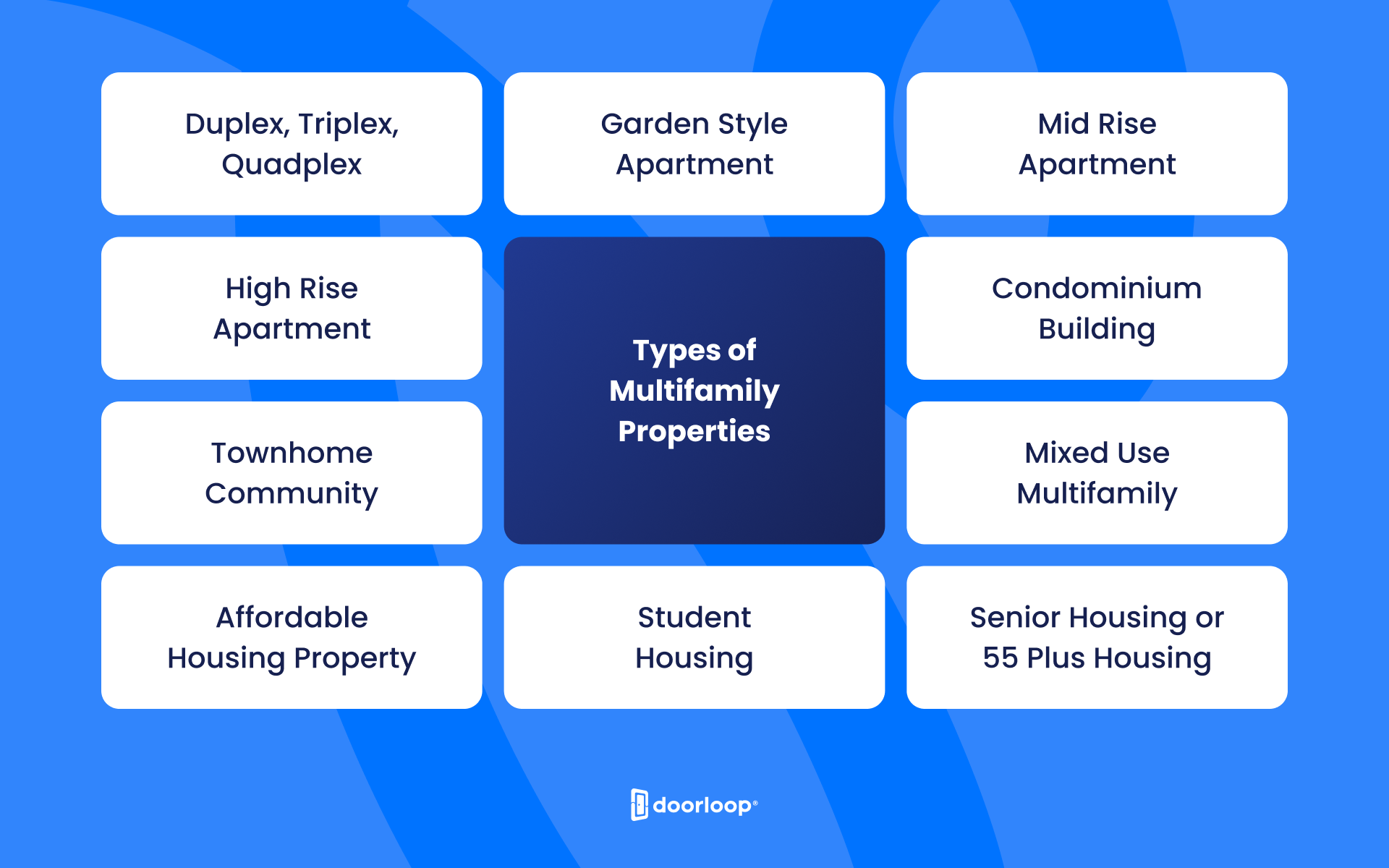
Multifamily properties come in named types distinguished by unit count, building style, and ownership structure. The most common categories are listed below, ranging from small two-unit buildings to large high-rise complexes.
Duplex
A duplex is a single building divided into exactly two separate residential units, each with its own entrance, kitchen, and bathroom. The two units are typically arranged side by side (sharing a vertical wall) or stacked (one unit per floor), with a single parcel of land underneath. The owner holds title to the entire building as one property. The configuration makes duplexes a common starting point for first-time investors, house hackers, and owner-occupants who rent one unit to offset mortgage costs.
Triplex
A triplex contains three separate residential units within a single building, each self-contained with its own entrance and living facilities. Units are arranged either stacked across three floors or side by side in a row, with shared structural walls. The triplex falls under the residential classification because it holds fewer than 5 units, qualifying for conventional residential mortgage financing. Investors drawn to steady rental income without commercial loan complexity frequently target triplexes, particularly in urban neighborhoods where the lot footprint limits larger construction.
Fourplex (Quadplex)
A fourplex, referred to interchangeably as a quadplex, is a single building containing four separate residential units. It is the largest multifamily property type that still qualifies as residential under U.S. financing and zoning conventions, placing it below the 5-unit commercial threshold. Lenders classify fourplexes alongside duplexes and triplexes for loan program purposes, meaning buyers access conventional residential mortgages rather than commercial financing. The four-unit structure offers investors the highest rental income available under residential financing terms, making it a strategic acquisition for small-portfolio landlords targeting cash flow.
Apartment Building and Apartment Complex
An apartment building is a single structure containing five or more residential units, placing it squarely in the commercial real estate classification for financing and zoning purposes. Unit counts vary widely, from compact 5-unit walk-ups to large buildings with 50 to 200 or more units. Common amenities include on-site laundry, parking structures, and a building-level leasing office.
An apartment complex is a distinct configuration, consisting of a group of apartment buildings located on a shared site, operating under unified management and offering shared amenities such as a pool, fitness center, courtyard, and leasing office. Apartment complexes frequently contain hundreds of units spread across multiple buildings on a single parcel. The key distinction between the two is structural, with one building versus multiple buildings on shared grounds.
Condominium
A condominium, commonly called a condo, is an individually owned residential unit within a multi-unit building or complex. Ownership of a condo differs fundamentally from renting an apartment. The unit holder owns the interior of the unit, while a homeowners' association (HOA) manages and maintains shared spaces such as hallways, roofs, lobbies, and exterior grounds. HOA fees fund the upkeep of the common areas. The physical building of a condo and an apartment is structurally identical, while the ownership and governance structure is what separates the two property types.
Townhouse
A townhouse is a multi-story residential unit in a row of similar attached units, sharing one or two party walls with neighboring units. The standard configuration runs 2 to 3 stories, with living areas on the ground floor and bedrooms above. Ownership in U.S. townhouse developments is typically individual, with each buyer holding title to the unit and its lot, though some townhouse communities operate under condominium-style ownership with an HOA managing exterior maintenance. Regional naming differences exist. The term "rowhouse" is more common in the Northeast United States, while "brownstone" specifically refers to a rowhouse clad in brown sandstone, most closely associated with New York City.
Garden Apartment
A garden apartment is a low-density multifamily building, typically 1 to 2 stories, set within a landscaped site featuring shared green space, courtyards, or open grounds between buildings. Units are accessed by ground-level or second-floor exterior walkways rather than shared interior corridors. Garden apartments are most common in suburban settings where land availability supports lower building heights and outdoor amenity space. Compared to mid-rise apartments, garden apartments offer lower density and greater outdoor access per unit, making them a distinct subtype within the broader multifamily category.
Mid-Rise and High-Rise Apartments
Mid-rise apartments are multifamily buildings standing 4 to 12 stories, constructed using a "one-plus-five" or "five-over-one" method, with one floor of concrete podium topped with five floors of wood-frame construction. The configuration is widely used in urban and inner-suburban markets where land costs justify taller structures. High-rise apartments stand 13 or more stories, relying on fully steel or reinforced concrete construction to support structural loads at greater heights. High-rises are concentrated in dense urban cores where land constraints require vertical development. The height threshold (4 to 12 stories versus 13 or more) is the primary distinction separating mid-rise from high-rise classification.
Mixed-Use Property
A mixed-use building is a single structure or development combining residential units with commercial, retail, or office space within the same property. The most common configuration places commercial or retail tenants on the ground floor with residential units on the floors above. The residential portion of a mixed-use building qualifies as multifamily when it contains two or more separate housing units. Mixed-use properties are prevalent in urban transit corridors and downtown districts where zoning encourages pedestrian-scale density. The dual-income structure (commercial rent plus residential rent) gives mixed-use property owners revenue diversification not available in purely residential multifamily assets.
Single-Family vs. Multifamily: What's the Difference?
The primary difference between single-family and multifamily is the number of separate residential units, with one unit versus two or more. The table below compares the two property types across key attributes relevant to ownership, financing, and investment.
<table><tbody><tr><td><b>Attribute</b></td><td><b>Single-Family</b></td><td><b>Multifamily</b></td></tr><tr><td><b>Number of units</b></td><td>1</td><td>2 or more</td></tr><tr><td><b>Typical ownership</b></td><td>One household</td><td>Multiple households</td></tr><tr><td><b>Utility metering</b></td><td>Shared or single meter</td><td>Separate meters per unit</td></tr><tr><td><b>Entrances</b></td><td>One</td><td>Multiple</td></tr><tr><td><b>Financing</b></td><td>Residential mortgage</td><td>Residential (2–4 units) or commercial loan (5+ units)</td></tr><tr><td><b>Typical investor profile</b></td><td>First-time investor</td><td>Experienced investor or house hacker</td></tr><tr><td><b>Vacancy risk</b></td><td>All-or-nothing</td><td>Diversified across units</td></tr><tr><td><b>Maintenance scope</b></td><td>One unit</td><td>Multiple units simultaneously</td></tr></tbody></table>
Is a Multifamily Property Residential or Commercial?
A multifamily property with 2 to 4 units is residential, while a multifamily property with 5 or more units is classified as commercial. The 5-unit threshold is the defining line across U.S. lending, zoning, and appraisal practice. Properties at 2 to 4 units qualify for conventional residential loan programs (FHA, Fannie Mae, Freddie Mac), while properties at 5 or more units require commercial financing with different underwriting standards, loan structures, and qualification criteria.
The classification is driven by financing and zoning conventions, not by building style alone. A 4-unit garden apartment and a 6-unit townhouse row may look similar in construction, but the 6-unit property crosses into commercial classification regardless of its physical appearance. Investors approaching the 5-unit threshold frequently structure acquisitions around the classification boundary to access the most favorable loan terms available. The residential-vs-commercial distinction addresses unit count, while a separate grading system, covered below, addresses property quality.
Multifamily Property Classes: A, B, C, and D
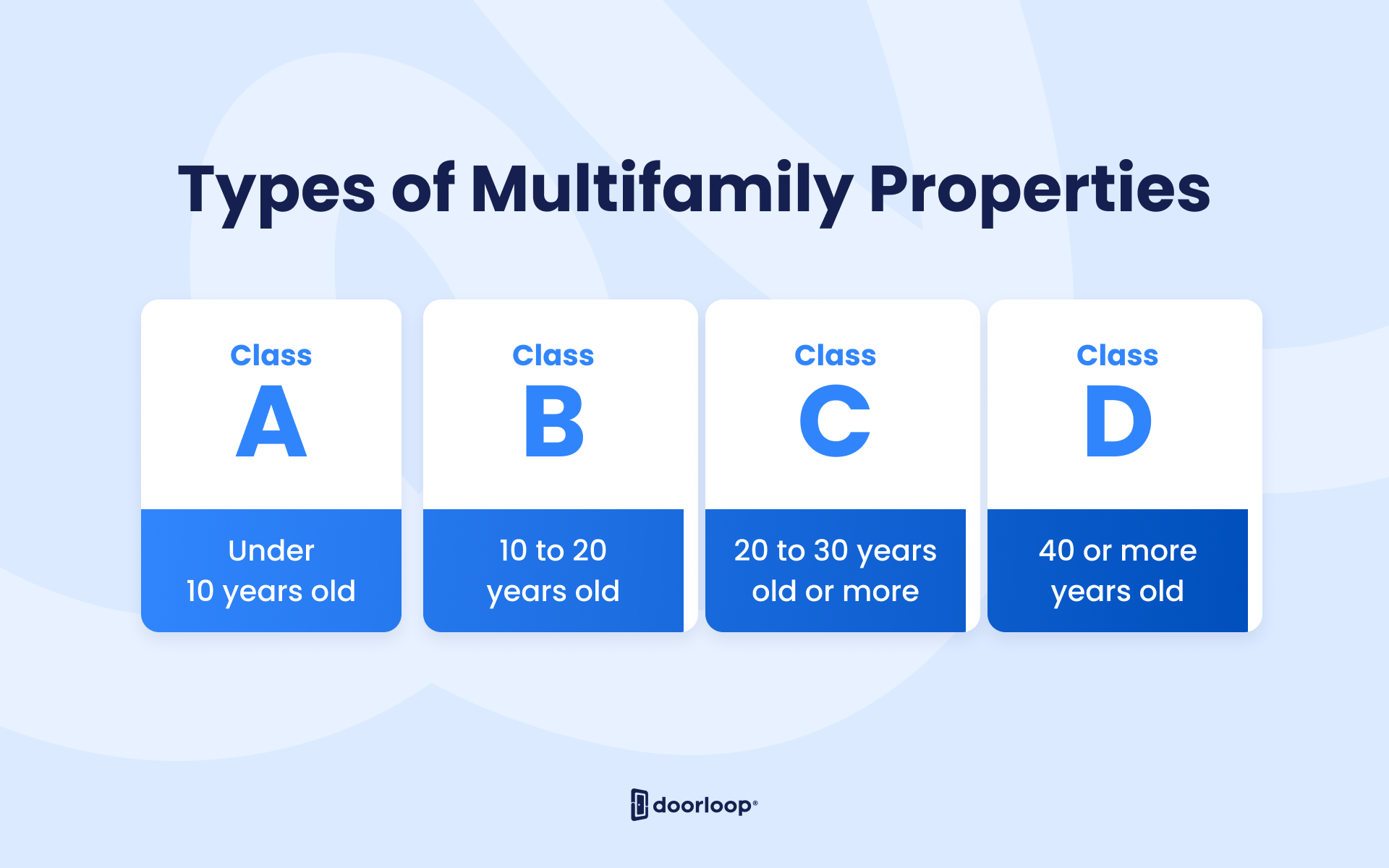
Investors and lenders grade multifamily properties into four classes (A, B, C, and D) based on age, construction quality, location, amenities, and tenant demographics. The classification is qualitative and market-relative, meaning a Class A property in a secondary market differs materially from a Class A property in a primary market like New York or Los Angeles. The grading system is separate from the residential vs. commercial unit-count classification covered above.
Class A Multifamily Properties
Class A multifamily properties are under 10 years old, built with top-tier construction materials and finishes, and located in prime urban or high-demand suburban markets. Amenity packages in Class A buildings frequently include fitness centers, resort-style pools, concierge services, co-working lounges, and package lockers. The tenant base consists predominantly of higher-income professionals. Cap rates on Class A assets fall in the 4% to 6% range, reflecting strong demand and lower perceived risk. The combination of new construction, prime location, and institutional-quality amenities makes Class A properties the most stable multifamily investment from a vacancy and credit-loss standpoint.
Class B Multifamily Properties
Class B multifamily properties are 10 to 20 years old, with solid construction quality and locations in established neighborhoods that are not at the top of the market. Amenity packages exist, but feature dated finishes relative to Class A peers. The tenant base is a mix of white-collar and skilled blue-collar renters. Cap rates on Class B assets fall in the 6% to 8% range. Class B is the primary target of the value-add investment strategy, with light renovations to kitchens, bathrooms, and common areas allowing owners to push rents toward Class A levels, narrowing the gap from older finishes to current market standards without the full cost of ground-up development.
Class C Multifamily Properties
Class C multifamily properties are 20 to 30 years old or more, with dated exterior and interior finishes and a limited or no formal amenity package. Locations sit in working-class neighborhoods or secondary submarkets where land values and rents are lower. The tenant base consists primarily of working-class and lower-income renters. Cap rates on Class C assets fall in the 7% to 9% or higher range, reflecting higher risk and maintenance burden. Class C properties carry the highest cash-flow potential on a percentage basis, but maintenance costs and tenant turnover rates are substantially higher than Class A or B assets, compressing actual net returns relative to the gross figures.
Class D Multifamily Properties
Class D multifamily properties are 40 or more years old, in need of significant repair or full rehabilitation, and located in declining neighborhoods with elevated crime rates. Vacancy and tenant turnover are structurally high, and eviction activity is frequent relative to higher-grade asset classes. Cap rates appear strong on paper, frequently exceeding 9% to 10%, but in practice, vacancy losses, eviction legal costs, and deferred maintenance regularly erode those returns to levels below what Class C assets produce. Lenders apply stricter underwriting to Class D assets, and institutional capital generally avoids the category. Individual investors attracted by headline yields frequently underestimate the operating complexity and cost base of Class D properties.
Investing in a Multifamily Property
Investing in a multifamily property is a distinct real estate strategy built on rental income from multiple units, diversified vacancy risk across the unit count, and operational scale advantages not available in single-family investing. A vacancy in one unit does not eliminate all income, as the remaining units continue generating rent. The sections below cover the key financial metrics investors use to evaluate multifamily acquisitions, including net operating income, cap rate, and cash-on-cash return.
Key Metrics for Evaluating a Multifamily Property
Investors evaluate multifamily properties using a defined set of financial metrics, each measuring a different dimension of performance and risk. The table below lists the core metrics, what each measures, and why it matters.
<table><tbody><tr><td><b>Metric</b></td><td><b>What It Measures</b></td><td><b>Why It Matters</b></td></tr><tr><td><b>Net Operating Income (NOI)</b></td><td>Total rental income minus operating expenses, before debt service</td><td>Baseline measure of property profitability</td></tr><tr><td><b>Cap Rate</b></td><td>NOI divided by purchase price or property value</td><td>Compares return potential across properties regardless of financing</td></tr><tr><td><b>Cash-on-Cash Return</b></td><td>Annual pre-tax cash flow divided by total cash invested</td><td>Measures actual return on equity deployed</td></tr><tr><td><b>Debt Service Coverage Ratio (DSCR)</b></td><td>NOI divided by annual debt payments</td><td>Lender benchmark: A DSCR below 1.0 means the property does not cover its debt</td></tr><tr><td><b>1% Rule</b></td><td>Monthly rent as a percentage of purchase price</td><td>Quick screen for cash-flow viability (monthly rent should equal at least 1% of purchase price)</td></tr><tr><td><b>Gross Rent Multiplier (GRM)</b></td><td>Purchase price divided by annual gross rent</td><td>Fast valuation comparison across similar properties</td></tr></tbody></table>
NOI and cap rate are the two most foundational metrics for multifamily valuation, while NOI establishes what the property earns operationally, and cap rate contextualizes that income relative to market pricing.
Managing a Multifamily Property
Managing a multifamily property differs from managing a single-family rental in scale, complexity, and operational discipline. A single-family property generates one lease, one maintenance queue, one rent payment, and one tenant relationship. A multifamily property generates all of the above simultaneously across every unit, compressing timelines and multiplying the consequences of process gaps.
Active leases overlap and expire on different cycles. Maintenance requests from separate units arrive in parallel, sometimes affecting shared building systems (plumbing risers, HVAC, roofing) that impact multiple tenants at once. Rent collection must be tracked at the unit level, not just at the property level, and accounting must segregate income and expenses by unit for accurate performance reporting. Tenant communication load is proportional to unit count, meaning a 20-unit building generates at a minimum 20 simultaneous tenant relationships to maintain. The sections below cover the specific operational functions multifamily property managers handle and the software that consolidates them.
Rent Collection Across Multiple Units
Rent collection across multiple units involves managing payment cycles, payment methods, and late-fee enforcement across every unit simultaneously. Properties operate on either a synchronized rent cycle (all units due on the first of the month) or staggered cycles tied to individual lease start dates, creating parallel tracking obligations for the property manager. Common challenges include chasing late payments across a large tenant base, correctly applying payments to the right unit ledger, and enforcing late fees consistently without creating fair-housing exposure. Modern multifamily operations address the above through online payment portals that accept ACH and card payments, automated payment reminders sent before the due date, and automated late-fee application triggered by system rules rather than manual tracking.
Tenant Screening Across Multiple Units
Tenant screening across multiple units involves processing higher application volumes, maintaining consistent screening criteria across all applicants, and running parallel background, credit, and eviction checks for multiple vacancies at the same time. The volume alone creates operational pressure, with a 30-unit building turning over 20% annually, generating 6 screening cycles per year, each potentially involving multiple competing applicants per unit. Fair Housing compliance requires that screening criteria (minimum credit score, income-to-rent ratio, criminal history policy) be applied uniformly across all applicants, regardless of protected class. Centralized screening systems standardize the application intake process, run automated credit and background checks, and produce consistent scoring outputs that protect against discriminatory inconsistency in tenant selection decisions.
Maintenance Coordination in a Multifamily Property
Maintenance coordination in a multifamily property involves managing parallel service requests across multiple units, addressing shared building systems that affect more than one tenant simultaneously, and dispatching vendors at a volume that single-family operations do not generate. A plumbing failure in a shared riser, for example, creates maintenance obligations across every unit connected to that line. Triage is a core challenge, with requests ranging from emergency (no heat in winter) to routine (broken cabinet hinge), and the property manager must prioritize and route each without losing track of open work orders. Centralized work-order systems log requests by unit, assign and track vendor dispatch, record completion status, and allocate costs to the correct unit or common-area ledger.
Multifamily Property Management Software
Multifamily property management software is a services that consolidates the core operational functions of a multifamily property into a single system, with rent collection, tenant screening, online rental applications, lease e-signing, maintenance ticketing, accounting and financial reporting, and tenant communication portals. The services tracks data at the unit level, not just at the property level, enabling managers to see the payment status, maintenance history, and lease details of each individual unit without switching between disconnected tools. The distinction from general property management software is the depth of unit-level tracking, with multifamily operations requiring bulk lease management across many overlapping lease terms, centralized communication for tenants in a shared building, and financial reporting that separates income and expenses by unit for accurate per-unit performance analysis.
Multifamily Property FAQ
Common questions about multifamily properties are addressed below, covering definitions, classifications, and property-type distinctions.
What qualifies as a multifamily property?
A multifamily property qualifies as a residential building or complex that contains two or more separate housing units designed to accommodate different tenants or families. Each qualifying unit must have its own kitchen, bathroom, and private entrance, making it independently habitable without shared cooking or bathing facilities. A single-family home with an in-law suite sharing a kitchen does not meet the definition. A duplex, triplex, fourplex, apartment building, or condominium complex with two or more independent units meets the definition, regardless of building style or ownership structure.
Is a duplex considered a multifamily property?
Yes, a duplex is considered a multifamily property. A duplex contains two separate residential units within a single building, satisfying the two-or-more-unit threshold that defines the multifamily category. Each unit has its own entrance, kitchen, and bathroom, meeting the self-contained requirement. The duplex is the smallest and most common entry point into multifamily property ownership.
What's the difference between multifamily and an apartment complex?
The difference between multifamily and an apartment complex is mainly in scale and terminology. All apartment complexes are multifamily, but not all multifamily properties are apartment complexes. Multifamily is the umbrella category covering any residential property with two or more units, from a duplex to a 500-unit tower. An apartment complex is a specific subtype, while a group of apartment buildings on a shared site, typically containing five or more units, crosses into commercial real estate classification. A duplex is multifamily, while a duplex is not an apartment complex.
How many units make a property commercial multifamily?
Five or more units make a property a commercial multifamily under U.S. financing and zoning conventions. Properties with 2 to 4 units are classified as residential, qualifying for conventional residential mortgage programs (FHA, Fannie Mae, Freddie Mac). Properties with five or more units are classified as commercial, requiring commercial real estate financing with separate underwriting standards, loan structures, and qualification criteria. The 5-unit threshold applies regardless of building style or physical configuration.
What is the difference between a duplex and a townhouse?
The difference between a duplex and a townhouse is in their structure and ownership. A duplex is two residential units in a single building owned as one property by a single title holder. A townhouse is an individual multi-story unit, typically 2 to 3 stories, in a row of structurally attached units where each unit is individually owned. A duplex has one owner with two rental units, while a row of townhouses has one owner for each unit. The ownership structure and unit-count-per-title are the primary distinctions between a duplex and a townhouse.
What is the difference between a condo and an apartment?
The difference between a condo and an apartment is the ownership structure. A condo is an individually owned unit within a multi-unit building, with the owner holding title to the interior space while the HOA manages shared areas. An apartment is a rented unit within a building owned by a single entity (landlord or investment group). The physical construction of the building is identical, but the legal and financial relationship between the tenant or owner and the property distinguishes the two.
Frequently Asked Questions