







Multifamily housing is defined as a single structure divided into separate residential units for multiple households. Multifamily housing Multifamily housing is classified by structural classifications as well as asset classes. Structural classifications organize buildings by story count and physical layout to help investors understand density. Multifamily asset classes are a standardized rating method to evaluate the quality and risk profile of a property. Multifamily housing is considered residential housing when it is less than four-units, and is considering commercial at five-units and above. Multifamily property management can help ensure the long-term viability and profitability of a multifamily investment.
What Is Multifamily Housing?
Multifamily housing consists of a single structure divided into separate residential units for multiple households. Ownership remains unified under one deed for the entire property, even though the building houses many tenants. Real estate professionals use terms (multi-dwelling unit or MDU) to describe the specific developments. Residential multifamily properties contain two to four units, while commercial designations apply to buildings with five or more dwellings. Shared structural elements like roofs, walls, and foundations define the physical nature of what is a multifamily property.
Multifamily Housing vs Single-Family Housing
Multifamily housing differs from single-family housing in the number of households living within a single tax parcel. The following table compares the two property categories across households, structures, ownership, financing, amenities, tenants, and management.
<table><tbody><tr><td>Attribute</td><td>Multifamily Housing</td><td>Single-Family Housing</td></tr><tr><td>Number of households</td><td>Two or more</td><td>One</td></tr><tr><td>Shared structure</td><td>Common walls or floors</td><td>Detached structure</td></tr><tr><td>Ownership model</td><td>Single owner for all units</td><td>Single owner for one unit</td></tr><tr><td>Typical financing</td><td>Commercial or residential multi</td><td>Conventional residential</td></tr><tr><td>Common amenities</td><td>Shared gyms or pools</td><td>Private yards</td></tr><tr><td>Tenant profile</td><td>Diverse urban renters</td><td>Families or long-term residents</td></tr><tr><td>Management approach</td><td>Professional or software-led</td><td>Self-managed or individual</td></tr></tbody></table>
Transitioning from single-family to multifamily investments requires a shift toward professionalized operations and income-based valuation.
8 Types of Multifamily Housing
Structural classifications of multifamily housing classify buildings by story count and physical layout. These include duplexes, triplexes, fourplexes, garden apartments, walk-ups, mid-rises, high-rises, and mixed-use properties. The classification will fluences the revenue potential, long-term maintenance requirements, and operational expenses of the property.
Duplex
A duplex is defined as a residential building with two separate living units contained within one structure. Side-by-side configurations feature units sharing a common wall, while stacked versions place one residence above another. Owners frequently live in one unit while renting the other to help cover mortgage expenses (a situation commonly referred to as "house hacking"). Units feature separate entrances to maintain privacy for each household. Local zoning laws in some cities allow for additional dwelling units on single-family lots.
Triplex
Triplexes contain three distinct residential units within a single physical building. Each unit houses one complete apartment with its own kitchen and bathroom facilities. Investors find the properties attractive for increased cash flow compared to smaller residential types. Middle-income renters seek out triplexes for the community feel and neighborhood locations. Chicago features many three-flats, which serve as the primary example of this housing type in urban regions.
Fourplex (Quadplex)
Fourplexes or quadplexes consist of four separate residential units under one roof. Common layouts include two units on the ground floor with two units above or four side-by-side townhome-style residences. Investors target fourplexes because they represent the largest property size eligible for residential financing. Conventional and FHA loans apply to properties with up to four units. Commercial lending requirements begin at the five-unit mark.
Garden Apartments
Garden apartments consist of low-rise buildings reaching one to three stories in height. The properties feature extensive landscaping and outdoor-access points for residents. Suburbs and urban edges house most garden-style developments due to the larger land requirements. Typical properties include multiple buildings arranged in a courtyard layout with direct outdoor access for each tenant. Families and pet owners favor these units for the accessible green space and lower density.
Walk-Up Apartments
Walk-up apartments lack elevator service and require residents to use stairs for access. The buildings reach two to six floors in height and appear frequently in older urban neighborhoods. Tenants accept lower rent prices in exchange for the lack of an elevator. Owners benefit from lower operating costs and fewer mechanical maintenance requirements. Accessibility regulations limit the height of new walk-up developments to ensure compliance with modern standards.
Mid-Rise Apartments
Mid-rise apartments reach four to eight stories and include elevator access. Urban infill projects and close-in suburbs use the building height to balance density with construction costs. Developers refer to the "5-over-1" wood-over-podium construction as a standard for the category. The method places five stories of wood-framed housing over a concrete base used for parking or retail. The buildings provide a balance between the density of high-rises and the affordability of low-rise structures.
High-Rise Apartments
High-rise apartments stand at eight stories or higher, reaching twelve or more floors. Steel and concrete frames support the massive structures located in dense urban cores. Operating costs rise due to the need for concierge services, security, and complex elevator maintenance. Luxury amenities (rooftop pools or fitness centers) distinguish the buildings from lower-density housing types. High-rises cater to high-income professionals who value proximity to business districts and city views.
Mixed-Use Multifamily
Mixed-use multifamily properties combine residential units with commercial or retail spaces in the same building. Urban infill areas and transit-adjacent developments favor the integrated model. Commercial leases on the ground floor provide additional income streams and longer-term stability for owners. Grocery stores or restaurants commonly occupy the street-level spaces below the apartments. Management requires handling residential tenant needs and commercial lease requirements simultaneously.
Comparison of Multifamily Structural Types
The following table summarizes the eight structural types based on unit count, story height, and density.
<table><tbody><tr><td>Type</td><td>Typical Unit Count</td><td>Typical Stories</td><td>Elevator</td><td>Common Tenant</td><td>Typical Density</td></tr><tr><td>Duplex</td><td>2</td><td>1-2</td><td>No</td><td>Individual/Family</td><td>Very Low</td></tr><tr><td>Triplex</td><td>3</td><td>2-3</td><td>No</td><td>Small Family</td><td>Low</td></tr><tr><td>Fourplex</td><td>4</td><td>2-3</td><td>No</td><td>Young Professionals</td><td>Low</td></tr><tr><td>Garden</td><td>50-200</td><td>1-3</td><td>No/Some</td><td>Families</td><td>Medium</td></tr><tr><td>Walk-up</td><td>10-50</td><td>2-6</td><td>No</td><td>Urban Renters</td><td>Medium</td></tr><tr><td>Mid-rise</td><td>50-300</td><td>4-8</td><td>Yes</td><td>Professionals</td><td>High</td></tr><tr><td>High-rise</td><td>100+</td><td>8+</td><td>Yes</td><td>High-Income</td><td>Very High</td></tr><tr><td>Mixed-use</td><td>Varies</td><td>3+</td><td>Yes</td><td>Urbanites</td><td>Varies</td></tr></tbody></table>
Selecting the right structural type depends on the local market demand and the specific investment goals of the property owner.
Multifamily Asset Classes (A, B, C, D)
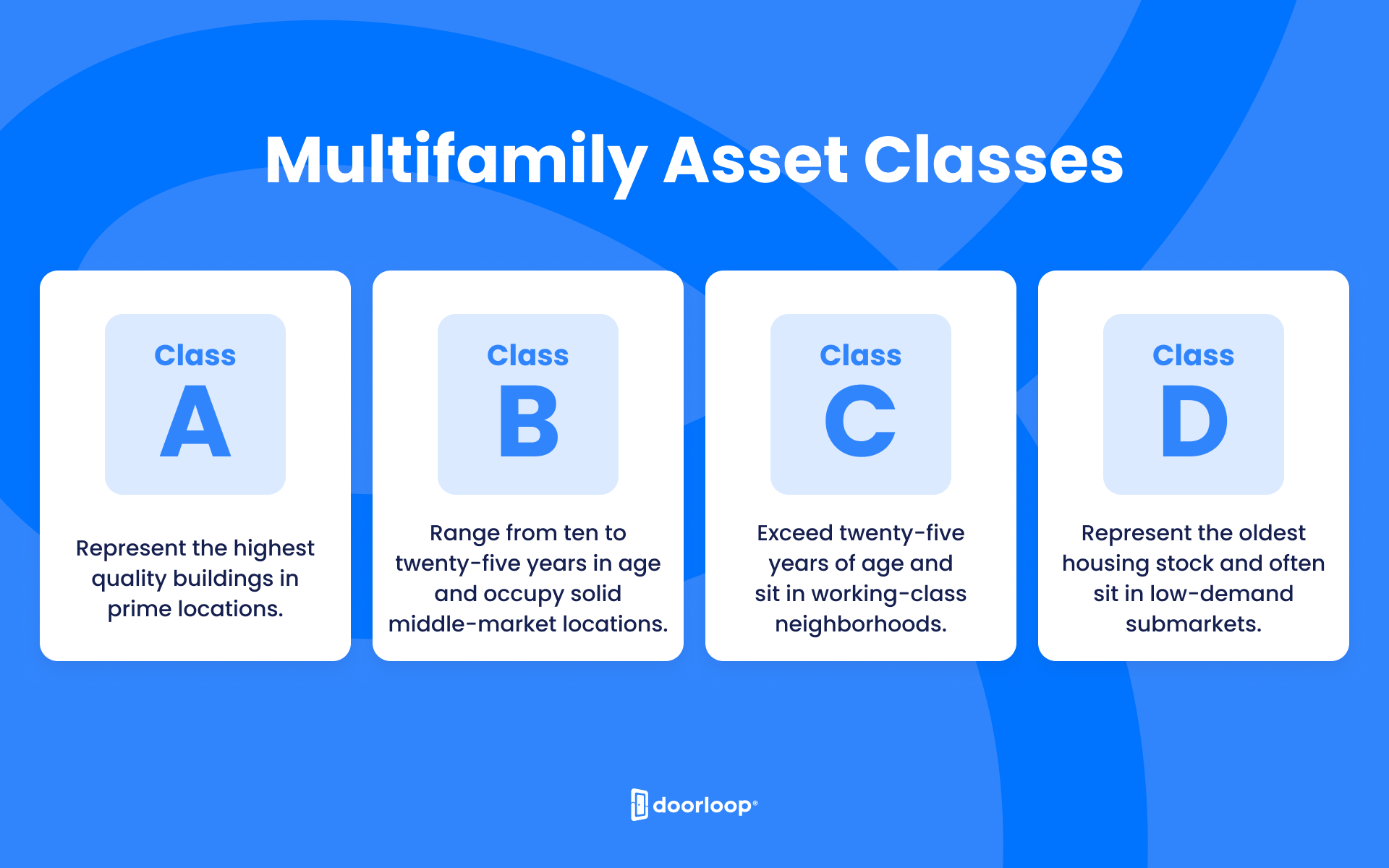
Multifamily asset classes provide a standardized rating system to evaluate the quality and risk profile of a property. The term "class" represents a grading system ranging from A to D and is based on age, location, and condition of multifamily properties. Investors use the letters to compare buildings across different geographic markets. A Class A building in one city matches the general quality expectations of a Class A building elsewhere.
Class A Multifamily
Class A properties represent the highest quality buildings in prime locations. Class A assets are under ten years old and feature top-tier finishes and amenities. High-income renters pay premium rates for luxury features. Investors accept lower cap rates for Class A assets because the perceived risk is minimal. Prime submarkets with strong employment growth attract Class A investment capital.
Class B Multifamily
Class B properties range from ten to twenty-five years in age and occupy solid middle-market locations. Amenities remain functional and attractive but lack the luxury status of Class A counterparts. Middle-income white-collar workers comprise the primary tenant profile for the buildings. Investors target Class B assets for value-add strategies involving moderate renovations to increase rental income. Properties offer a balance between stable cash flow and potential appreciation.
Class C Multifamily
Class C properties exceed twenty-five years of age and are generally located in working-class neighborhoods. Amenities remain basic or non-existent while the physical structure requires more maintenance compared to Class A or B properties. Working-class households and hourly-wage earners form the core tenant base for these assets. Owners undertake operational improvements or interior updates to push the property toward a Class B rating. Higher cap rates compensate investors for the increased management effort and maintenance requirements.
Class D Multifamily
Class D properties represent the oldest housing stock and often sit in low-demand submarkets. Significant deferred maintenance and older structural systems characterize the high-risk assets. Tenants face economic challenges and require intensive management oversight. Many investors avoid Class D properties unless they possess specialized expertise in distressed asset recovery. Buildings offer the highest potential cap rates but carry the greatest risk of vacancy or non-payment.
Residential vs Commercial Multifamily: The 5-Unit Threshold
Multifamily housing splits into residential and commercial categories at the five-unit threshold. Properties with one to four units qualify for residential lending, while larger buildings require commercial financing. The distinction changes how banks evaluate loan applications and borrower creditworthiness. Valuation methods shift from comparable sales to income-based calculations once a building reaches five units.
- Financing: Residential loans include FHA and VA products for up to four units, while commercial loans apply to larger assets.
- Valuation: Comparable sales drive residential value, whereas net operating income and cap rates drive commercial value.
- Insurance: Commercial property insurance policies become necessary for buildings meeting the five-unit mark.
- Property management requirements: Owners adopt professional management or specialized software at the commercial scale.
- Tax treatment: Multifamily commercial properties continue to use a 27.5-year depreciation schedule because the primary use remains residential.
The five-unit mark serves as the practical point where owners shift from individual landlording to professional real estate operations.
How to Manage Multifamily Property
To manage multifamily property, have a coordinated maintenance schedules, rent collection, and tenant screenings across multiple units. Effective managers prioritize resident retention to minimize the costs associated with unit turnover. Communication tools help bridge the gap between ownership goals and tenant satisfaction. Owners must decide between self-management and hiring a third-party firm.
For more information see our full article: How to Manage a Multifamily Property.
How Property Management Software Helps Manage Multifamily Housing
Property management software helps manage multifamily housing with the administrative needs of running a multi-unit building. Property management software handles complex tasks like automated rent collection and common-area maintenance tracking. Managers use the software to maintain clear communication with residents at a high volume. Scaled accounting features allow for detailed financial reporting across various units or properties. Investors increase operational efficiency by centralizing all data within multifamily property management software.
Frequently Asked Questions About Types of Multifamily Housing
The frequently asked questions about types of multifamily housing section answers the most common questions readers ask about multifamily housing types and classifications.
What Are the Four Types of Multifamily Housing Structures?
The four most common structural types include duplexes, triplexes, garden-style apartments, and high-rise apartments. The four-type framing provides a simplified view of the market for beginner investors. The full eight-type breakdown earlier in this article offers a more granular look at the diversity of the housing stock.
Is a Duplex Considered Multifamily Housing?
Yes, a duplex is considered multifamily because it contains two separate residential units in one structure. Residential real estate classifications include any building with more than one dwelling unit in the category. Financing rules treat duplexes as residential assets because they fall below the five-unit commercial threshold.
Is a Townhouse Multifamily Housing?
A townhouse can be classified as multifamily housing depending on the ownership structure and the classifying organization. The Census Bureau treats townhouses as single-family attached when units have separate ownership deeds. Multifamily industry sources include them when the entire row operates as a rental property under unified ownership.
What Is the Difference Between Multifamily and Multi-Dwelling Unit (MDU)?
The term multi-dwelling unit or MDU serves as a synonym for multifamily housing. Multifamily and Multi-Dwelling Unit (MDU) describe a physical structure containing two or more separate residential units. MDU appears more frequently in telecommunications and utility industries, while multifamily dominates real estate investment discussions.
Frequently Asked Questions