





Managing a multifamily property is a process that includes leasing, rent collection, maintenance, financial reporting, tenant relations, and legal compliance across multiple units simultaneously, treating each responsibility as part of a repeatable operating system rather than a set of isolated tasks. The U.S. multifamily rental market encompasses more than 20 million units across apartment buildings, duplexes, condominiums, and townhouses, representing one of the largest segments of the residential real estate industry (U.S. Census Bureau, 2024). The guide below covers what multifamily property management is, the four main property types, how each affects daily operations, and the full scope of responsibilities a property manager carries.
The core of the guide is a 10-step workflow that moves from business setup and budgeting through leasing, rent collection, maintenance, tenant communication, and performance tracking, applicable whether the portfolio is 4 units or 400. The steps connect directly to the financial KPIs that measure whether the system is producing results, including occupancy rate, net operating income, cap rate, and tenant turnover rate.
Challenges of multifamily property management include high turnover, utility complexity, communication overload, fair housing compliance risk, and maintenance coordination at scale.
The decision to self-manage a multifamily property or hire a property management company is unique to every owners situation, but a rule of thumb is that once a multifamily portfolio is bigger than 10 units, or once the owner lives more than an hour from the property, hiring a management company is worth it due to higher occupancy, less vacancy, and reduced legal exposure.
Property management software helps support multifamily property management by automating rent collection, centralizing accounting, managing maintenance requests, and providing tenants with a self-service portal.
What Is Multifamily Property Management?
Multifamily property management is the ongoing oversight of residential properties containing two or more rental units, covering day-to-day operations, leasing, maintenance coordination, rent collection, financial reporting, and legal compliance across all units under a single management structure. The goal is to maintain tenant satisfaction at a level that supports lease renewals and referrals while producing the highest possible net operating income for the property owner.
Multifamily property management differs from single-family management primarily in scale and system requirements. A single-family property manager tracks one lease, one tenant household, and one set of operating expenses. A multifamily property manager tracks multiple leases simultaneously, coordinates shared systems across units (roofs, boilers, elevators, common areas), manages a rent roll that changes as leases expire at different times, and produces consolidated financial reports covering the entire building or portfolio.
Multifamily property management is often confused with multifamily asset management, but they are different concepts. Multifamily property management refers to the day-to-day operational execution (filling vacancies, collecting rent, responding to maintenance requests, and keeping the property running). Multifamily asset management refers to portfolio-level strategic oversight: ensuring the property is performing against the owner's investment thesis, evaluating capital improvements, and managing hold-versus-sell decisions. Property managers handle operations; asset managers handle strategy, and at larger ownership groups, separate professionals fill each role.
What Are the Types of Multifamily Properties?
The four multifamily property types are duplexes, apartment complexes, condominiums, and townhouses. Each type affects how the property is managed in three ways: the scale of the tenant base, the ownership structure that determines who the property manager reports to, and the amenity complexity that determines how much shared-infrastructure coordination the daily workload requires. The sections below cover each type and its management implications.
Duplex
A duplex is a residential building containing exactly two distinct, self-contained living units within a single structure. Units are arranged either side-by-side on the same floor with separate entrances, or stacked vertically with one unit above the other, each with an independent entry. A duplex is owned by a single owner who rents out one or both units. A common situation is the owner occupying one unit and renting out the other (i.e. "owner-occupied", or "house hacking").
Management implications for a duplex are the simplest of any multifamily property type. The tenant base consists of two households at most, so leasing cycles, rent collection, and maintenance requests involve a small number of interactions per month. The most distinctive management dynamic in a duplex is the proximity of the two households: disputes about noise, shared outdoor space, or parking require mediation from the property manager or owner. Marketing a duplex targets renters who want the experience of a house-like space with separate entry and outdoor access.
Apartment Complex
An apartment complex is a collection of multiple residential rental units contained within one or more buildings under a single ownership structure. Unit counts vary across three tiers: small complexes run from 5 to 50 units, mid-size complexes run from 50 to 200 units, and large complexes exceed 200 units, with institutional ownership common at the upper end of that range. A single individual, a partnership, or a real estate investment entity owns the entire property.
Management implications scale directly with unit count. Small apartment complexes of under 20 units are frequently managed by the owner or a part-time manager without dedicated on-site staff. Mid-size and large complexes require at least one full-time on-site property manager, a leasing agent, and maintenance staff. The full leasing cycle runs continuously as individual leases expire at different times throughout the year, and shared amenities (laundry rooms, parking lots, fitness centers, and common areas) require a separate maintenance and scheduling layer. Lease administration at scale requires software rather than manual management via spreadsheets/etc. The biggest operational difference from a duplex is the volume: every operational task from collecting rent to responding to maintenance requests happens across dozens or hundreds of units simultaneously.
Condominium
A condominium is a residential property type in which each individual unit is owned separately by a distinct owner. The condominium common areas, structural elements, and shared amenities are owned collectively through a condo association or homeowners association (HOA). The condo association is governed by an elected board, operates under a set of recorded covenants and rules, and collects association dues from unit owners to fund shared expenses.
Management implications for a condominium differ from apartment management in the ownership structure. A property manager hired by a condo association does not report to a single owner, they report to the condo board, and decisions about budgets, maintenance, and rule enforcement require board approval rather than a single owner's authorization. Day-to-day work includes enforcing association rules consistently across all unit owners and tenants, managing common-area maintenance funded by association dues, coordinating with the board on capital improvement decisions, and handling association finances as a separate budget from any individual unit's P&L. A property manager hired by an individual condo investor to manage their single unit within the building operates under a different mandate: filling the unit, collecting rent, and maintaining the interior, while the association handles everything outside the unit boundary. The biggest difference in day-to-day work compared to an apartment complex is navigating board governance alongside operational execution.
Townhouse
A townhouse is a multi-story residential unit that shares one or more walls with adjacent units but has its own ground-floor entry, vertical living space, and typically a small private outdoor area. Ownership can take two forms: a landlord owns and rents individual townhouse units to tenants, or each townhouse is individually owned by a resident under an HOA structure that governs the exterior and common areas.
Management implications for townhouses sit between apartment and single-family management in complexity. Exterior maintenance, including rooflines, shared walls, walkways, and landscaping, is typically governed by an HOA whose rules the property manager must enforce for rental units within the community. The tenant demographic skews toward families and long-term renters who value the house-like layout and private entry, which produces lower turnover than apartment buildings. That lower turnover rate and the typically smaller unit count in any given townhouse community reduce the continuous leasing pressure that characterizes apartment management. What makes townhouse management distinct from both apartment complexes and condominiums is the combination of HOA coordination for shared exteriors and direct landlord-tenant management for the interior of each rental unit, requiring the property manager to operate in both frameworks simultaneously.
What Does a Multifamily Property Manager Do?
A multifamily property manager is responsible for the full operational lifecycle of a residential rental property with two or more units, from marketing vacant units and screening applicants to collecting rent, managing maintenance, and producing financial reports for the property owner. A single property manager oversees anywhere from 4 to 150 or more units (depending on the portfolio size), with larger portfolios supported by leasing agents, maintenance staff, and administrative coordinators.
For more information see our dedicated article: What Does a Property Manager Do?
Tenant screening
Tenant screening is the front-end process that determines which applicants are approved. It includes a rental application, a background check for criminal and eviction history, a credit check, income verification against a standard threshold (three times the monthly rent), and references from prior landlords. The Fair Housing Act requires property managers to apply the same screening criteria to every applicant, without exception, regardless of race, color, national origin, religion, sex, familial status, or disability.
Tenant relations
Tenant relations is all ongoing communication between the property management office and current residents: responding to complaints, addressing maintenance concerns, enforcing community rules. Professional responsiveness, resident engagement, can help encourage lease renewals and lower tenant turnover.
Rent collection
Rent collection means receiving payments on or before the due date, applying late fees according to the lease when payments are overdue, and depositing funds into the property's designated bank account.
Accounting
Accounting in multifamily property management means maintaining an accurate general ledger for the property, reconciling bank statements monthly, tracking income and expenses against the operating budget, and producing monthly owner statements that report on the property's financial performance. Monthly reporting is the standard cadence in multifamily management. Property management software such as DoorLoop automates many of these accounting responsibilities.
Property maintenance
Property maintenance management covers three categories of work: reactive repairs in response to tenant-submitted work orders, emergency responses for urgent issues like flooding, heating failure, or electrical hazards, and preventive maintenance scheduled in advance to prevent larger failures. The property manager coordinates between tenants who report issues, in-house maintenance staff or outside vendors who complete the work, and the owner, who approves expenditures above a pre-agreed threshold. Three budget benchmarks guide multifamily maintenance planning. The 50% rule (operating expenses, including maintenance, should not exceed 50% of gross rental income), the 1% rule (budget approximately 1% of the property's value annually for maintenance and repairs), and the square-footage rule (budget roughly [$1] per square foot per year for maintenance).
Marketing
Marketing covers the activities that fill vacant units: professional listing photos, rental listing copy that highlights the property's features and location, publication of the listing across high-traffic websites (Zillow and Apartments.com), and paid advertising placements when vacancy rates are elevated.
Leasing
Leasing covers the pre-lease funnel from initial inquiry through unit tours, application processing, lease signing, and move-in. Renewals are handled through the same leasing function, beginning 60 to 90 days before each lease expiration.
Legal compliance
Legal compliance in multifamily management covers the full range of landlord-tenant law at the federal, state, and local levels. The Fair Housing Act prohibits discrimination in advertising, screening, leasing, and enforcement. State and local landlord-tenant laws govern security deposit handling, required lease disclosures, notice periods for entry and rent changes, and eviction procedures. Building code and safety inspection requirements vary by jurisdiction and property type. Local laws vary significantly by state, and a property manager operating in multiple markets must track compliance requirements in each location separately.
Financial oversight
Financial oversight of a multifamily property includes building the annual operating budget before the start of each fiscal year, projecting income from rent and other sources, budgeting for operating expenses, setting aside capital expenditure reserves, and accounting for debt service. The property manager tracks the monthly actual income and expenses against the budget and produces variance reports for the owner. Capital expenditure reserves for multifamily properties should equal between three to six months of total operating expenses, and be held in a liquid account, to cover unexpected major repairs and capital improvements without requiring emergency owner contributions.
A multifamily property manager wears many hats, shifting between the operational, financial, legal, and interpersonal demands of the role throughout any given workday. Here is the step-by-step process that ties those responsibilities together into a working management system.
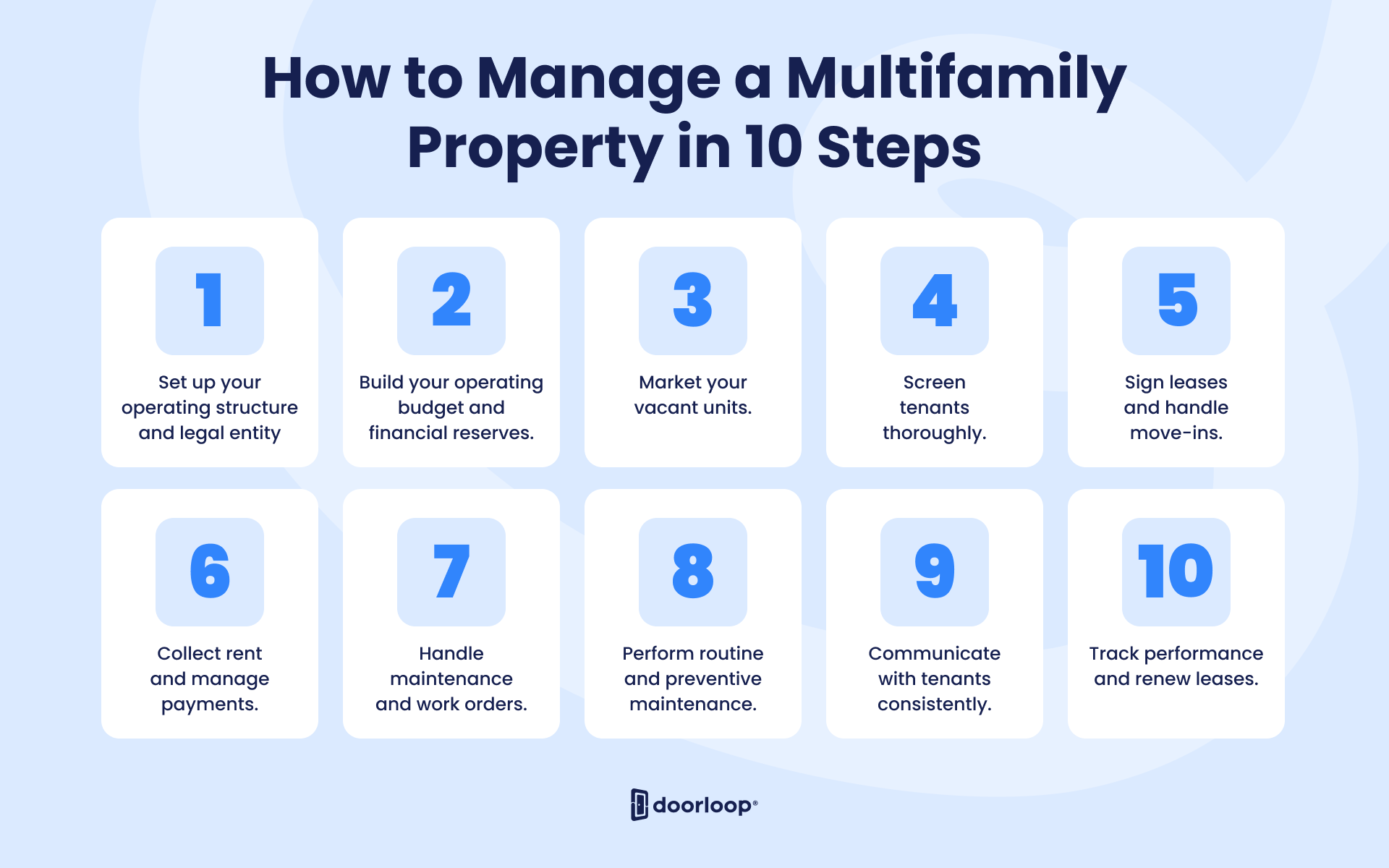
How to Manage a Multifamily Property in 10 Steps
The workflow below walks through the end-to-end operating process a property manager runs, in the sequence in which the work happens across a property's lifecycle. The process applies whether the portfolio is 4 units or 400, and each step builds the foundation for the next.
1. Set up your operating structure and legal entity
Multifamily owners usually establish an LLC to hold the property, separating personal liability from property liability at the asset level. The LLC opens a dedicated bank account for the property before any rental income is received, preventing commingling of personal and property funds. Registration with the state and any required local business licenses or rental permits come next. The minimum insurance coverage for multifamily rental properties is usually a landlord insurance policy that covers the structure, liability, and loss of rental income; an umbrella policy adds additional liability protection above the primary policy limits for larger portfolios.
2. Build your operating budget and financial reserves
The annual operating budget projects income from rent (at full occupancy minus an estimated vacancy allowance), other income (e.g. late fees, application fees, laundry revenue, pet fees), and all operating expenses line by line: property taxes, insurance, management fees, maintenance and repairs, utilities paid by the owner, landscaping, administrative costs, and marketing. Three heuristics can help guide the budgeting process: the 50% rule, which establishes that total operating expenses must not exceed half of gross rental income, the 1% rule recommends budgeting approximately 1% of the property's current value for maintenance annually, and the square-footage rule suggests roughly $1 per square foot per year as a baseline maintenance budget. The reserve fund target sits above the operating budget as a separate fund (three to six months of total operating expenses) to cover capital repairs without emergency owner calls.
3. Market your vacant units
Every marketing campaign for a vacant unit starts with professional photos that show each room in accurate, well-lit condition (the listing quality directly affects the volume and the quality of applicants). Listing copy highlights the unit's specific features, the building's amenities, the neighborhood's walkability and transit access, and the lease terms. The listing publishes across major websites (Zillow, Apartments.com, and Rent.com), and paid placements within websites are worth activating when the unit's days-on-market exceed the local average. Setting the rent at or slightly below comparable active listings in the same submarket reduces vacancy duration more reliably than holding for the top of the market.
4. Screen tenants thoroughly
The screening checklist covers seven items: a completed rental application, a background check for criminal and eviction history, a credit check with a minimum score threshold applied consistently, income verification at three times the monthly rent, employment verification, references from prior landlords covering at least the past two years, and an eviction history search. The Fair Housing Act requires the same criteria to be applied to every applicant without exception. Documenting the criteria in writing before any application is reviewed, and using the same written criteria for every decision, is the most reliable protection against a fair housing complaint.
5. Sign leases and handle move-ins
A complete multifamily lease covers the lease term, the monthly rent amount, the grace period and late fee structure, the security deposit amount and conditions for its return, which utilities are included and which are the tenant's responsibility, the pet policy, parking assignment, and the community rules that apply to all residents. The property manager and the incoming tenant complete a move-in inspection using a written checklist that documents the condition of every surface, fixture, and appliance before handing over keys. The signed checklist protects both parties at move-out. The first month's rent and the security deposit are collected and deposited before move-in day.
6. Collect rent and manage payments
Rent collection runs on a consistent monthly cycle: a payment due date (typically the first of the month), a grace period (typically three to five days, set in the lease), and an automatic late fee applied to any payment received after the grace period expires. Online payment options reduce collection friction and eliminate the handling of paper checks. The property manager issues a pay-or-quit notice in compliance with the state's landlord-tenant law timeline before initiating any eviction proceeding when rent remains unpaid after the late fee period. All funds deposit into the property's dedicated bank account, not a personal account.
7. Handle maintenance and work orders
Every maintenance request enters a tracking system the moment it is received, regardless of the channel (resident portal, phone, email). The property manager triages each request into urgent or routine: urgent requests including water intrusion, heating or cooling failure in extreme weather, plumbing leaks, and electrical hazards receive a response within 24 hours. Routine requests are scheduled within the normal work queue based on availability of staff or vendors. Completed work is confirmed with the tenant, and the repair cost and vendor information are logged against the unit's maintenance record.
8. Perform preventive maintenance
Preventive maintenance runs on a seasonal calendar. HVAC systems receive servicing in the spring before the cooling season and in the fall before heating season. Gutters are cleaned in late fall after leaf drop. Fire alarms and carbon monoxide detectors are tested annually and at tenant move-in. Older buildings with boilers receive annual boiler inspections before winter. Landscaping and common-area cleaning follow a weekly or biweekly schedule through the active growing season. An annual unit inspection, conducted with proper notice to the tenant per state law, identifies deferred maintenance and lease compliance issues before they compound.
9. Communicate with tenants consistently
Each communication channel serves a different function in multifamily management: email covers formal notices (rent increase letters, lease renewal offers, entry notices, and policy changes). SMS or push notifications through the resident portal cover urgent building alerts (the resident portal handles rent payments, maintenance requests, and document storage as self-service functions), and community bulletin boards or group announcements cover events and general building updates. State law governs the required notice period for landlord entry (24 to 48 hours) and for rent changes. Setting a written standard for response time within one business day for non-urgent tenant communications and publishing it to residents reduces complaint volume.
10. Track performance and renew leases
Monthly financial reports compare actual income and expenses against the operating budget, surfacing variances that require action. Occupancy shortfalls, maintenance overspend, or income from late fees signal a collection problem. Occupancy rate and NOI are reviewed monthly. Renewal conversations with current tenants begin 60 to 90 days before the lease expiration date, allowing time to offer renewal terms, negotiate if needed, and begin marketing the unit if the tenant declines. A tenant who renews costs the property nothing in turn, costs, leasing fees or vacancy loss. A tenant who leaves triggers the full leasing cycle from marketing through screening to move-in.
The 10 steps above define the operating rhythm of a successful multifamily property management operation. The next section covers how to measure whether the system is working, using four KPIs that drive major management decisions.
What Financial KPIs Should You Track for a Multifamily Property?
Every management decision in multifamily property management should reference at least one metric, because intuition about a building's performance degrades quickly under the complexity of managing multiple units (e.g. leases expire at different times, maintenance costs vary across units, and market rents shift mid-year). The four KPIs below, occupancy rate, net operating income, capitalization rate, and tenant turnover rate, together give the property manager a data-driven overview of operational health and investment performance.
Occupancy Rate
Occupancy rate measures the percentage of a property's total units that are currently leased and generating rental income. Occupancy rates drive revenue directly, and every vacant unit is lost income that cannot be recovered. The occupancy rate is the first number an owner or lender looks at when assessing a property's performance.
Occupancy Rate = (Occupied Units ÷ Total Units) × 100
Example: A 50-unit apartment building has 46 units occupied and 4 vacant. Each vacant unit has a market rent of $1,500.
Occupancy Rate = (46 ÷ 50) × 100 = 92%
The 4 vacant units represent $6,000 in lost monthly revenue, or $72,000 annualized at the monthly rent of $1,500 per unit, before accounting for turn costs or marketing expenses.
The industry benchmark for a stabilized multifamily property in most U.S. markets is 93% to 97% occupancy. A rate below 93% signals a leasing problem, a pricing problem, or a product-quality issue that warrants immediate investigation rather than a wait-and-see approach.
Net Operating Income (NOI)
Net operating income (NOI) measures a multifamily property's profitability from operations before debt service and income taxes are factored in. Lenders use NOI to calculate the debt service coverage ratio when underwriting a loan, and investors use it to compare properties of different sizes and price points on an apples-to-apples basis. NOI is the single most important financial metric in multifamily management because it reflects the property's ability to generate cash flow independent of how it is financed.
NOI = Gross Rental Income + Other Income − Operating Expenses
Operating expenses include maintenance and repairs, property management fees, insurance, property taxes, utilities paid by the owner, landscaping, and administrative costs. Operating expenses do not include mortgage principal and interest payments, capital expenditures, income taxes, or depreciation. Excluding debt service is what makes NOI an "unlevered" metric usable across properties with different financing structures.
Example: A 20-unit building collects $30,000 per month in gross rent and $500 per month in laundry and parking income. Total annual income is $366,000. Annual operating expenses total $150,000.
NOI = $366,000 − $150,000 = $216,000
Capitalization Rate (Cap Rate)
The capitalization rate measures the unlevered annual return a property generates relative to its market value, treating the property as if it were purchased entirely with cash. Buyers use cap rate to compare investment opportunities across different markets and property types: a property with a higher cap rate generates more income per dollar of purchase price than one with a lower cap rate, though higher cap rates typically reflect higher risk or a less desirable market.
Cap Rate = (NOI ÷ Property Value) × 100
Example: A multifamily property generates $120,000 in annual NOI and was purchased for $2,000,000.
Cap Rate = ($120,000 ÷ $2,000,000) × 100 = 6%
Typical multifamily cap rate ranges vary by market, asset class, and property age. Cap rates for stabilized Class A multifamily properties have compressed to the 4% to 5% range in primary markets with strong rental demand (New York, Los Angeles, Seattle). Cap rates for similar assets commonly fall from 6% to 8% in secondary and tertiary markets with lower land costs. A cap rate outside the normal range for a submarket warrants further investigation into the property's income quality and expense structure.
For more information see our dedicated article: What is Cap Rate?
Tenant Turnover Rate
The tenant turnover rate measures the percentage of a property's total units experienced a move-out during a given period. Turnover is one of the most expensive operational events in multifamily management: each vacated unit generates immediate costs for cleaning, painting, repairs, carpet replacement if needed, leasing fees if a broker is involved, and marketing costs to fill the unit, before the lost rent during the vacancy period is even counted.
Turnover Rate = (Units Vacated During Period ÷ Total Units) × 100
Example: A 40-unit building had 8 move-outs during the year.
Turnover Rate = (8 ÷ 40) × 100 = 20%
The cost of a single unit turn ranges from $1,000 to $5,000 or more, depending on unit size, the condition in which the tenant left the unit, and the local labor and materials costs for make-ready work. In this example the property incurs 8 turns per year at a mid-range cost of $2,500 each, totaling $20,000 annually at 20% annual turnover on a 40-unit building (and this is before accounting for the vacancy loss associated with turnover). Reducing turnover by retaining any additional tenants per year is the fastest single lever for improving NOI.
What Are the Biggest Challenges of Managing a Multifamily Property?
Multifamily management scales both the rewards and the operational complexity of rental property ownership or management, and the five challenges below create the most damage for owners and managers who do not have a system in place to address them. First-time landlords and self-managing owners who handle operations on an ad hoc basis will usually encounter all five in the first 12 months. Property management software and/or using professional property management services are the two most common paths to resolving these challenges.
High tenant turnover
Multifamily properties experience structurally higher turnover than single-family rentals because the renter demographic skews toward individuals and young households using apartments as a transitional housing step rather than a long-term home. Average tenancy in a typical apartment building runs 12 to 24 months, compared to three or more years in single-family rentals. Each turn costs the property $1,000 to $5,000 in direct expenses plus vacancy loss during the make-ready and leasing period. Two retention tactics produce the most consistent results: Responding to maintenance requests within 24 hours (which directly correlates with renewal intention in resident satisfaction surveys) and initiating renewal conversations 60 to 90 days before lease end with a defined incentive rather than waiting for the tenant to raise the topic.
For a full guide on reducing tenant turnover, see our dedicated article: How to Reduce Tenant Turnover.
Managing utilities across multiple units
Utilities in multifamily properties create a cost allocation problem that does not exist in single-family management. Water and trash are commonly owner-paid because shared infrastructure makes individual metering difficult. Electricity and gas are tenant-paid in separately metered units. Properties with shared utility meters and no sub-metering infrastructure face a choice: absorb the cost as an owner expense, or allocate it through a Ratio Utility Billing System (RUBS), which divides the shared utility bill across units based on occupancy, square footage, or a blended formula. Sub-metering eliminates the allocation problem by measuring each unit's consumption individually, with the capital cost of meter installation usually offset by reduced owner-paid utility expense within two to four years.
Scaling tenant communication
Tenant communication is a unique challenge at different unit-count scales. A duplex requires a property manager to manage communication with two tenant. A 50-unit apartment building requires tracking 50 or more, each with different lease terms, different maintenance histories, different payment patterns, and different communication preferences. Dropped maintenance requests, missed entry notices, and unaddressed lease violations accumulate faster than a single property manager can clear them without a centralized system. The legal exposure from a missed entry notice or an unacknowledged maintenance request is not theoretical: state landlord-tenant laws specify notice requirements and tenant remedies for violations, and a pattern of communication failures creates liability that a disciplined system prevents.
Fair housing and legal compliance risk
Multifamily properties generate more applicant interactions, more tenant communications, and more enforcement decisions than single-family rentals, and each interaction is a potential fair housing touchpoint. The Fair Housing Act prohibits discrimination on the basis of race, color, national origin, religion, sex, familial status, and disability in every aspect of the rental process, from advertising language to screening criteria to lease enforcement. The Americans with Disabilities Act (ADA) adds accessibility requirements for common areas in multifamily properties. A single substantiated fair housing complaint can result in civil penalties, consent agreements, required training, and reputational damage that affects leasing activity for years. The cost of a complaint that proceeds to a formal HUD investigation routinely exceeds $50,000 in legal fees, settlement costs, and management time before a final resolution.
Coordinating maintenance across units and vendors
Maintenance volume does not scale linearly with unit count because multifamily properties contain shared systems that affect all units simultaneously when they fail. A roof leak, boiler failure, elevator outage, or main sewer backup creates simultaneous maintenance emergencies across the building, not just in one unit. Each unit generates its own routine maintenance queue on top of shared-system failures. Coordinating vendor scheduling, tracking work order completion, and logging repair costs across all units on paper or in a shared email inbox usually breaks down when handling more than 10 units, as the volume of open requests exceeds what any single person can track manually without a dedicated system.
Every challenge above can be mitigated with two approaches, and the next two sections cover them: hiring a professional management company or adopting purpose-built property management software.
Should You Self-Manage or Hire a Multifamily Property Management Company?
The main difference from a self-management perspective versus hiring a property management company is time and expertise needed when self-managing, vs. the monthly cost of a project management company. Self-management keeps more revenue in the owner's pocket but demands hours of operational attention every week, while professional management costs a percentage of collected rent.
The table below compares the two approaches across seven dimensions that most directly affect the owner's experience and the property's performance:
<table><tbody><tr><td>Dimension</td><td>Self-Manage</td><td>Hire a Property Management Company</td></tr><tr><td>Monthly cost</td><td>No management fee; owner's time is the cost</td><td>4% to 12% of collected rent plus additional fees</td></tr><tr><td>Time required</td><td>5 to 20+ hours per week, depending on unit count</td><td>Minimal owner time after initial setup</td></tr><tr><td>Expertise needed</td><td>High; owner must know leasing, maintenance, law, and accounting</td><td>Low; the management company provides expertise</td></tr><tr><td>Scale that fits best</td><td>1 to 10 units, nearby location</td><td>10+ units, or any size if owner is remote</td></tr><tr><td>Tenant response time</td><td>Depends on owner availability</td><td>Dedicated staff with defined response standards</td></tr><tr><td>Compliance risk</td><td>High if owner is unfamiliar with landlord-tenant law</td><td>Managed by a company with compliance experience</td></tr><tr><td>Best for owners who...</td><td>Want full control, have time, and live nearby</td><td>Want passive income, manage remotely, or own a large portfolio</td></tr></tbody></table>
The general rule of thumb: once a multifamily portfolio crosses roughly 10 to 20 units, or once the owner lives more than an hour from the property, hiring a management company typically pays for itself through higher occupancy, fewer vacancy days, and reduced legal exposure.
How Much Does a Multifamily Property Management Company Cost?
The standard fee structure for a multifamily property management company includes a monthly management fee calculated as a percentage of collected rent from 4% to 12%. The percentage decreases as the unit count rises: a 5-unit building might pay 10% to 12%, while a 100-unit building commonly pays 5% to 7%, because the fixed management overhead spreads across more revenue-generating units at a larger scale.
Additional fees beyond the monthly management fee vary by company. A leasing fee is charged when a new tenant is placed, typically equal to 50% to 100% of the first month's rent, depending on the market. A lease renewal fee for processing an existing tenant's renewal ranges from $100 to $300 per renewal in many markets. A one-time setup fee for onboarding a new property ranges from $200 to $500. Property management companies may add a maintenance markup of 10% to 15% on vendor invoices.
Owners negotiating a management agreement should prioritize the monthly fee percentage, the leasing fee structure, and whether the maintenance markup applies to all work orders or only those above a defined dollar threshold.
How Property Management Software Simplifies Multifamily Property Management
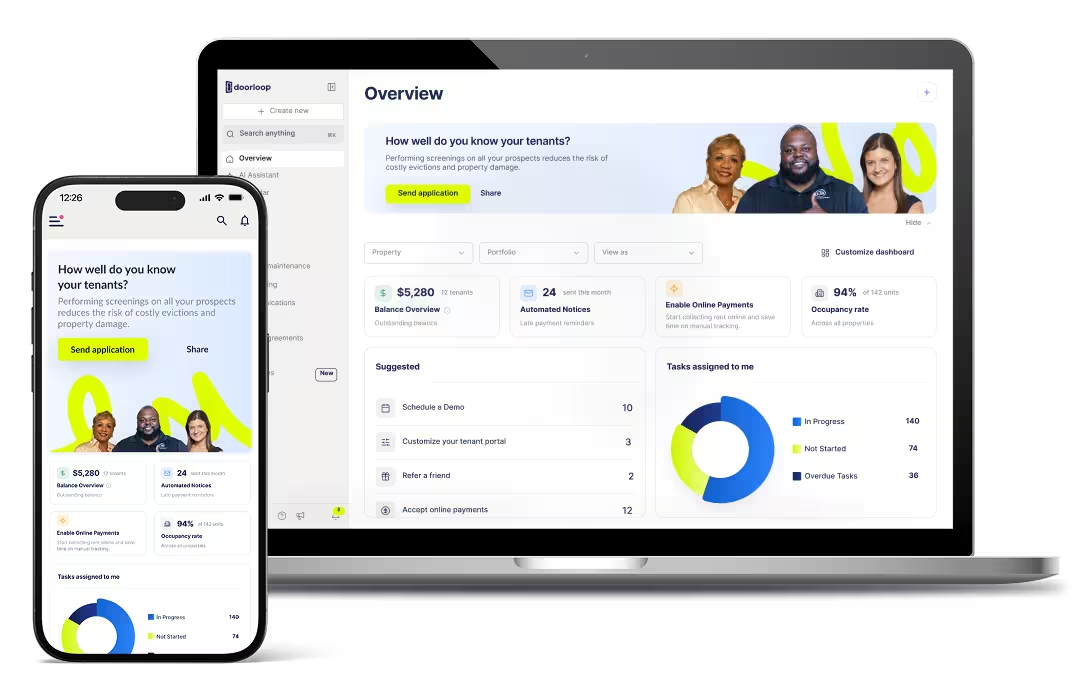
Multifamily property management software is the operational infrastructure that helps run the property management workflow at scale and without requiring separate tools for each function. Features that help multifamily operators include: automatic rent collection, centralized accounting, maintenance workorder management, simplified leasing and tenant screening, and improved tenant communication. DoorLoop's multifamily property management software consolidates all of these functions into a single system used by property managers ranging from small duplex owners to large apartment operators. The five capabilities below represent the workflows where multifamily property management software most directly reduces the property manager's daily operational burden.
Automatic Rent Collection
Multifamily property management software automates rent collection through a recurring ACH payment system that drafts each tenant's rent on the due date without any manual intervention from the property manager. Late fees apply automatically when a payment is not received by the end of the grace period, based on the fee structure entered in the lease record. Every payment generates an automatic receipt to the tenant and posts to the property's accounting ledger simultaneously, updating the rent roll in real time.
The change for the property manager is operational: instead of tracking 50 rent payments through a spreadsheet, following up by phone with delinquent tenants, manually recording checks, and making trips to the bank, the entire collection cycle runs through the software and surfaces only the exceptions that require human attention, such as a failed ACH or a payment dispute. DoorLoop handles online rent collection across multiple units through a single dashboard, giving the property manager a live view of every account's status at any point in the month.
Centralized Multifamily Accounting
Multifamily accounting in purpose-built software maintains separate books for each property within the same portfolio, consolidates all unit-level income and expenses into building-level financial statements, and produces automated owner statements on a monthly schedule without manual report assembly. The accounting system handles bank reconciliation, tracks accounts payable and receivable, generates the 1099 forms required for vendors paid [$600] or more annually, and maintains the audit trail that state real estate commissions require for trust account compliance.
Three reports drive most owner conversations about multifamily performance: the rent roll showing every unit's current lease status and payment position, the income statement comparing revenue to expenses for the period, and the cash flow statement showing how much cash the property generated after all obligations were paid. All three generate directly from the accounting ledger inside the software, eliminating the manual compilation that produces most owner reporting errors. DoorLoop's accounting module supports multifamily-specific reporting that general accounting tools like QuickBooks require manual customization to approximate.
Maintenance Work Order Management
Maintenance management in multifamily property management software starts with the tenant. Residents submit work orders through the tenant portal on any device, attaching photos and a description of the issue. The submission automatically enters the property manager's maintenance queue, tagged to the specific unit, and categorized by issue type.
The property manager triages each request from a single dashboard covering all units in the portfolio simultaneously, assigns the work to an in-house maintenance staff member or a preferred vendor from the vendor directory, and sets a target completion date. Status updates from the assigned party flow back to the tenant automatically without requiring the property manager to act as a relay between the two. The cost and vendor information log against the unit's maintenance record, building a cost history per unit that the property manager uses to identify which units are consuming disproportionate maintenance resources and to track vendor performance over time when the work is marked complete.
Simplified Multifamily Leasing and Tenant Screening
The leasing pipeline in multifamily property management software runs from the initial application through lease signing without requiring the property manager to switch between multiple external tools. Prospective tenants complete online applications through the portal, triggering integrated background checks, credit checks, and eviction history searches through the software's built-in screening system. The results return to the property manager's dashboard alongside the application, with all information in one view rather than in separate browser tabs or email threads.
Approved applicants receive a digital lease generated from a pre-built template that auto-populates the property address, unit number, tenant name, rent amount, lease term, and key dates from the application record. Both parties sign through an e-signature workflow with a full audit trail. The signed lease is stored in the tenant's digital file alongside their application, screening report, and move-in inspection checklist. The entire workflow stays inside one system, eliminating the integration gaps between screening services, e-sign tools, and document storage that standalone resolutions require.
Improved Tenant Communication
A resident portal in multifamily property management software gives every tenant a single destination for all interactions with the property: rent payment, maintenance request submission, lease document access, renewal offers, building announcements, and direct messaging with the management office. Tenants access the portal through a browser or mobile app at any time, without calling the leasing office during business hours.
Renter expectations in 2026 include digital self-service as a baseline: prospective tenants comparing multifamily properties evaluate the digital experience alongside the physical amenities, and properties without an online portal lose applicants to competitors who offer one. The practical benefit is the reduction in inbound phone and email volume for the property manager. A tenant who submits a maintenance request through the portal, receives a status update through the portal, and pays rent through the portal has no reason to call the office for routine interactions, freeing the property manager's time for the higher-value work of lease renewals, vendor coordination, and owner reporting.
Frequently Asked Questions
The questions below cover what multifamily property managers and owners ask most frequently when building or refining their management approach.
What Is the Difference Between Multifamily Property Management and Asset Management?
Multifamily property management covers day-to-day operational execution (filling vacancies, collecting rent, maintaining the physical property, managing tenant relationships, and producing monthly financial reports for the owner). Multifamily asset management covers portfolio-level strategy: ensuring the property performs against the owner's investment thesis, evaluating capital improvements, underwriting refinancing decisions, and determining when to hold or sell an asset. A property manager handles operations while a dedicated asset manager handles strategy, with the two roles reporting to different parts of the organization at larger ownership groups and institutional real estate firms.
How Is Multifamily Property Management Different from Single-Family?
Mulifamily property management is different from single-family by its scale. A single-family rental is one unit with one tenant household, while multifamily means two or more units and tenant households managed simultaneously under a single operational system. Multifamily properties include shared systems (roofs, boilers, common areas, and parking) that require coordination across all units and require on-site staff rather than part-time management on the operational side. Multifamily properties carry a consolidated rent roll, a portfolio-level NOI figure, and shared operating expenses that require a more structured accounting system than a single-unit ledger on the financial side.
What Does a First-Time Multifamily Landlord Need to Know?
The first two actions before collecting any rent are establishing the LLC and opening a dedicated property bank account, because commingling personal and property funds creates both legal exposure and accounting problems that compound quickly. The operating budget must account for the 50% rule from day one. Operating expenses on a stabilized multifamily property (maintenance, insurance, taxes, and management) consume roughly half of gross rental income, leaving the other half for debt service and owner return. Tenant screening must follow Fair Housing–compliant criteria applied consistently to every applicant. Multifamily property management software from the first rental eliminates the paper-based habits that become liabilities as the portfolio grows.
How Many Units Do You Need Before Hiring a Property Management Company?
No hard unit-count threshold applies universally, but most multifamily owners hire a management company once the portfolio crosses roughly 10 to 20 units, when the property is located more than an hour from the owner's primary residence, or when the owner wants to reclaim the 10 to 20 hours per week that hands-on management of a mid-size portfolio requires.
Can I Manage a Multifamily Property Remotely?
Yes, you can manage a multifamily property remotely. Remote multifamily management is common and operationally viable with the right infrastructure in place. Three components make it work: The first is cloud-based multifamily property management software, which provides the remote manager with visibility into rent collection, maintenance status, and financial performance. The second component is a trusted maintenance contact or property supervisor, who handles physical tasks and emergency responses. The third is an online tenant portal, allowing residents to manage rent payments, maintenance requests, and document access without requiring in-person contact.
Frequently Asked Questions