






Key Takeaways
- For multifamily teams managing 100+ units, move-in inspections protect NOI by reducing turnover friction, emergency repairs, deposit disputes, and vacant-day losses.
- A standardized checklist with timestamped photos creates a defensible condition baseline, which matters because many states put the burden of proof on landlords.
- The biggest pitfall is treating inspections as paperwork. Operators should document every room, fixture, system, exterior area, and repair need consistently across staff.
- Traditional inspections can take 1 to 4 hours, but DoorLoop AI Inspections cuts the workflow to about 20 minutes and creates work orders from findings.
Too many tenants leave rental properties due to maintenance-related frustrations and avoidable disputes. Worse, many of those issues could have been prevented before the tenant ever moved in.
The paradox is striking. Property managers spend enormous time resolving disputes, coordinating emergency repairs, and navigating security deposit disagreements. Yet the single process most capable of preventing those problems—the move-in inspection—is often rushed or inconsistently executed.
Inspections are not administrative formalities. They are one of the highest-leverage operational controls available to property managers. When executed systematically, they drive preventative maintenance, enforce lease standards, improve tenant experience, and, most importantly, strengthen retention.
And today, they no longer require hours to deliver results.
What Is a Move-In Inspection?
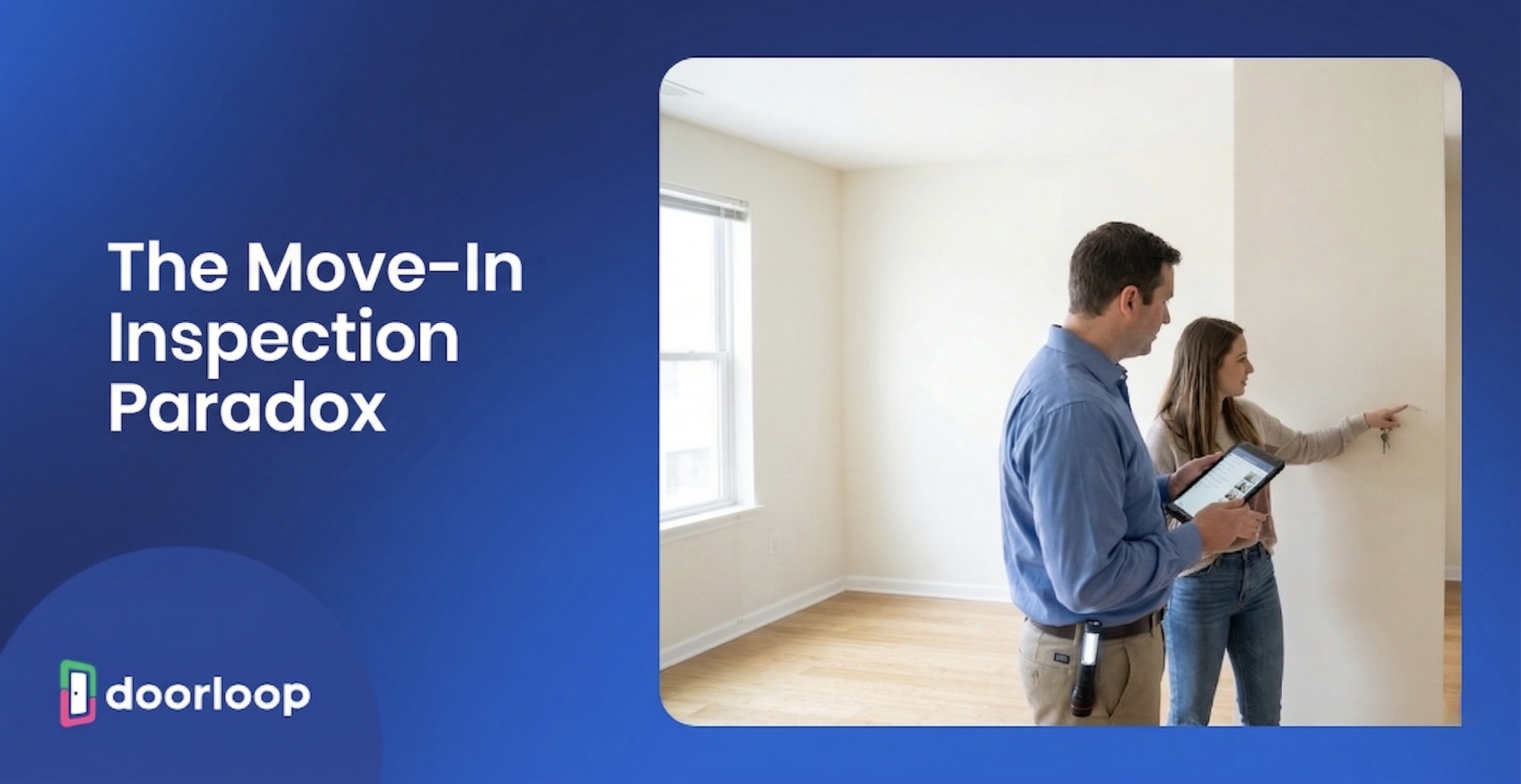
A move-in inspection is a systematic walkthrough of a rental property conducted by the landlord or property manager (often with new tenants) just before the tenancy begins. The primary goal is to establish a clear, documented baseline of the property's condition, an essential for determining tenant-caused damage versus normal wear and tear at move-out, preventing security deposit disputes, and identifying immediate maintenance needs.
What the Industry Data Shows About Inspection Impact
Move-in and move-out inspections are standard practice across the rental housing industry. HUD guidance highlights their crucial role in determining tenant-caused damage and justifiable security deposit deductions. But their impact extends well beyond deposit protection.

Turnover remains one of the most significant operational expenses in property management. According to a National Apartment Association survey, turnover rates were 46.9%, even in a strong rental market. Each vacancy carries direct and indirect costs — cleaning, repairs, leasing time, and lost rent — and requires an average of three weeks to fill.
According to Zillow's December 2025 Rental Report, the typical asking rent is over $1,900 per month. At that rate, every single vacant day costs roughly $63 in gross rent—and consistent online rent collection helps keep cash flow predictable once the unit is occupied. For portfolios of 100+ units, even marginal improvements in retention and turnover speed translate into substantial NOI impact.
Inspections directly influence that equation.

With clear expectations, reduced ambiguity, and minimized friction, property managers see stronger tenant relationships at scale while reducing avoidable turnover costs. Standardized inspections prevent costly security deposit disputes (which often average $1,500 to $3,000 to resolve), capture missed damage deductions, and stop minor maintenance issues from escalating into profit-killing emergencies.
The Professional Standard for Move-In Inspections
As a baseline, comprehensive inspections are not optional for serious operators.
The Institute of Real Estate Management includes property inspections as a core component of its Certified Property Manager curriculum. Professional standards call for thorough documentation covering every room, fixture, surface, and system. A properly designed checklist should be consistent enough that two different inspectors would document the same findings.
This level of standardization is critical for scaling portfolios, ensuring:
• Consistency across properties and teams
• Protection against claims of inconsistent treatment
• Documentation that withstands legal and audit scrutiny
Professional property management is built on such repeatable systems.
The Preventative Maintenance Value
The most expensive maintenance issue is the one discovered too late. A comprehensive move-in inspection is your first line of defense against minor problems before they escalate into emergencies.
A slow drain becomes a flood. A loose seal becomes water damage. A neglected HVAC filter becomes a system failure. Even When multiplied across dozens or hundreds of units, these preventable escalations erode margins quickly.
Preventative discipline cannot stop at move-in. Recurring inspections throughout tenancy reinforce this preventative strategy. They:
- Detect developing issues early
- Reinforce lease compliance
- Establishes a well-cared for property
- Improve safety
- Provide updated documentation
Instead of reacting to problems months later, teams address them systematically and in real time. The result? Fewer emergencies, lower repair costs, stronger tenant satisfaction, improved retention, and protected assets.
The Trust and Retention Multiplier
A lease defines the legal agreement. The inspection defines how that agreement is managed.
Walking the property together establishes shared expectations. Tenants see what a “well-maintained” means in your portfolio. They understand how documentation works and how conditions will be evaluated at move-out.
That transparency builds trust. Trust reduces friction. Reduced friction improves retention.
The National Apartment Association’s 2023 Industry Pulse survey of over 2,000 professionals identified operational efficiency as a top-three challenge. Happy, informed tenants require fewer reactive interactions, fewer escalations, and fewer disputes.
Retention also fuels growth. More than 60% of property managers cite referrals as a primary source of new business. Positive move-in experiences help generate those referrals.
Done well, the move-in inspection becomes more than a formality. It becomes the foundation of trust that supports a longer-lasting tenancy that protects your revenue.
The Legal Protection Dimension
Security deposit disputes are rarely about the money alone. They are about proof. Legal guidance consistently emphasizes that tenants should carefully inspect a unit at move-in to protect their deposit. That protection works both ways. When landlords conduct thorough inspections with tenant participation, they significantly reduce their own legal exposure.
In most states, landlords carry the burden of proof when withholding deposits. Without clear move-in records, even legitimate deductions can fail in court.
A written checklist paired with timestamped photos is one of the strongest legal protections available. In Virginia, landlords are required to provide tenants with a written statement of the property’s condition at move-in. Many jurisdictions impose similar documentation standards.
For portfolios managing hundreds of leases annually, even a small number of disputes can become operational distractions.
Move-in inspections are not just compliance tasks. They are risk management systems.
But that protection only works when documentation is structured, accessible, and standardized.
What Comprehensive Inspections Include
A professional move-in inspection is structured, methodical, and complete. The goal is to create a clear, defensible baseline of the property’s condition before the tenancy begins.
A thorough inspection should include:
• Walls, ceilings, and flooring
• Doors, windows, and locks
• Appliances and fixtures
• HVAC systems
• Plumbing and electrical components
• Safety devices
• Exterior and common areas
• Major mechanical systems
The key is not just what is inspected, but how it is documented.
Standardized checklists. Consistent photography. Clear notes. Completely organized. Repeatable across properties and team members.
For a deeper dive, see DoorLoop’s Inspection Guide.
The Traditional Time Barrier
Here is where the paradox historically emerged.
A thorough move-in inspection typically requires 1–4 hours when accounting for the walkthrough, detailed notes, photography, report creation, and administrative follow-up.
For portfolios of 100+ units, that time commitment scales quickly. Across turnover cycles, inspection hours compound into hundreds of staff hours annually. And yet, those hours have traditionally been justified.
Structured inspections prevent disputes, reduce emergency maintenance, protect deposits, and support retention. The tradeoff was accepted: invest hours upfront to avoid months of downstream friction.
Those hours were not wasted. They were preventative.
They were also manual.
The Real Return on a Thorough Inspection
The business case is clear. Standardized inspections can prevent:
- Costly security deposit disputes (averaging $1,500-$3,000)
- Missed damage deductions ($200-$500 per turnover)
- Escalating maintenance issues
- Tenant dissatisfaction and turnover
- Negative reviews and reputation damage
- Missed referrals
Layer in vacancy math — $1,200–$1,400 in lost revenue per unit — and even modest retention gains materially impact portfolio performance.
Inspections do not just protect deposits.
They protect revenue streams. They protect time. They protect asset value.
The equation was simple: spend hours upfront to save thousands later. Professional operators accepted that tradeoff.
The Long-Term Portfolio Impact
When inspections are consistent and recurring, the impact extends beyond individual leases.
Routine documentation across move-ins, move-outs, and annual inspections builds a historical record of property condition. That record informs capital planning and reduces surprise expenditures.
According to the National Apartment Association’s Income & Expense IQ data, capital expenditures average roughly 10% of Gross Potential Rent for professionally managed properties. Inspection-driven insight allows that capital to be deployed strategically rather than reactively.
Over time, this discipline increases asset longevity and portfolio stability.
The benefits are clear. The ROI is proven. The only constraint has been time.
The Breakthrough: 20 Minutes, Same Protection

Historically, thorough move-in inspections required 1 to 4 hours when accounting for the walkthrough, detailed notes, photography, report creation, and administrative follow-up. Across turnover cycles, inspection hours compounded into hundreds of staff hours annually.
Today’s property management environment demands both productivity and resident satisfaction. Fortunately, the missing puzzle piece towards achieving that balance—giving property managers back their time—exists.
DoorLoop AI Inspections reduce that traditional hours-long workflow to approximately 20 minutes. Not by cutting corners—just by eliminating busywork.
Instead of manually drafting reports, organizing photos, and compiling documentation after the walkthrough, DoorLoop AI Inspections handles the hard work for you. Snap photos and add details in bulk as you walk the property. The AI Assistant organizes everything for you with no desk work afterward. The moment you finish, DoorLoop generates a comprehensive PDF inspection report, an organized and legally binding record of the property’s condition.
If repairs are needed, you can create work orders directly from the inspection, sending vendors the details and photos immediately.
Inspection. Documentation. Report. Action. All in one pass and standardized across your portfolio. The paradox is no longer about sacrificing hours today to prevent problems tomorrow. It is about deploying protections for tomorrow without consuming today.
Ready to upgrade your operations and save hours per door?
Book a demo with DoorLoop and see AI Inspections in action.
Sources
- Zillow Research – Renters End 2025 With Improved Affordability Not Seen Since 2021 (December Rental Report)
- U.S. Census Bureau – Housing Vacancies and Homeownership (Current)
- Property Meld – Property Maintenance Operations Benchmarking Report (June 2025)
- HUD – HUD Handbook 4350.3 REV-1 (PDF)
- DoorLoop Help Center – AI Assistant Package Overview
Frequently Asked Questions