




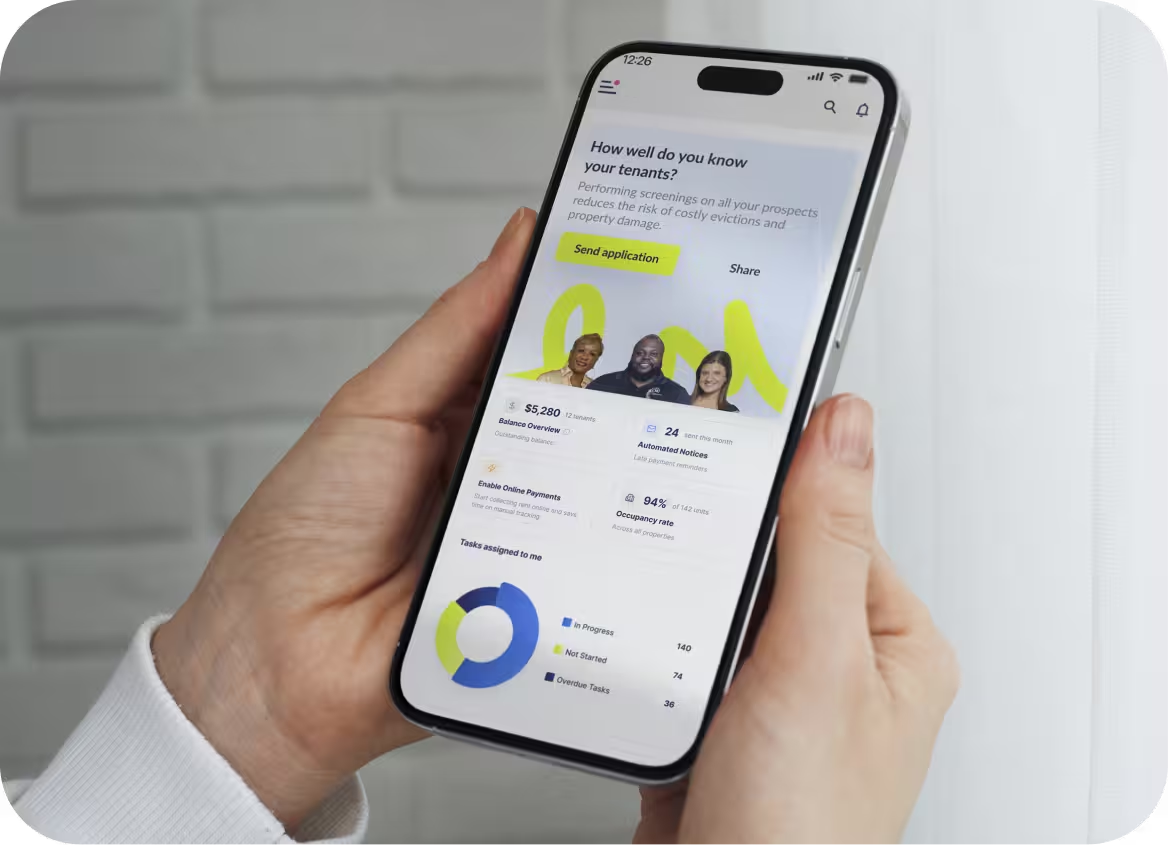
Property management software serves as a comprehensive digital program designed to centralize and optimize every aspect of rental business operations. Landlords and property managers utilize digital tools to replace fragmented manual systems with unified databases, allowing professional organizations to scale operations without increasing overhead costs, improve overall asset value by reducing vacancy rates, and enhance tenant retention through better service delivery.
Property management software features include tenant screening, rent collection, lease tracking, maintenance request management, accounting, and financial reporting, each addressing a distinct operational bottleneck that manual workflows cannot resolve at scale. Tenant screening modules within platforms such as TurboTenant, DoorLoop, and Buildium run credit reports, background checks, and eviction history checks against applicants in real time, with screening-integrated workflows shown to reduce tenant default rates by up to 25%, according to industry research. Online rent collection automates payment reminders, ACH transfers, and late fee enforcement, and is now used by 58% of landlords globally, according to property management industry data, directly addressing the challenge cited by 41% of property managers who identify late payments as their top operational problem, according to the Buildium 2025 Property Management Industry Report.
Common benefits of the Property Management Software (PMS) are listed below.
Specialized platforms assist in simplifying complex financial reconciliations by pulling data directly from bank feeds.
- Automated calculations prevent human errors in bookkeeping and financial reporting processes by providing essential features (rent tracking, lease management, tenant communication, maintenance coordination, accounting, and reporting) and benefits (streamlining daily operations, automating repetitive tasks, and simplifying complex accounting processes in real time).
- Software systems are cloud-based, allowing secure access to data from any location while maintaining organized records of financial transactions and tenant activity.
According to the Primior Group, property management software delivers 15 to 25% cost reductions across enterprise portfolios and saves property managers an average of 15 hours per week by automating routine tasks including rent reminders, compliance tracking, and maintenance scheduling. According to the U.S. General Services Administration, centralized property data systems increase oversight accuracy and reduce administrative redundancy across federally managed real estate portfolios, findings that align with private sector adoption patterns where 67% of property management companies now use dedicated software, 65% rely on AI-driven tenant screening tools, and 48% have adopted automated lease management systems, according to REsimpli.
Features of Property Management Software
Property management software typically includes rent collection automation, tenant screening, maintenance tracking, and financial reporting features. Digital payment portals support secure transactions for more consistent cash flow, while integrated screening modules help verify applicant reliability through credit and criminal background checks. Maintenance management systems streamline repair requests, assign vendors, and improve operational follow-up. Built-in communication centers make landlord-resident communication faster and more traceable for issue resolution. Financial reporting tools generate profit and loss statements, support tax preparation, and reduce bookkeeping errors caused by manual spreadsheet workflows. Cloud-based systems centralize lease documents, resident records, and operational data, making them accessible from any internet-connected device.
Simplified workflows in PMS allow asset owners to handle daily tasks without administrative friction. Residents benefit from clear communication channels and convenient payment options. Vendors receive precise repair details to finish work orders efficiently. Unified tools ensure a predictable experience for all parties in the rental process operations of property management software.
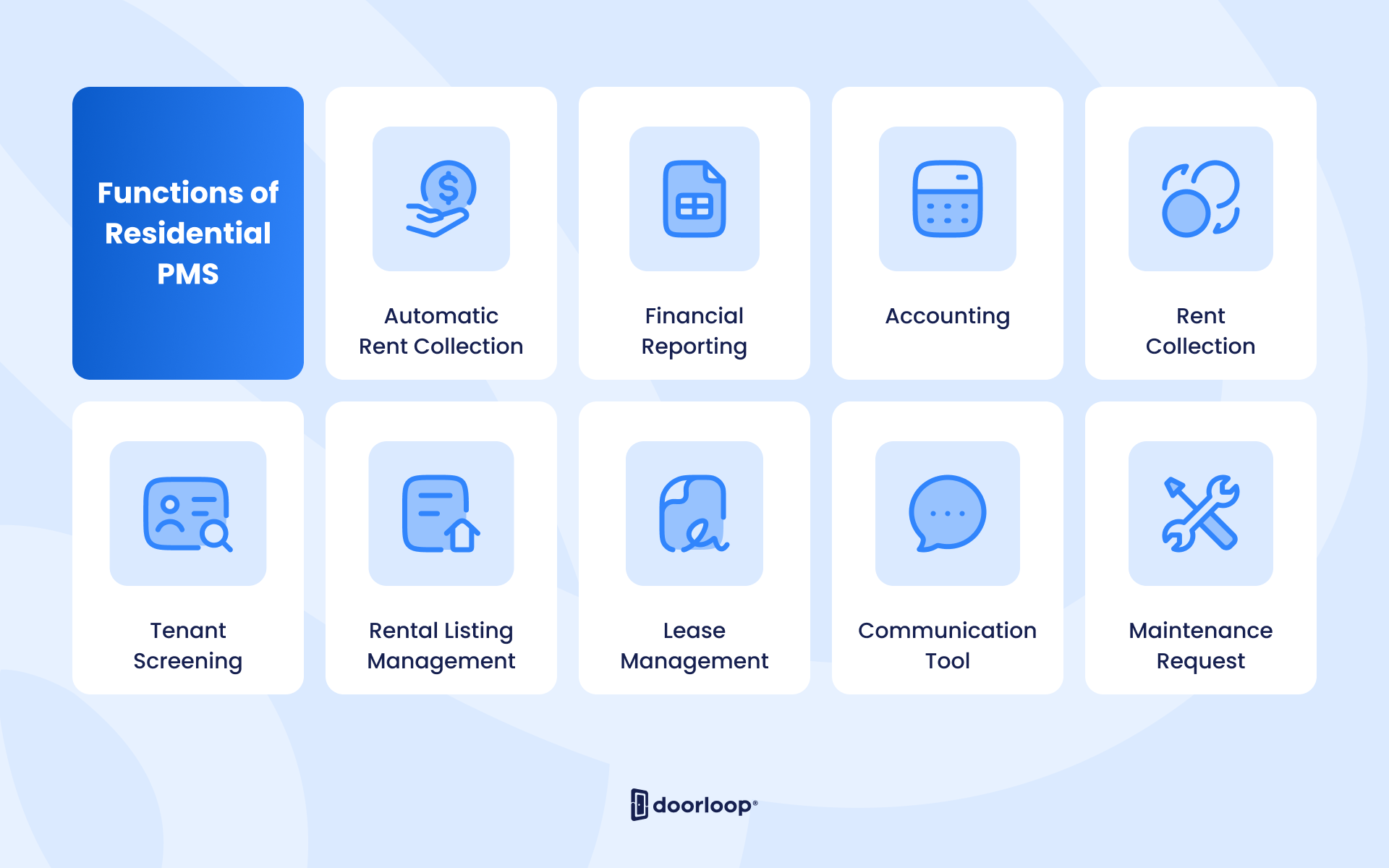
Features of Property Management Software are listed below.
- Rent Collection: Enables tenants to pay electronically via secure portals, with automatic payment tracking and reminders. Reduces risk of lost payments and enhances operational planning.
- Accounting: Tracks financial transactions and organizes expenses and income. Automates reconciliation, provides real-time data updates, and ensures compliance with tax regulations.
- Lease Management: Digitally stores rental agreements, tracks expiration dates, and automates lease renewals. Reduces paperwork, speeds up the onboarding process, and improves accuracy during tenant turnover.
- Rental Listing Management: Syndicates property listings across multiple platforms, maintaining professional branding and providing detailed analytics. Increases visibility and reduces tenant acquisition costs.
- Tenant Screening: Performs background and credit checks, ensuring consistent application processes and protecting the property from high-risk tenants. Provides fast and reliable data for decision-making.
- Tenant Communication: Provides a portal for direct communication between tenants and managers. Allows announcements, issue tracking, and clear documentation of interactions to avoid disputes.
- Maintenance Request/Work Orders: Allows tenants to submit maintenance issues online, which are tracked and assigned to vendors. Ensures prompt repairs and keeps the property in good condition.
- Financial Reporting: Generates detailed reports on financial performance, streamlining budgeting and investment decision-making. Automated reporting saves time and ensures accurate data.
- Software Integrations: Connects the property management system with other business tools like accounting apps and smart technology, creating a seamless operational ecosystem and improving productivity.
1. Rent Collection
Rent collection features provide tenants with electronic payment methods like credit cards and bank transfers through a secure portal. The software processes transactions and updates the ledger to reflect the current balance immediately. Landlords avoid physical handling of checks and trips to the bank by receiving funds into connected accounts. Automated systems send notifications to tenants before the due date to encourage timely payments. Users track payment histories and generate receipts without manual intervention. Electronic processing reduces the risk of lost payments or theft within the office. Management teams see immediate updates on which units remain delinquent. Online payment options in a PMS involve modern tenant preferences for digital convenience. Funds transfer faster into property bank accounts compared to traditional paper check methods. Consistent cash flow supports better operational planning for the property.
According to REsimpli, 80% of renters now prefer paying rent online, and in Q1 2025, online rent payments accounted for 81.7% of all transactions processed through property management platforms, up from 78.4% during the same period in 2024, according to TenantCloud.
DoorLoop includes this feature, and it contributes to the platform’s overall average time savings of 23 hours per month by reducing manual vacancy posting and leasing follow-up.
2. Accounting
Accounting modules in property management software track every dollar entering or leaving the business through integrated general ledgers. Specialized software categorizes expenses and income to provide a clear picture of the property's financial health. Managers reconcile bank statements within the platform to identify discrepancies. Integrated tools eliminate the need for external spreadsheets by hosting all financial data in a centralized database. Accurate accounting ensures compliance with tax regulations and provides transparency for property owners. Financial records stay organized for year-end reporting or internal audits. Automation reduces human errors associated with manual data entry. Property managers gain insights into profitable units and high-cost areas. Real-time data updates enable proactive financial management. Detailed audit trails document every financial change for legal security.
According to Leasey.AI, organizations using automated accounting and document workflows reduce processing errors by 89%, directly lowering the risk of compliance penalties and inaccurate owner financial reporting.
3. Lease Management
Lease management functionality stores all rental agreements digitally and tracks expiration dates to prevent unexpected vacancies. The software allows users to create, send, and sign leases electronically through integrated electronic signature tools. Landlords set up automated alerts for lease renewals to begin negotiations with tenants well in advance. Digital storage of documents ensures that important clauses and addenda remain accessible. Systemized organization reduces paperwork and organizes tenant history for retrieval during disputes. Property managers oversee multiple lease terms from a single dashboard. Automated reminders notify staff when a resident needs to provide updated insurance or contact information. Electronic signatures speed up the onboarding process for new occupants. Secure storage protects lease documents from physical damage or loss. Centralized lease data improves accuracy during tenant turnovers.
According to Leasey.AI, property management firms that adopt digital lease management with integrated e-signature tools report a 60% reduction in lease execution time, with error rates dropping from 15% to 2% and vacancy cycles shortening by 3 to 5 days on average.
4. Rental Listing Management
Rental listing management syndicates property advertisements to multiple online listing sites with a single click. The software stores high-quality photos, descriptions, and amenities for each unit to create professional postings. Managers update availability status across all platforms when a unit becomes occupied. Centralized approaches save time by removing the need to log into various websites individually. Increased visibility for vacant units leads to faster placement of qualified tenants. Listing tools help maintain consistent branding across all marketing channels. Detailed analytics show which websites generate the most leads for the property. Integrated calendars manage showing appointments for prospective renters. Property descriptions remain saved for future vacancies to reduce repetitive work. Streamlined marketing efforts lower the overall cost of tenant acquisition.
According to TenantCloud, rental listings using syndication tools receive nearly 4 applications per listing, and platforms that add listing syndication report up to 50% more views and leads per vacant unit compared to single-site postings.
5. Tenant Screening
Tenant screening tools perform background checks, credit evaluations, and eviction history searches directly within the software. Landlords receive comprehensive reports to make informed decisions about potential renters. Systems ensure consistency in the application process by applying the same criteria to every applicant. Digital screening protects the business from high-risk tenants who cause property damage or skip rent payments. Integrated applications collect necessary data and documents securely. Managers view credit scores and criminal records to assess risk levels. Screening results populate within the applicant profile for easy comparison. Automated checks save time compared to manual verification processes. Reliable data helps maintain a safe environment for all residents. Fast screening turnaround times prevent qualified applicants from finding other housing options.
According to TransUnion, renter-optimized credit scoring models such as ResidentScore predict evictions 15% more accurately than a standard credit score, and application fraud currently affects an estimated 20 to 30% of rental submissions, making automated screening a critical safeguard for property operations, according to NARPM.
DoorLoop includes this feature, and it contributes to the platform’s overall average time savings of 23 hours per month by reducing manual applicant review and screening coordination.
6. Tenant Communication
Tenant communication features provide a dedicated portal or messaging system for direct interaction between residents and managers. Users send mass announcements regarding building updates or emergency repairs to all tenants. The software maintains a complete history of all conversations to serve as a record of communication. Residents feel more connected and informed through notifications on mobile devices. Prompt responses to inquiries improve tenant satisfaction and retention rates. Digital messaging replaces unreliable paper notices left on doors. Portals allow tenants to ask questions or report concerns outside of office hours. Managers organize messages by unit or tenant name for quick reference. Clear communication channels reduce the likelihood of disputes over lease terms. Documenting interactions protects the management team in case of legal disagreements.
DoorLoop includes this feature, and it contributes to the platform’s overall average time savings of 23 hours per month; DoorLoop’s AI Assistant handles over half of tenant requests automatically.
7. Maintenance Request/Work Orders
Maintenance request systems allow tenants to submit repair issues with photos and descriptions through an online portal. The software converts submitted requests into work orders that managers assign to specific vendors or in-house staff. Users track the progress of every repair from the initial report to completion and final payment. Centralized tracking ensures that no maintenance task remains unresolved. Efficient maintenance management protects the physical asset and keeps residents happy. Vendors receive detailed information to prepare for the job before arriving on site. Automated updates notify tenants when a technician is scheduled or when a job is finished. Maintenance history reports help managers identify recurring issues with specific equipment. Digital records justify repair expenses during financial reviews. Prompt attention to repairs increases the long-term value of the property.
DoorLoop includes this feature, and it contributes to the platform’s overall average time savings of 23 hours per month by reducing coordination work between tenants, managers, and vendors.
8. Financial Reporting
Financial reporting tools generate detailed balance sheets, profit and loss statements, and cash flow reports at the push of a button (balance sheet, income statement, cash flow statement) The software pulls data from the integrated accounting system to provide accurate and up-to-date information (rent payments, vendor invoices, security deposits). Owners use reports to analyze the performance of their portfolio and make strategic investment decisions. Automated reporting saves hours of manual data compilation. Professionals share documents with stakeholders or tax professionals through secure digital links. Customizable reports focus on specific metrics like occupancy rates or maintenance costs. Visual charts help identify seasonal trends in income or expenses. Reliable data supports loan applications or property valuations. Management teams track budget variances to stay on target with financial goals. Consistent reporting builds trust between property managers and investment partners.
According to US Tech Automations, property managers who deliver consistent automated owner reports achieve 41% higher owner satisfaction scores and 2.3x longer average management contract duration than those relying on manual reporting, while automated accounting reduces bookkeeping errors by 70 to 80% compared to manual entry systems.
9. Software Integrations
Software integrations connect the property management platform with other business tools like specialized accounting apps (QuickBooks, Xero) or smart home technology (smart locks, thermostats, security cameras). Systems share data across different applications to create a cohesive ecosystem for business operations. Managers avoid redundant data entry by syncing information between platforms (tenant records, rent payments, maintenance updates). Integrations expand the capabilities of the software to meet specific business needs (tax reporting, vendor coordination, leasing workflows). Connectivity ensures that all aspects of property management work together. Smart lock integrations allow for keyless entry and easier showings of vacant units (self-guided tours, temporary access codes). Accounting integrations transfer financial data to specialized tax software (general ledger entries, expense categories, owner statements). Application programming interface connections enable custom development for unique business requirements (custom dashboards, automated notifications, portfolio-level reporting). Integrated systems provide a holistic view of the entire real estate enterprise (leasing, accounting, maintenance, communication). Professional tools work in harmony to improve overall management productivity.
According to industry research, API integrations between property management and accounting platforms improve operational efficiency by 42%, and smart IoT integrations for energy monitoring and predictive maintenance grew by 31% in 2024, with the global Building IoT market projected to expand from $64.1 billion in 2024 to $101.0 billion by 2030, according to Messe Frankfurt.
Benefits and Advantages of Property Management Software
Benefits and advantages of property management software include centralized data storage, improved communication, and automated financial workflows. Cloud-based platforms provide instant access to lease agreements and tenant records from any location, while digital automation reduces time spent on repetitive administrative chores. Real-time financial dashboards generate accurate reports regarding occupancy rates, as automatic payment reminders encourage residents to submit rent on time.
Verified background screening reports help landlords select qualified tenants to reduce eviction risks, while organized maintenance portals allow managers to track repair requests. Secure messaging systems foster transparent relationships between management teams and occupants to ensure higher satisfaction levels for all parties. Owners protect the physical condition of assets by coordinating vendor performance through a centralized digital interface. Digital tools eliminate manual bookkeeping errors by providing real-time updates to financial ledgers across every managed unit.
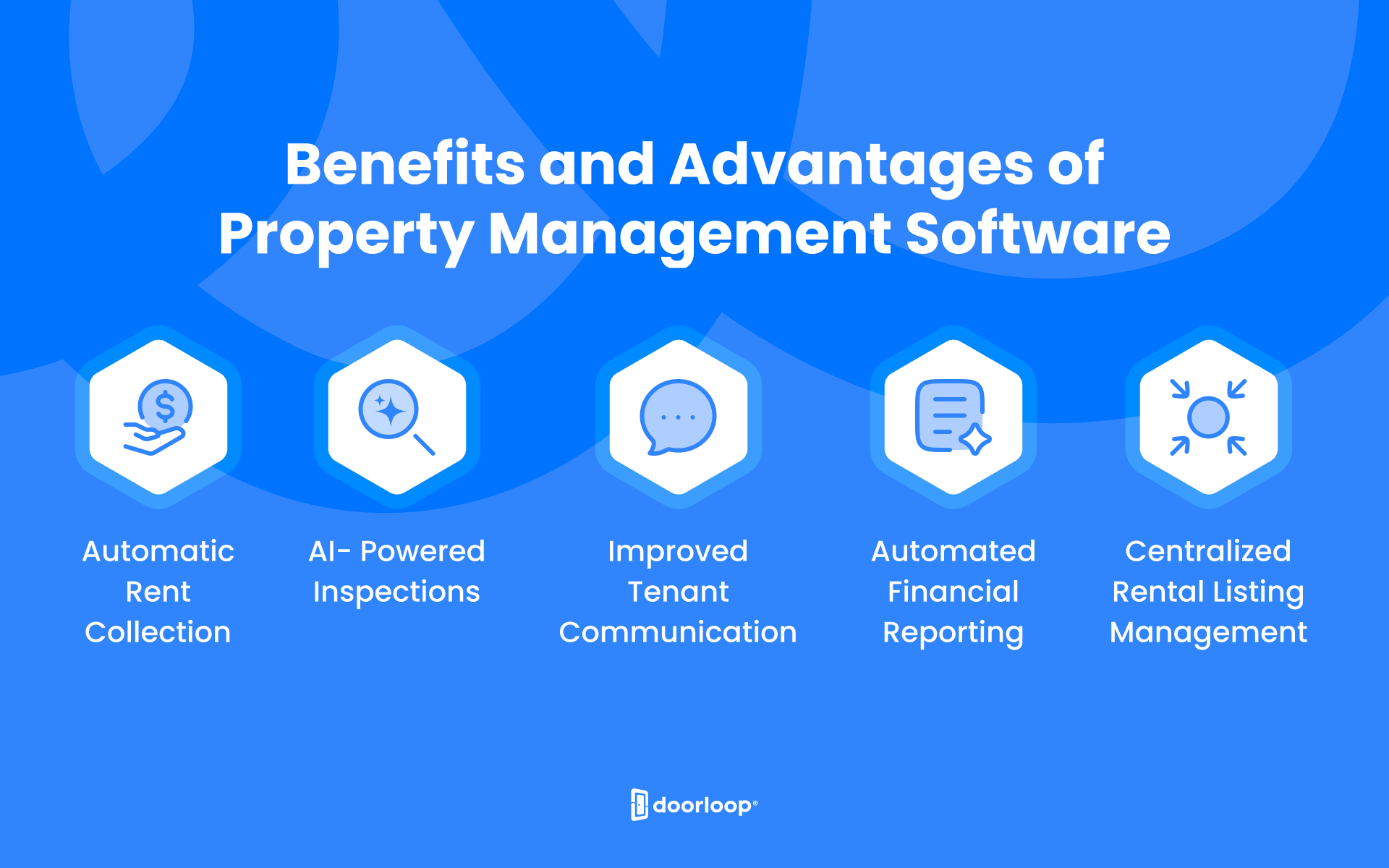
The Benefits of Property Management Software are listed below.
- Automatic Rent Collection: Automates recurring rent payments to ensure timely, predictable cash flow. Reduces administrative workload, applies late fees automatically, and provides a digital audit trail for transparency. Tenants benefit from convenient payment options, and property owners receive funds quickly.
- Improved Tenant Communication: Facilitates clear, efficient communication through a centralized platform. Tenants voice concerns and receive updates via digital portals, increasing satisfaction and reducing turnover. The platform keeps communication professional and documented for future reference or dispute resolution.
- Automated Financial Reporting: Delivers instant access to financial data with visual dashboards and detailed breakdowns. Eliminates manual report preparation, streamlining budgeting, tax reporting, and identifying areas for cost reduction. Automated reports ensure accurate and consistent financial insights.
- AI-Powered Inspections: Uses artificial intelligence to analyze property photos and identify maintenance needs, ensuring thorough, objective inspections. The technology detects hidden issues and generates detailed digital reports, improving the accuracy of damage assessments and preventing costly repairs.
- Centralized Rental Listing Management: Maximizes efficiency by pushing property listings to multiple sites from one platform. Streamlines vacancy management, reduces downtime, and improves lead generation. Updates to listings, pricing, or amenities reflect across all platforms instantly, ensuring quick responses and better tenant acquisition.
1. Automatic Rent Collection
Automatic rent collection benefits landlords by ensuring a steady and predictable cash flow without the need for manual follow-ups. The software executes recurring payments on the specified date to reduce the occurrence of late or missed payments. Tenants enjoy the convenience of payment options that eliminate the risk of forgetting the due date. Managers spend less time chasing payments and more time focusing on property improvements. Digital records of all transactions provide an audit trail for financial transparency. Automated late fees apply based on predefined rules in the lease agreement. Property owners receive funds faster through direct deposit. Electronic systems reduce the administrative burden of processing paper checks. Real-time ledger updates provide an accurate picture of monthly revenue. Reliable income streams allow for better budgeting and vendor payments.
DoorLoop supports automated rent payments, late fees, and payment reminders, helping owners collect rent faster with less manual follow-up. Set up online payments first, then open Leasing, Active Leases, select the lease, go to the Rent tab, and use Recurring Rent for rent schedules or Recurring Payment for non-ePay recurring payments. DoorLoop’s online payments flow is documented separately under tenant online payments, and recurring charges can be added from the lease itself.
2. Improved Tenant Communication
Improved tenant communication results from a centralized platform that facilitates quick and clear exchanges of information. The software provides a professional channel for residents to voice concerns and receive timely updates. Clear communication reduces misunderstandings regarding lease terms or building rules. Tenants appreciate the transparency and accessibility of their management team through digital portals. Higher satisfaction levels lead to longer lease durations and lower turnover costs. Community-wide announcements reach every resident via email or text message instantly. Dedicated messaging keeps personal phone numbers private for property managers. History logs preserve every interaction for future reference or dispute resolution. Effective communication builds a positive reputation for the rental property. Satisfied tenants are more likely to recommend the property to others.
DoorLoop includes a tenant portal and AI Assistant, helping managers respond faster and keep communication documented in one place. For one-to-one or ongoing messaging, first configure the Communications Center under Settings, Communications Center. After setup, use the Communications Center inbox to view and manage messages. For broadcasts or direct notices, go to Communications, Announcements, click Create New, and choose whether to send to all tenants or a specific tenant. DoorLoop also tracks sent communications in the Communications Log.
3. Automated Financial Reporting
Automated financial reporting provides property owners with instant access to critical data regarding their investments. The software eliminates the wait time associated with manual report preparation by staff members. Managers identify trends and financial leakages through visual dashboards and detailed breakdowns. Consistent reporting ensures that all stakeholders have a clear understanding of the property performance. High-quality data supports better budgeting and future financial planning. Users generate tax-ready reports to simplify the end-of-year filing process. Detailed expense tracking helps in identifying areas for cost reduction. Owners monitor the return on investment for individual properties or the entire portfolio. Automated schedules deliver reports to owners' inboxes on a weekly or monthly basis. Accurate financial data reduces the risk of errors during audits.
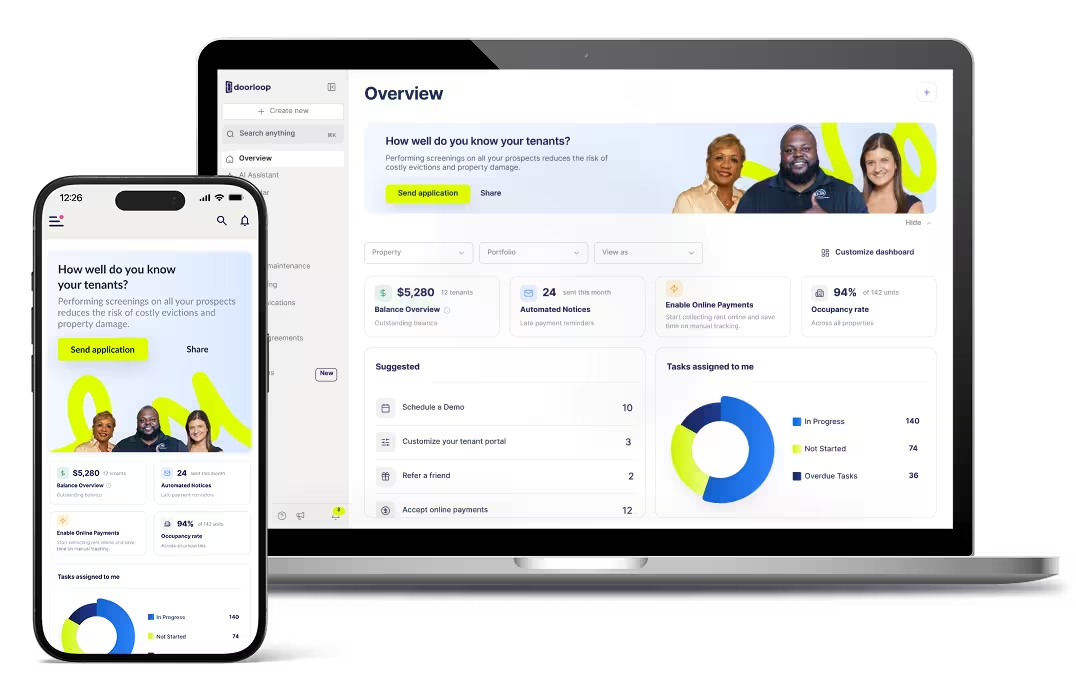
DoorLoop provides real-time reports, owner statements, and accounting dashboards, helping managers review property performance more efficiently. Go to Reports and run the financial report you need, such as the Owner Statement Report. DoorLoop’s owner statement article explains that statements can be configured and generated for a selected period. If you need cleaner accounting before reporting, DoorLoop also provides Bank Reconciliation tools, including optional bank transaction import via Plaid.
4. AI-Powered Inspections
AI-powered inspections utilize advanced algorithms to analyze property photos and identify potential issues or maintenance needs. The software guides inspectors through a standardized process to ensure no area of the property is overlooked. Managers receive objective data about property conditions without relying solely on subjective human judgment. Automated analysis detects wear and tear to prevent expensive repairs. Digital inspection reports provide a clear record of property status over time. Artificial intelligence flags damage that a human eye might miss during a quick walk-through. Consistent inspection data helps in making fair security deposit deductions. Property owners view high-resolution images of their assets from remote locations. Automated scheduling ensures that move-in and move-out inspections occur on time. Modern inspection tools increase the professionalism of the property management company.
DoorLoop does not clearly advertise AI-powered photo inspection detection as a core feature, but its AI Assistant helps with task creation, reporting, and operational insights.
5. Centralized Rental Listing Management
Centralized rental listing management offers the advantage of massive time savings when filling vacant units. The software pushes listing information to dozens of websites to maximize exposure to potential tenants. Managers maintain a single source of truth for property details and availability status. Faster lead generation reduces the time a unit sits empty and generates no income. The streamlined process allows property managers to handle larger portfolios with greater efficiency. Integrated lead tracking identifies which marketing sources provide the best applicants. Professional listings attract high-quality renters through better presentation of the property. Management teams update pricing or amenities once to reflect changes across the entire internet. Rapid responses to inquiries through the software prevent losing leads to competitors. Efficient vacancy management improves the overall profitability of the real estate business.
DoorLoop supports one-click listing syndication and e-sign leasing workflows, helping managers fill vacancies faster from one platform. Go to Leasing, Listings, find the unit, and click List Unit under the Listing Visibility column. That starts the Unit Listing Wizard, where you set up the online listing. DoorLoop’s listing article presents this as the workflow for creating online rental listings from the platform.
What is the Best Property Management Software for Large Portfolios?
DoorLoop is the best property management software for large portfolios of up to 2000 units because specialized tools cater to high-volume operations. Enterprise clients require robust systems that handle complex accounting and massive tenant databases without performance lag. DoorLoop is redefining property management software as the AI-native operating platform for innovative property management teams. Large portfolios benefit from automated workflows that reduce manual labor across hundreds of individual units. The platform provides real-time visibility into occupancy rates and financial health for extensive real estate holdings.
Professional managers utilize advanced reporting features to deliver deep insights to institutional investors. Scalability remains a core feature that allows businesses to grow unit counts without switching platforms. Enterprises rely on Doorloop property management software to maintain consistency across diverse locations. High-performance databases ensure that user experience remains fast even as portfolios expand. Implementation of enterprise-grade solutions supports the long-term growth goals of professional management firms.
Is AI used in Property Management Software?
Yes, AI is used in property management software through automation and data analysis tools. Artificial intelligence integrates into platforms to predict maintenance needs and screen potential tenants. Intelligent algorithms process rental data to optimize pricing strategies for property owners. Automated chatbots manage resident inquiries to improve response times for maintenance requests. Machine learning models detect patterns in financial records to prevent fraudulent activity quickly. Innovative firms adopt intelligent technologies to gain a competitive edge in local markets. Real-time data processing allows immediate reactions to sudden market shifts. Modern systems reduce time spent on repetitive administrative duties through logic-based workflows. DoorLoop serves as an AI native operating platform for innovative property management teams. Landlords achieve superior operational oversight by implementing AI Property Management Software into business models.
Is Property Management Software Cloud-based?
Yes, property management software is primarily cloud-based to provide seamless access and data security. Most modern providers utilize the Software as a Service model to deliver real-time updates to users across various devices. DoorLoop is a leading SaaS platform that ensures property data remains accessible from any location with internet connectivity. Cloud technology eliminates the need for expensive on-site servers and manual hardware maintenance. Managers view tenant ledgers and maintenance requests from mobile devices while performing property inspections. Centralized databases protected by high-level encryption keep sensitive financial records secure from physical loss. Reliable access ensures that teams stay connected regardless of physical office locations. Professional teams rely on Cloud-Based Property Management Software for automatic backups, preventing data loss caused by local hardware failures. Digital storage solutions provide scalable environments for growing real estate businesses.
Who Uses Property Management Software?
The main users of property management software are listed below.
- Property Managers: Property managers are professionals who handle leasing, maintenance, rent collection, vendor coordination, and resident communication across one or more properties. The occupation is projected to grow 4% from 2024 to 2034, with about 39,000 openings per year in the U.S. PMS improves day-to-day control by centralizing leases, maintenance, payments, and communication inside one operating system.
- Owners and Landlords: Owners and landlords are individuals or firms that own rental property and need visibility into income, expenses, occupancy, and tenant activity. In 2023, the U.S. had 42.5 million renter households, which reflects the scale of rental operations tied to ownership decisions. PMS improves financial visibility by organizing rent status, lease records, maintenance costs, and reporting in one place.
- Small Businesses: Small businesses include independent landlords, boutique property firms, and local operators with limited staff and tighter operational capacity. The SBA reports 34.8 million small businesses in the U.S., representing 99.9% of all businesses. PMS reduces manual work by replacing spreadsheets, scattered files, and disconnected workflows with one centralized platform.
- Condominiums: Condominiums are shared ownership communities that require management of common areas, dues, records, maintenance, and resident communication. Community association data shows about 369,000 community associations nationally, housing about 77.1 million Americans. PMS improves governance by centralizing dues tracking, notices, service requests, and property records for boards and managers.
- Apartments: Apartments are multi-unit residential properties that require consistent leasing, rent collection, maintenance coordination, renewals, and tenant communication across many units. The U.S. had 42.5 million renter households in 2023, and large renter surveys now cover 172,703 renters across 4,220 communities in 77 markets, showing the scale of apartment operations and renter expectations. PMS supports operational scale by standardizing workflows across units, tenants, vacancies, and maintenance activity.
- Commercial Properties: Commercial properties include office, retail, and industrial real estate that depend on lease administration, tenant coordination, maintenance oversight, and financial tracking. The BLS groups commercial, industrial, and residential oversight under the same management occupation, with 39,000 annual openings projected on average. PMS improves lease and asset control by organizing tenant records, maintenance workflows, and reporting across commercial operations.
- Large Companies: Large companies include enterprise operators, portfolio managers, and multi-location real estate businesses that need standardized oversight across teams and assets. Small firms make up 99.9% of businesses, which means large companies represent a much smaller but more operationally layered segment with greater coordination demands. PMS standardizes reporting, workflows, and portfolio visibility across multiple properties, departments, and markets.
- HOA and Community Associations: HOA and community associations manage common-property operations, dues, violations, board documentation, and resident notices for planned communities. CAI reports that 77.1 million Americans live in more than 369,000 community associations. PMS improves administrative consistency by centralizing dues collection, communication, records, and compliance-related workflows in one system.
1. Property Managers
Property managers oversee the daily operations of rental properties and use software to coordinate leasing, maintenance, payments, and tenant communication across 1, 10, or 100+ units. Technology helps track lease expiration dates, manage work orders, and monitor property activity across multiple buildings from one dashboard. The unique value is control at scale. Instead of reacting to missed emails, delayed repairs, or scattered records, property managers gain one operating system for faster response times, fewer missed deadlines, and stronger portfolio oversight.
Shifting the role from reactive coordination to proactive control allows managers to focus on tenant satisfaction and asset performance instead of administrative follow-ups. The result is faster response times, fewer missed deadlines, and stronger oversight across an entire portfolio.
2. Owners and Landlords
Owners and landlords use digital tools to monitor cash flow, rent collection, expenses, and property performance in real time. Whether managing 1 rental home, 4 duplex units, or 20 apartments, software turns ownership data into a clearer financial picture through automated reports, payment records, and tax-ready documentation. The unique value is visibility. Property management software shifts ownership from passive observation to active financial control with less manual follow-up.
3. Small Business
Small businesses manage portfolios efficiently through automated administrative tasks. Software reduces the need for large staff sizes by handling repetitive billing and communication, allowing small operators to compete with larger firms. Automating routine processes and streamlining operations reduces overhead costs while simplifying day-to-day management without sacrificing control.
4. Condominiums
Condominiums use management platforms to track unit owner information and common area maintenance. Tools facilitate communication regarding building rules, shared amenities, and centralized systems, eliminating communication gaps. Cloud-based platforms enable streamlining of announcements, simplifying record-keeping, and automating maintenance coordination, improving transparency among residents and administrators.
5. Apartments
Apartments require systems to manage high tenant turnover and complex utility billing. Integrated screening tools ensure only qualified applicants occupy units, reducing vacancy risks and operational friction. Automating tenant screening and billing while streamlining turnover processes leads to faster leasing cycles and more consistent occupancy rates.
6. Commercial Properties
Commercial Properties use software to handle unique lease structures and triple-net lease accounting. Managers track square footage utilization and common area maintenance reconciliations, simplifying lease management and automating calculations. Systems improve accuracy while streamlining reporting for higher-value assets.
7. Large Companies
Large Companies manage portfolios across different geographic regions using centralized databases. Management software brings high-level reporting features that provide oversight of thousands of units simultaneously, giving clarity to complex financial structures. By simplifying lease management and automating calculations, systems improve accuracy while streamlining reporting for higher-value assets.
8. HOA and Community Associations
Neighborhood organizations use management software tools to collect dues and manage architectural review requests, providing a central hub for news and document sharing, strengthening community governance. Automating dues collection, streamlining approvals, and simplifying communication platforms create more organized, transparent, and engaged communities.
How to Choose the Right Property Management Software?
Choosing the right property management software requires a structured evaluation of portfolio size, property type, tool integrations, and ease of use.
First, evaluate the portfolio size to ensure the platform accommodates the total number of units and scales with future growth. Portfolios range from single units to thousands of properties, and DoorLoop serves every range with flexible pricing models. Second, consider the property type because residential, commercial, and affordable housing each require specific management tools. DoorLoop provides specialized modules for diverse asset classes to ensure every niche is managed effectively. Third, analyze tool integrations to confirm the software connects with existing accounting, marketing, and communication platforms. Seamless data flow between applications prevents manual entry errors and saves significant time. Fourth, assess ease of use by checking third-party review sites like Capterra or G2, which consistently rank DoorLoop as a leader in user interface design. A simple interface ensures quick staff adoption and minimizes training costs for new employees. Decision makers follow these steps to understand How to Choose the Best Property Management Software.
1. Portfolio Size
Portfolio size refers to the total count of individual rental units or properties (single-family homes, multi-family complexes) managed by a business. Selecting a system based on unit volume ensures the database handles high quantities of tenant data and financial transactions without performance delays. Common ranges include small portfolios under 20 units, mid-sized operations up to 500 units, and enterprise-level portfolios exceeding 1,000 units.
DoorLoop serves the entire range from a single rental home to thousands of units through a highly scalable cloud architecture. Scalability prevents the need to switch platforms as the business acquires more assets over time. High-volume users benefit from automated bulk actions that save time across large property counts. Reliable systems manage extensive unit lists while maintaining individual record accuracy.
2. Property Type
Property type describes the specific classification of an asset, like residential apartments, commercial offices, or student housing. Choosing software based on asset class ensures the presence of essential niche features like triple net lease accounting or roommate tracking. Common categories include multi-family housing, single-family residential homes, retail centers, and industrial warehouses.
DoorLoop provides specialized modules that adapt to the distinct workflows and legal requirements of various real estate sectors. Residential managers utilize tenant portals for rent collection while commercial managers track square footage and common area expenses. Specific tools cater to the unique lease structures found in different parts of the industry. Versatile platforms allow for the management of mixed-use portfolios within a single digital dashboard.
3. Tool Integrations
Tool integrations connect applications like QuickBooks, Stripe, and Zillow to the main property management platform for data sharing, creating a unified work environment where information flows automatically between disparate systems without manual entry. Common connections include financial links to accounting programs, payment processing gateways, and marketing syndication to rental websites.
DoorLoop offers a suite of built-in integrations and an open API to ensure all business tools work in harmony. Seamless connectivity reduces the risk of human error when transferring financial or tenant information between databases. Professional teams rely on connected ecosystems to maintain a single source of truth for their data. Automated data syncing ensures that every department stays updated with real-time information.
4. Ease of Use
Ease of use measures the intuitive nature of software interfaces and navigation menus found in modern property management platforms. A user-friendly system ensures that staff members spend more time managing properties and less time troubleshooting technical issues. Common usability levels range from complex legacy software with steep learning curves to modern mobile-responsive platforms with clean designs.
DoorLoop focuses on a streamlined user experience that consistently receives top ratings for simplicity on professional software review sites. Simple navigation encourages every team member to utilize the software fully. Reduced training requirements lower the overall cost of implementing new technology within a management firm. High usability levels lead to better data entry compliance and more accurate financial reporting.
Frequently Asked Questions about Property Management Software
Property Management Software vs. Property Management System - What is the Difference?
Property management software and property management systems are terms used interchangeably within the real estate industry. Historically, the term property management system referred specifically to hotel management tools, but the definition has grown to encompass all digital rental management platforms. Modern users select these names based on preference rather than functional differences.
Both concepts involve centralizing data, automating finances, and streamlining communication for property professionals. Users interested in technical distinctions find detailed explanations in the What is a Property Management System article for more information. Real estate professionals adopt these terms to describe the digital infrastructure supporting their business operations. Consistent terminology helps in searching for the most effective technological solutions. Comprehensive systems provide all the necessary tools for modern asset management. Firms implement these platforms to maintain a competitive advantage.
Frequently Asked Questions