




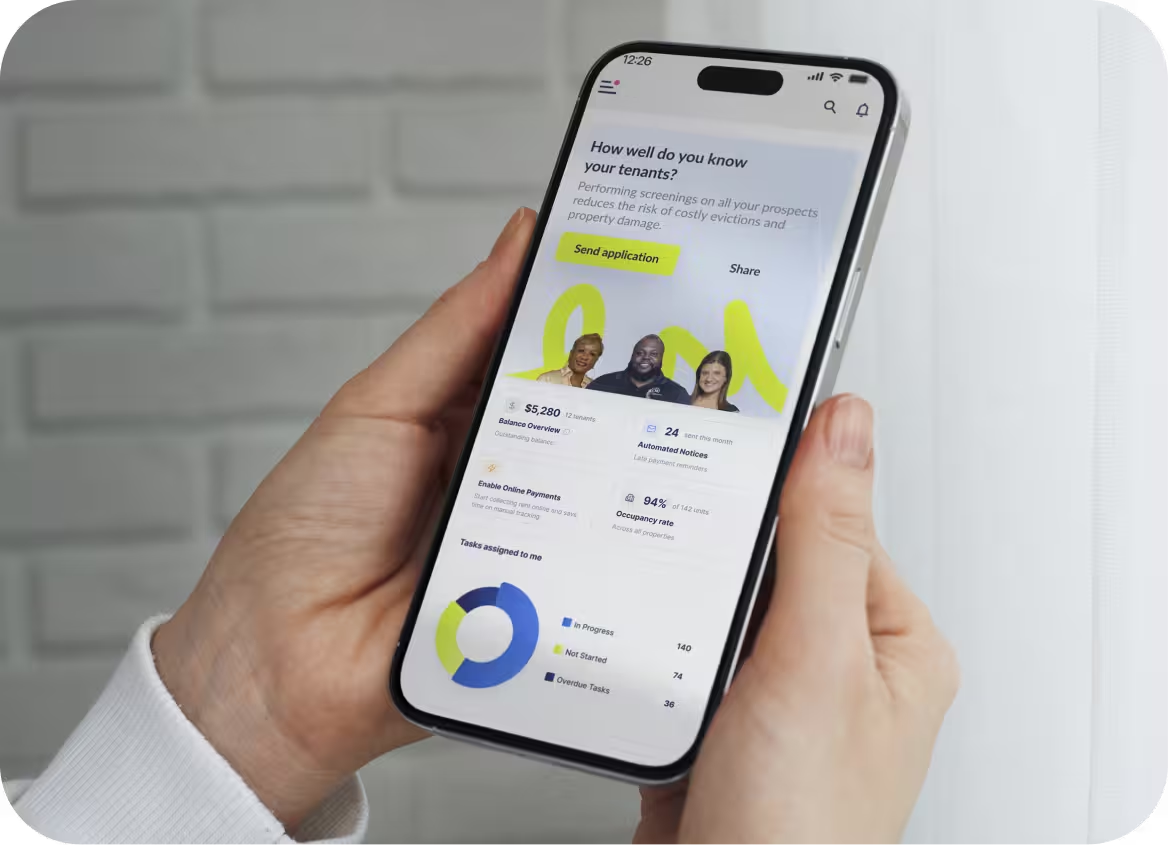
A property management system (PMS) is software that manages and streamlines the day-to-day operations of real estate properties, covering leasing, tenant management, maintenance, accounting, and reporting. A property management system (PMS) centralizes key processes (tenant screening, rent collection, lease tracking, maintenance scheduling, and financial reporting), allowing property managers to maintain accurate records and improve efficiency across residential, commercial, and mixed-use portfolios.
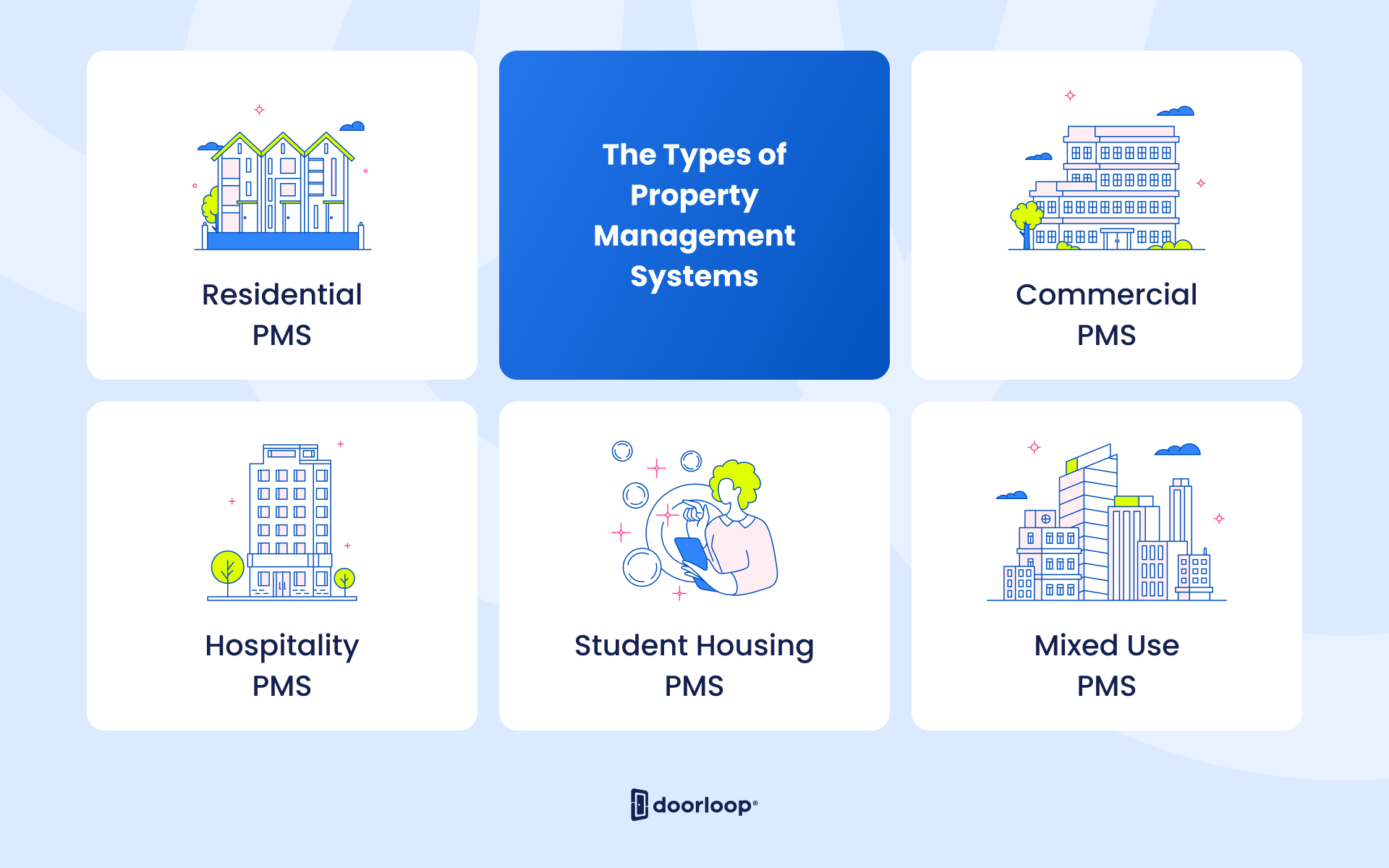
Types of property management systems are residential PMS, commercial PMS, hospitality PMS, student housing PMS, and mixed-use property PMS. Features and complexity vary based on property type and operational needs. Residential PMS focuses on tenant lifecycle and rent tracking, while commercial PMS handles lease agreements and asset performance. Hospitality PMS manages reservations, guest services, and room inventory, reflecting a structure different from long-term leasing.
The main benefit of a property management system is stronger operational control through automation and centralized data. A property management system reduces manual tasks, improves financial accuracy, and supports compliance with regulations. Examples of leading property management system providers are DoorLoop for residential property management, Agilysys for hospitality operations, and Hostaway for short-term rental management, each designed to support specific property types and operational needs. The global property management software market was valued at approximately $3.61 billion in 2025 and is projected to reach $5.89 billion by 2033, growing at a compound annual growth rate (CAGR) of 6.4% (Grand View Research).
The U.S. property management industry employs over 466,100 professionals across an estimated 330,400 firms and generates approximately $134.2 billion in annual revenue (IBISWorld, 2025). North America holds the largest regional share of the property management software market at 35.53%, while the residential segment accounts for 70.5% of overall software demand (Fortune Business Insights, 2025). PMS platforms enable property managers to maintain financial accuracy, regulatory compliance, and tenant service quality at scale across all of these segments.
Types of Property Management Systems
Types of property management systems define how software platforms handle real estate operations across different asset classes, from residential rentals to commercial portfolios and student housing. A property management system aligns features with operational needs, improving leasing, maintenance, and financial tracking, much like a CRM organizes customer relationships or an ERP centralizes business operations. Residential workflows prioritize tenant portals and rent collection, while commercial systems emphasize lease abstraction and CAM tracking, and hospitality platforms focus more on reservations and occupancy. Platforms such as DoorLoop (Best Overall), AppFolio, and Yardi support multiple property types within one system, helping operators manage different asset classes through a unified interface.
The types of property management systems are listed below.
- Residential PMS: Residential PMS manages long-term rental properties (apartments, single-family homes) by handling tenant records, leases, and rent collection. The relevance focuses on automated rent tracking and tenant portals. Reduced vacancy periods improve cash flow and support stable ROI.
- Commercial PMS: Commercial PMS manages office, retail, and industrial properties by focusing on lease agreements and asset tracking. The relevance centers on lease monitoring and financial reporting. Higher revenue per space strengthens ROI over long lease terms.
- Hospitality PMS: Hospitality PMS manages short-term stays (hotels, resorts) through reservations and occupancy tracking. The relevance covers booking coordination and guest data management. Increased occupancy rates raise daily revenue and improve ROI.
- Student Housing PMS: Student housing PMS manages dormitories by tracking tenant turnover and lease cycles. The relevance supports structured leasing and payment tracking. Full occupancy during academic seasons increases ROI.
- Mixed Use PMS: Mixed-use PMS manages combined properties (residential, retail, office) through integrated workflows. The relevance connects operations into one system. Diversified income streams stabilize and improve overall ROI.
Residential Property Management Systems (PMS)
Residential property management systems (PMS) are software platforms designed to manage long-term rental properties (apartments, single-family homes) by centralizing leasing, tenant management, rent collection, maintenance tracking, and financial reporting within one system. Residential property management systems serve the use case of handling high-volume tenant operations, reducing manual tasks, and maintaining accurate records across portfolios, where consistent rent collection and vacancy control directly influence property performance. Residential property management systems support operational clarity by connecting tenant data, lease timelines, and maintenance workflows into a single interface, improving decision accuracy and reducing administrative inefficiencies.
The top provider in the residential property management systems category is DoorLoop due to its strong adoption in rental portfolios and high user satisfaction metrics. DoorLoop holds a 4.8 out of 5 rating from over 700 verified reviews on Capterra, with about 98% positive feedback, reflecting consistent performance and reliability across property managers. Automation features reduce workload by about 23 hours per month, showing measurable efficiency gains that improve portfolio oversight and revenue stability within a property management system.
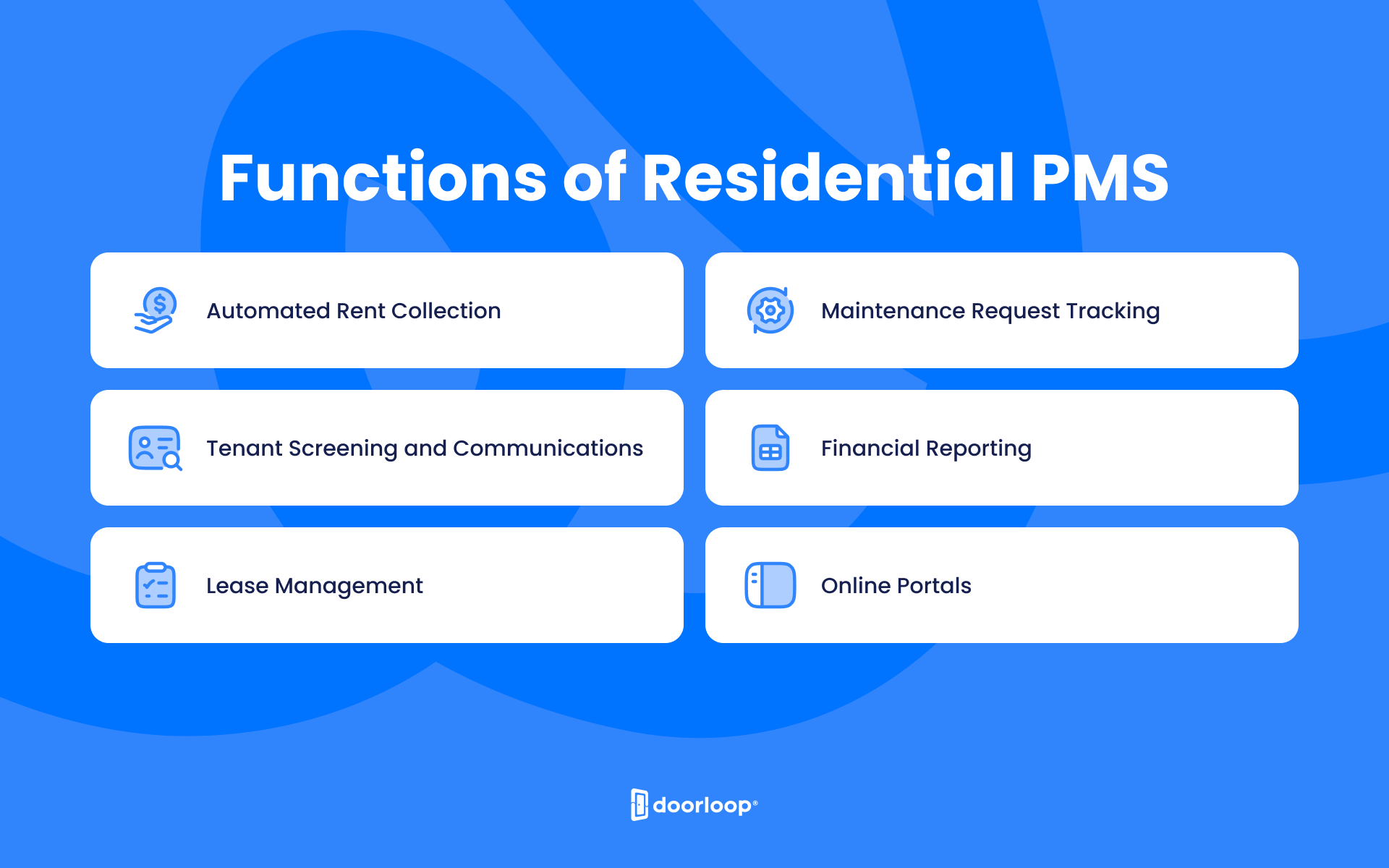
Functions of Residential PMS
The functions of residential PMS and its benefits are listed below.
- Automate Rent Collection: Automate rent collection refers to processing rental payments through scheduled billing and digital payment tracking. Automating rent collection is useful because it improves cash flow, reduces late payments, and ensures consistent rent tracking across tenants.
- Tenant Screening and Communication: Tenant screening and communication refer to evaluating tenant applications and managing ongoing communication with residents. Tenant screening and communication are useful because it improves tenant selection quality and strengthen response handling between property managers and tenants.
- Lease Management: Lease management refers to creating, storing, and tracking lease agreements and renewal schedules. Lease management is useful because it reduces contract errors, improves renewal tracking, and ensures organized lease documentation.
- Maintenance Request Tracking: Maintenance request tracking refers to recording and monitoring repair and maintenance requests from tenants. Maintenance request tracking is useful because it improves response time, organizes repair workflows, and ensures property conditions are properly maintained.
- Financial Reporting: Financial reporting is the process of summarizing rental income, expenses, and payment records. Financial reporting is useful because it improves financial visibility, supports budgeting, and ensures accurate income tracking.
- Online Portals: Online portals refer to digital access platforms for tenants and property managers to view payments, leases, and requests. Online portals are useful because they improve communication, increase transparency, and provide convenient access to property information.
Commercial Property Management Systems (PMS)
Commercial property management systems (PMS) are software platforms designed to manage income-producing properties (office buildings, retail centers, industrial facilities) by centralizing lease administration, tenant tracking, rent collection, maintenance coordination, and financial reporting within one system. Commercial property management systems serve the use case of handling complex lease structures, managing multiple tenants, and tracking long-term contracts, where lease accuracy and occupancy rates directly influence revenue performance. Commercial property management systems support operational clarity by connecting lease data, tenant obligations, and financial metrics into a single interface, improving contract enforcement and reducing administrative inefficiencies.
Functions of Commercial PMS
The functions of commercial PMS and its benefits are listed below.
- Automated Rent Collection: Automated rent collection refers to processing tenant payments through scheduled billing and digital tracking systems. Automated rent collection is useful because it improves cash flow consistency, reduces late payments, and ensures accurate rent tracking across multiple tenants and units.
- CAM Reconciliation: CAM reconciliation refers to calculating and distributing common area maintenance costs among tenants based on lease agreements. CAM reconciliation is useful because it ensures fair cost allocation, improves transparency, and reduces disputes over shared building expenses.
- Vendor Management: Vendor management refers to coordinating external service providers for maintenance, security, cleaning, and repairs. Vendor management is useful because it improves service quality, controls operational costs, and ensures the timely completion of property maintenance tasks.
- Portfolio Performance Analytics: Portfolio performance analytics refers to analyzing income, occupancy, and operational performance across multiple commercial properties. Portfolio performance analytics is useful because it improves decision-making, supports investment planning, and helps identify performance gaps across property portfolios.
Hotel Property Management Systems
Hotel Property Management Systems are software platforms that manage hotel operations (reservations, front desk tasks, housekeeping, billing, and guest data). Hotel Property Management Systems serve the use case of centralizing operations into one system that improves efficiency, reduces manual work, and improves coordination across departments. Real-time updates support accurate room availability, payment tracking, and guest management across daily hotel workflows.
Functions of Hotel Property Management Systems
The functions of hotel PMS and its benefits are listed below.
- Reservation Management: Reservation management refers to handling hotel bookings, changes, cancellations, and room availability updates. Reservation management is useful because it improves booking accuracy, reduces overbooking, and ensures efficient room allocation across all reservations.
- Check-in/Check-out Management: Check-in and check-out management refer to processing guest arrivals and departures while updating room status and guest records. Check-in and check-out management is useful because it reduces waiting time, improves guest flow, and ensures accurate occupancy tracking.
- Housekeeping: Housekeeping refers to managing room cleaning schedules and tracking room status (clean, dirty, or ready for occupancy). Housekeeping is useful because it improves room turnover speed, ensures cleanliness standards, and supports smooth guest transitions.
- Billing: Billing refers to recording guest charges, generating invoices, and managing payments for hotel services. Billing is useful because it ensures accurate financial records, reduces payment errors, and improves revenue tracking.
- Reporting: Reporting refers to summarizing hotel performance data (occupancy rates, revenue, and booking trends). Reporting is useful because it supports better decision-making, improves forecasting, and helps monitor overall hotel performance.
Short Term Rental (STR) and Vacation Property Management Systems
Short-term rental (STR) and vacation property management systems are software platforms used to manage temporary lodging properties (vacation homes, Airbnb units, serviced apartments) by centralizing bookings, guest communication, pricing, maintenance, and payment tracking. These systems serve the use case of handling frequent guest turnover, synchronizing listings across booking platforms, and managing dynamic pricing based on demand and season (peak months, holiday periods). Compliance with data privacy and payment regulations (General Data Protection Regulation (GDPR), Payment Card Industry Data Security Standard (PCI DSS)) protects guest data and ensures secure financial transactions.
Functions of STR Property Management Systems
The functions of short-term rental PMS and its benefits are listed below.
- Multi channel calendar synchronization (Reservation Management): Multi channel calendar synchronization refers to aligning booking calendars across multiple rental platforms to update availability in real time. Multi channel calendar synchronization is useful because it prevents double bookings, improves occupancy accuracy, and ensures consistent scheduling across all listings.
- Guest communication management (Check-in/Check-out Management): Guest communication management refers to handling guest inquiries, booking confirmations, and stay instructions. Guest communication management is useful because it improves response speed, reduces communication errors, and ensures clear coordination with guests.
- Automated task scheduling (cleaning/maintenance, Housekeeping): Automated task scheduling refers to assigning cleaning and maintenance tasks based on booking schedules and property needs. Automated task scheduling is useful because it ensures timely property preparation, reduces missed tasks, and improves operational coordination.
- Secure payment processing (Billing): Secure payment processing refers to handling rental payments through safe and verified transaction systems. Secure payment processing is useful because it reduces payment risks, improves transaction accuracy, and ensures faster payment collection.
- Financial reporting: Financial reporting refers to summarizing rental income, expenses, and performance data. Financial reporting is useful because it improves financial visibility, supports budgeting, and ensures accurate tracking of rental performance.
Examples of Property Management Systems
The examples of Property Management Systems are listed below.
- Residential Property Management System: A system used in residential properties (apartments, condominiums, rental homes) to manage tenant records, lease agreements, rent collection, and maintenance requests. Residential Property Management System helps housing operations maintain consistent rent tracking, organized tenant management, and efficient handling of maintenance activities. The residential segment accounts for 66% of the global property management software market revenue in 2024, and digital rent collection, maintenance tracking, and communication tool adoption increased 37% between 2022 and 2024 (IMARC Group).
- Hotel Property Management System: A system used in hotels to manage reservations, check-ins and check-outs, room allocation, and billing. Hotel Property Management System helps hotel operations maintain organized guest flow and accurate room availability through centralized coordination of daily hotel activities. According to the HotelTechReport 2026 PMS Impact Study, 89% of hoteliers save between 2 and 10+ hours per week through PMS automation, accumulating to over 500 hours of reclaimed staff time annually per property.
- Short Term Rental Property Management System: A system used for vacation rentals to manage bookings, guest communication, cleaning schedules, and pricing. Short-term rental property management systems help rental operations coordinate multiple listings, maintain property readiness, and ensure consistent booking management across platforms. The global vacation rental market is projected to reach $108 billion in 2025, growing at a CAGR of 9.8% through 2035, with Airbnb, Booking.com, and Vrbo commanding 71% of short-term rental bookings according to Skift..
- Commercial Property Management System: A system used for commercial properties to manage leases, tenant records, rent collection, and maintenance coordination. Commercial Property Management System helps property operations track tenant agreements, monitor rental income, and organize maintenance activities efficiently. Lease and tenant management holds a 35.44% revenue share within the property management software market in 2025, and lease automation tools now cover 68% of total commercial leases worldwide, according to Grand View Research.
- Enterprise Property Management System: A system used by large property organizations to manage operations, reporting, and financial performance across multiple locations. Enterprise Property Management System helps property organizations maintain centralized control, standardize operations, and monitor performance across all managed properties. API integrations between property management and accounting platforms improved operational efficiency by 42% for enterprise portfolios, and AI-driven analytics demonstrated a 38% improvement in tenant issue resolution across large-scale deployments, according to SNS Insider.
DoorLoop - The Best Residential Property Management System
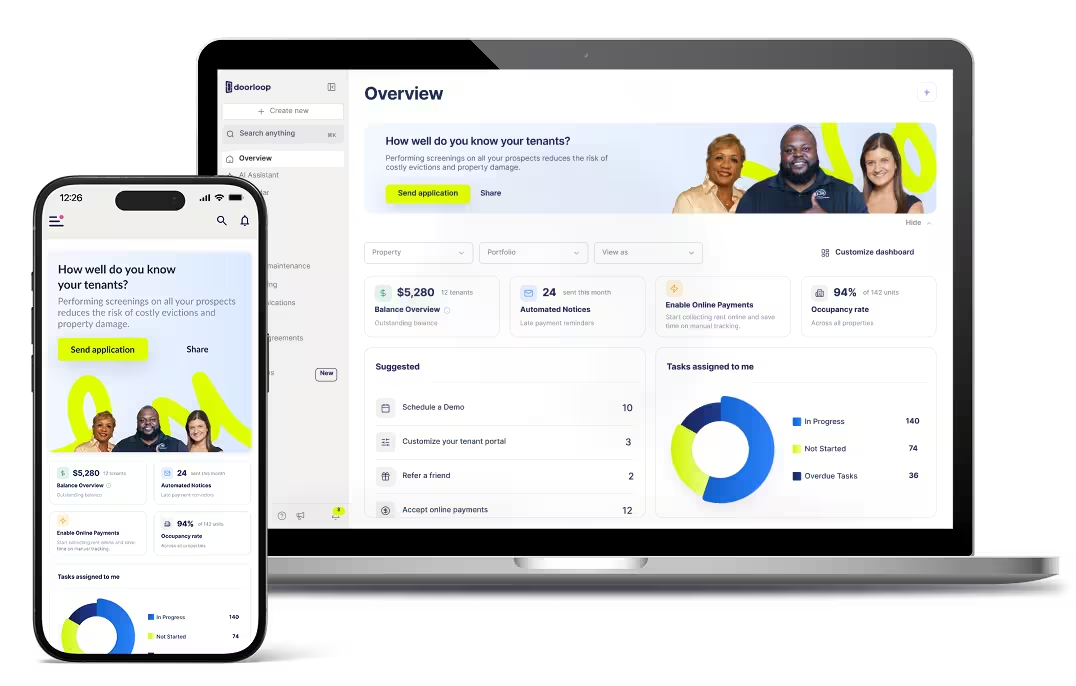
DoorLoop is redefining property management software as the AI-native operating platform for innovative property management teams. DoorLoop is a cloud-based residential property management software founded in 2019 and used by landlords, property managers, and real estate investors across more than 100 countries. DoorLoop manages tenant screening, rent collection, lease tracking, maintenance requests, accounting, and financial reporting within a single platform. It holds a 4.8/5 rating across 702 verified reviews on Capterra and has earned 47 awards from G2, with a support quality score of 9.5/10, higher than competitors Buildium (8.9) and AppFolio. Pricing ranges from $69 to $199 per month across three plan tiers.
DoorLoop was founded in 2019 and is headquartered in Miami, Florida. DoorLoop was created to simplify property management by combining automation, reporting tools, and tenant management features into one platform for residential and commercial use. DoorLoop continues to expand internationally and is used by property managers across multiple countries to support scalable rental operations and improve portfolio management efficiency.
DoorLoop has expanded its capabilities by launching Looper AI, an assistant for task automation, and opening a new office in New York to support its global growth. It recently secured $100 million in Series B funding to further its technological development.
Advantages of DoorLoop
- Centralizes bookings, guest communication, payment tracking, maintenance, and reporting in one platform.
- Reduces manual coordination by automating repetitive operational tasks such as reservation updates, reminders, and status tracking.
- Improves visibility across listings, calendars, and guest activity, which helps managers respond faster during high-turnover periods.
- Supports more consistent guest experiences through organized communication workflows and clearer operational oversight.
- Helps operators monitor revenue, occupancy, and payment activity more efficiently through unified dashboards and reporting tools.
- Scales more easily across multiple units or property types by keeping operational data, workflows, and performance tracking in one system.
- Strengthens coordination between front-end guest processes and back-end property operations, including cleaning, maintenance, and availability control.
Agilysys - Leading Hospitality Property Management System
Agilysys is a leading hospitality property management system provider that delivers integrated software solutions designed for hotels, resorts, casinos, and other hospitality businesses. Agilysys property management system supports hotel operations by managing reservations, guest check-in and check-out, housekeeping coordination, billing, and guest experience management through a unified platform. Agilysys focuses on improving operational efficiency, guest personalization, and revenue performance across hospitality environments.
Agilysys is a United States-based technology company founded in 1963 with roots tracing back to earlier electronics businesses that later transitioned into enterprise software solutions for the hospitality industry. Agilysys shifted its focus to hospitality software in the early 2000s and has since expanded globally, serving clients across North America, Europe, and Asia. Agilysys is known for its hospitality-focused systems that combine property management, point of sale, and guest engagement tools to support end-to-end hotel operations and improve service delivery.
Compared to DoorLoop, Agilysys can have two disadvantages for some users. Its platform is generally more hospitality-specific, which may make it less suitable for mixed portfolios that include residential or general rental properties. It may also involve greater operational complexity and implementation demands for smaller teams that want a simpler property management workflow.
Hostaway - Airbnb and Vacation Rental Software
Hostaway is an Airbnb and vacation rental software platform that manages short-term rental operations through a centralized system for bookings, guest communication, pricing, payments, and reporting. Hostaway supports property managers by coordinating reservations across multiple booking channels, managing guest messages, and organizing cleaning and task schedules to improve operational efficiency. Hostaway is useful because it reduces manual work, improves booking accuracy, and strengthens income consistency across rental properties by keeping all operations aligned in real time.
Hostaway was founded in 2015 to address the growing complexity of managing short-term rentals across platforms (Airbnb, Vrbo, and Booking.com). Hostaway expanded globally as demand increased for structured rental management tools that support professional property managers and multi-listing operations. The company is known for its focus on automation, operational coordination, and scalability for growing rental businesses.
Compared to DoorLoop, Hostaway can have two disadvantages for some users. Its feature set is more centered on short-term rental operations, which may make it less flexible for long-term residential or mixed-use property management. It can also be less aligned with users who want a broader all-in-one property management structure that covers leasing, accounting, maintenance, and multiple property categories in one platform.
Use of Technology in Property Management Systems
The use of technology in Property Management Systems involves digital tools that manage property operations (reservations, check-ins and check-outs, payments, maintenance coordination, guest communication, and reporting) through automated and centralized processes. Technology improves operational speed, reduces manual work, and increases accuracy in daily property management across hotels, rentals, and residential properties. Cloud-based systems are widely used to store and access data online, allowing real-time updates across multiple devices and locations. AI-driven systems support automation of repetitive tasks (guest communication, booking adjustments, scheduling, and performance tracking) to improve efficiency and decision-making.
On-premises systems operate through locally installed servers within the property, giving full control over data storage and system access while requiring higher maintenance and technical support. Cloud-based systems support flexibility and remote access, while AI-driven systems enhance automation and operational analysis across property functions. These technologies work together to improve coordination, reduce operational delays, and strengthen overall property performance by ensuring accurate and real-time management of property activities.
Cloud Based Property Management Systems
Cloud-based property management systems improve operational speed by centralizing leasing, rent collection, maintenance, accounting, and reporting within a single online environment. Instead of separating tenant records, payment data, and maintenance workflows across spreadsheets, local software, or disconnected apps, a cloud-based system synchronizes operational signals in real time and makes them accessible from any location. This creates stronger process continuity across residential, rental, and mixed-property portfolios, while reducing manual follow-up, duplicate data entry, and reporting delays.
Cloud-based Property Management Systems are useful because they improve operational efficiency, lower administrative friction, and support faster decision-making through real-time access to leasing, maintenance, payment, and occupancy data.
Accuracy improves because records update across users, workflows, and property activities within the same system, reducing duplicate entries, version conflicts, and reporting gaps.
Two examples of how Cloud-based PMSes help for better efficiency are given below.
- When a tenant submits a maintenance request, the system can immediately notify the property manager, assign the vendor, update the task status, and log the expense for later financial reporting.
- A manager overseeing 20 rental units across different locations can review rent payment status, vacancy changes, and open maintenance issues from one dashboard instead of coordinating through spreadsheets, emails, and phone calls.
Remote access, scalability, and centralized security controls make cloud-based systems suitable for both single-property operations and multi-property portfolios that need stronger visibility, faster response times, and better operational control.
DoorLoop stands out in cloud-based property management because it connects leasing, rent collection, maintenance operations, tenant communication, and financial reporting within one live system. That unified structure improves data continuity, reduces operational friction, and gives property managers a more complete control layer over day-to-day portfolio activity. DoorLoop reports serving tens of thousands of customers worldwide, and G2 lists the platform at 4.8 out of 5 from 235 verified reviews, which strengthens its position as a credible cloud-based PMS choice for operators that value usability, centralization, and workflow efficiency.
AI-powered Property Management Systems
AI-powered Property Management Systems are platforms that manage property operations (reservations, tenant management, rent collection, maintenance coordination, billing, and reporting) using artificial intelligence (AI) features. AI-powered Property Management Systems analyze operational data to automate repetitive tasks, support scheduling, and improve decision-making across residential, hotel, and rental properties. The system reduces manual workload by streamlining communication, task assignment, and performance tracking across daily operations.
AI-powered Property Management Systems are useful because they improve efficiency, increase accuracy, and support faster response times in property operations. The system reduces errors in scheduling, improves communication between tenants or guests and property staff, and provides data insights for financial and operational planning. AI-powered systems support predictive maintenance and occupancy forecasting, which improves long-term property performance and resource planning.
Three examples of AI-powered PMS uses are given below.
- When multiple maintenance requests are submitted at the same time, an AI-enabled system can group similar issues, identify priority based on urgency, route the job to the right vendor, and update both staff and tenants automatically.
- In a hotel or short-term rental setting, the system can help forecast occupancy trends, adjust staffing needs, and detect periods where room turnover or guest communication volume is likely to increase.
- In a residential portfolio, it can flag late payment patterns, recurring maintenance costs, or vacancy risks early enough for managers to act before they affect cash flow.
DoorLoop can be positioned as an AI-supported property management platform because it combines automation, centralized workflows, and real-time reporting within one operating system for leasing, rent collection, maintenance, accounting, and communication. Its practical advantage is not only task reduction, but also workflow continuity.
For example, a maintenance issue can move from tenant submission to assignment, status tracking, vendor coordination, and expense recording inside the same system, while managers keep visibility over the full process. DoorLoop supports more data-driven property operations by reducing fragmented work, improving response speed, and creating a clearer operational record for financial and management decisions.
On-Premises Property Management Systems
On-premises Property Management Systems are software platforms installed and operated within a property’s internal servers and local infrastructure to manage operations (reservations, tenant records, billing, maintenance, and reporting). On-premises Property Management Systems store all data within the property location, giving full control over system access, configuration, and data security. The system is commonly used in environments that require strict internal control and customized operational setups.
The benefits of on-premises property management systems are data control, system customization, offline operation, and internal security. Data control keeps property information within internal servers for stronger security and full ownership. System customization allows adjustments based on specific property needs and workflows. Offline operation ensures the system's use even without internet access. Internal security protects data through restricted in-house access and reduces external risks.
FAQs about Property Management Systems
Is DoorLoop a Property Management System?
Yes, DoorLoop is a property management system. DoorLoop serves property managers and owners managing up to 2,000 rental units. DoorLoop remains a cloud-based platform created to oversee rental operations (tenant records, rent collection, maintenance coordination, lease tracking, and financial reporting) within one centralized system. DoorLoop sustains residential, commercial, and mixed property management by structuring daily operations and lessening manual work across property workflows. Property managers utilize DoorLoop because they require a system handling multiple operational tasks in one place, improving accuracy in rent tracking and strengthening communication with tenants. DoorLoop connects core property management functions (payment processing, maintenance requests, and reporting) to boost efficiency and cut down operational delays.
Property Management System vs. Property Management Software - Is there a Difference?
No, Property Management System and Property Management Software are used interchangeably. Property Management System originally referred to hotel-focused systems that manage reservations, check-ins, check-outs, room allocation, and billing in hospitality operations. Property Management Software expanded the meaning of residential, commercial, and rental management functions (tenant records, rent collection, maintenance coordination, and financial reporting) across property portfolios.
PMS is used to refer to hotel systems, but it is evolved to refer to more general property management software (residential and commercial rental management software). Modern property management usage treats terms as the same category because they refer to digital tools that centralize property operations into one system. The evolution of industry terminology reflects how platforms now support broader property operations beyond hotels, aligning with what is property management software as the standard reference for modern property management solutions.
Property Management System vs. Building Management System - What is the Difference?
Property Management System manages property operations (tenant records, reservations, rent collection, billing, maintenance requests, and reporting across residential, hotel, and rental properties), focusing on administrative and financial functions that support tenants and property managers. Building Management System controls and monitors building infrastructure (HVAC, lighting, elevators, energy use, and security systems), focusing on equipment performance, safety, and environmental control within the building.
The difference lies in function, where the Property Management System handles property administration and tenant services while the Building Management System manages physical building operations and technical systems.
Property Management System vs. Maintenance Management System - What is the Difference?
Property Management System manages property operations (tenant records, reservations, rent collection, billing, lease management, and reporting across residential, hotel, and rental properties), focusing on administrative and financial control of property activities. Maintenance Management System manages maintenance activities (repair requests, equipment servicing, preventive maintenance scheduling, and work order tracking) to ensure property assets remain functional and in good condition.
The difference between property management system and maintenance management system lies in scope and purpose. Property Management System focuses on overall property administration, tenant or guest services, and financial operations, while Maintenance Management System focuses on maintaining physical assets, handling repairs, and ensuring operational equipment reliability.
Frequently Asked Questions