





Talent retention strategies for property management are practices that reduce voluntary employee turnover and keep skilled site teams, leasing agents, and property managers employed longer. The property management industry records roughly 33% annual turnover, nearly 11 percentage points above the 22% national cross-industry average, according to the National Apartment Association. The financial and operational damage from a single departure cascades across residents, owners, and the remaining team within weeks of a resignation.
The root causes of high turnover include workload burnout, flat career structures, lagging compensation, absent recognition, schedule rigidity, and outdated tools. Each cause is documented across exit interview data and industry surveys, and each point toward a specific corrective action.
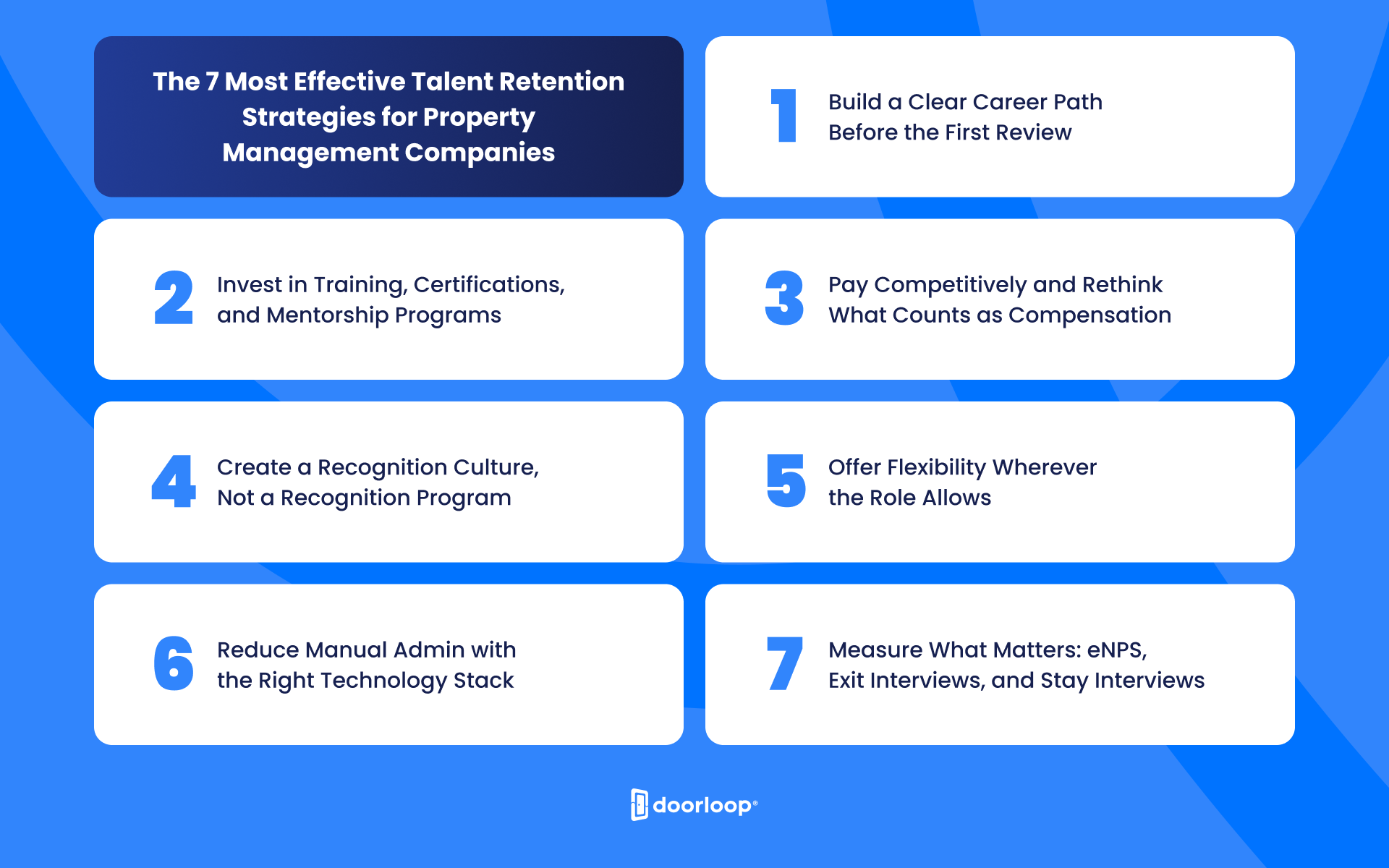
The seven actionable retention levers include building defined career paths before the first performance review, investing in certifications and mentorship, and benchmarking and restructuring compensation. They focus on building a recognition culture rather than a program, offering schedule flexibility within on-site role constraints, reducing manual admin through technology, and measuring retention with eNPS, exit interviews, and stay interviews.
Why Talent Retention Is a Critical Challenge in Property Management
Talent retention is a critical challenge in property management because it records annual turnover near 33%, compared to a 22% national cross-industry average, and the gap is not narrowing. Two structural features make retention harder in property management than in comparable service industries. First, on-site roles carry a scope of responsibility that most job descriptions understate. It can be a single property manager who handles resident relations, lease enforcement, maintenance coordination, vendor management, owner reporting, and regulatory compliance simultaneously without administrative support. Second, the industry is dominated by small and mid-size operators with flat org structures that offer limited promotion paths, which means ambitious employees who want a next role must find one at a different company.
The business impact of that gap flows directly to occupancy, resident experience, and net operating income. A departing leasing agent takes months of property-specific knowledge with them (which residents are approaching lease-end, which vendors respond fastest to after-hours calls, and which owners require weekly communication). The replacement hire spends their first 60 to 90 days rebuilding that knowledge base while current residents notice slower responses and declining service quality. Lease renewal rates drop, resident satisfaction scores fall, and owner confidence in the management company erodes. Each departure triggers a chain of downstream costs that accumulate faster than most operators account for.
Talent retention, employee retention, and employee engagement are terms used interchangeably in most property management conversations, but each refers to something specific. Talent retention refers to keeping high-performing employees in their roles over time. Employee retention is the broader measure of headcount stability across all tenure levels and performance tiers. Employee engagement measures how committed and motivated employees are in their current roles, which is a leading indicator of retention rather than a measure of it. A company tracks all three for different reasons (engagement predicts future turnover, retention measures past success, and talent retention specifically tracks whether the best performers are staying).
The True Cost of Losing a Property Manager or Leasing Agent
The true cost of losing a property manager or leasing agent is when they quit, and the immediate costs are visible and quantifiable. Recruiting fees paid to staffing agencies or job boards run $1,500 to $5,000 per posting for a leasing agent role and higher for an experienced property manager. Interview time from the hiring manager, regional manager, and any HR involvement represents unbillable hours. Onboarding and training a replacement takes 30 to 90 days before the new hire reaches full productivity, during which temp staffing or overtime from remaining team members fills the gap.
The indirect costs accumulate more slowly but run larger in total. The departing employee carries institutional knowledge about the property that is not documented anywhere (resident payment patterns, vendor reliability, ownership preferences, and the history of recurring maintenance issues). Slower maintenance response during the gap period generates resident complaints. Declining resident satisfaction during the transition directly depresses lease renewal rates. Owner relationships built over years with the departing manager do not automatically transfer to the replacement, and some owners use the transition as a trigger to rebid management contracts.
The True Cost of losing a Property Manager or Leasing Agent is shown in the table below:
<table><tbody><tr><td><b>Cost Category</b></td><td><b>What It Includes</b></td><td><b>Typical Impact</b></td></tr><tr><td>Recruiting and hiring</td><td>Job board fees, agency fees, and interview time</td><td>[$1,500 to $8,000] per role</td></tr><tr><td>Onboarding and training</td><td>Orientation, systems training, shadowing period</td><td>30 to 90 days of reduced output</td></tr><tr><td>Productivity gap</td><td>Temp coverage, overtime, missed follow-ups</td><td>60 to 120 days below full performance</td></tr><tr><td>Resident churn</td><td>Lower renewal rates during the transition period</td><td>1 to 3 additional vacancies per property</td></tr><tr><td>Owner confidence</td><td>Relationship disruption, contract rebidding risk</td><td>Variable; potentially full contract loss</td></tr></tbody></table>
Replacing a departing employee costs 40% to 200% of that employee's annual salary, according to The Liberty Group (2025), which means retaining a $55,000 property manager is financially equivalent to avoiding a $22,000 to $110,000 expense.
Property Management Turnover Rate vs. National Average
Property management averages around 33% annual turnover while the national cross-industry average sits near 22%, a gap of 11 percentage points that reflects structural differences in on-site role demands rather than industry-specific management failures. The gap exists because property management combines high-volume resident interaction, after-hours emergency exposure, and regulatory complexity into roles that are classified and compensated according to the actual scope warrants.
Turnover rates vary by role, with on-site positions running higher than regional or corporate roles. The table below compares typical annual turnover ranges and the primary stressors by position type.
<table><tbody><tr><td><b>Role</b></td><td><b>Typical Annual Turnover Range</b></td><td><b>Primary Stressors</b></td></tr><tr><td>Leasing agent</td><td>35% to 50%</td><td>High volume of prospect interactions, commission pressure, and limited advancement</td></tr><tr><td>On-site property manager</td><td>25% to 40%</td><td>After-hours emergencies, multi-task overload, owner and resident pressure simultaneously</td></tr><tr><td>Maintenance technician</td><td>30% to 45%</td><td>Physical demands, after-hours calls, compensation below the trades market</td></tr><tr><td>Regional manager</td><td>15% to 25%</td><td>Portfolio volume, operator conflict, and limited peer support</td></tr></tbody></table>
On-site property managers and experienced maintenance technicians cause the most operational damage when they leave, because they carry property-specific knowledge that takes months to rebuild. A leasing agent's departure affects the top of the leasing funnel. A departing on-site property manager or maintenance technician disrupts every operational layer of the property simultaneously, from resident relations to vendor coordination to owner communication.
The Root Causes of Employee Turnover in Property Management
Turnover in property management rarely traces back to a single cause, and the six root causes below appear consistently across exit interview data collected from on-site teams, leasing agents, property managers, and maintenance technicians. Each cause is specific enough to address directly, and each connects to a retention strategy in the section that follows.
Burnout from high-stress, high-demand workloads
Day-to-day burnout for a property manager or leasing agent looks nothing like the generic definition. After-hours calls from residents about heating failures, emergency maintenance dispatches at midnight, in-person confrontations during eviction proceedings, and compliance paperwork due to state agencies all land on the same person's plate within the same week. The cumulative effect of handling emotionally charged incidents, including eviction enforcement, criminal incidents on property, mental health crises among residents, and escalations from high-demand Class A residents, creates a fatigue pattern that standard PTO does not reset. Industry reporting from TheGuarantors and other multifamily sources has cited on-site team turnover near 52% annually, a figure that reflects how quickly burnout converts to resignation among the employees with the highest daily stress exposure.
No clear career path or advancement opportunity
The absence of a named next role is consistently among the top quit reasons in exit research across service industries, and property management is vulnerable because many firms operate with flat org structures that offer one or two rungs between leasing agent and regional manager. Swift Bunny's industry research found that only about one-third of rental housing companies have defined career paths in place, meaning the majority of employees work without knowing whether advancement is possible, on what timeline, or under what criteria. Top performers who do not receive a clear answer to "where do I go from here?" find that answer at a competing company within 12 to 18 months of reaching their current role ceiling.
Compensation that lags market and role demands
Property management compensation has not kept pace with the expansion of job scope over the past decade. A property manager hired to handle leasing in 2015 now handles leasing, resident communication, compliance documentation, vendor coordination, and owner reporting in the same role at the same pay grade. The "live-on-site discount" appears in many compensation packages as a benefit, but it does not translate into spendable income for employees who own homes or prefer to live off property, and it obscures the gap from a true market wage comparison. Bonus structures tied exclusively to leasing volume miss the operations half of the role entirely, leaving property managers who excel at retention, maintenance coordination, and owner satisfaction with no financial recognition for that work.
Lack of recognition and appreciation from leadership
Site teams describe a consistent experience of handling property emergencies with no acknowledgment from corporate leadership and reaching operational milestones that go unmarked. A leasing agent who converts a difficult prospect, a maintenance technician who resolves an emergency at 11 PM, and a property manager who controls a contentious eviction without escalation all perform work that is invisible to senior leadership unless something goes wrong. Recognition does not require a budget to begin producing retention impact: a specific, timely note from a regional director or VP after a crisis event has a measurable effect on how long the recipient stays in their role.
Rigid schedules and no flexibility
Rigid 9-to-5 on-site schedules drive out Millennial and Gen Z talent at higher rates than older cohorts, and the property management industry is hiring more heavily from those age groups as experienced employees age out of on-site roles. On-site property management roles cannot be fully remote, and that constraint is understood by most candidates who accept them. The middle ground exists and is underused: hybrid admin days where lease renewals, owner communications, and accounting tasks are completed off-site, compressed four-day schedules for leasing teams during low-activity seasons, staggered start times that allow for morning appointments, and rotating on-call coverage so no single employee carries weekend emergency responsibility every week.
Outdated tools that create manual admin overhead
Paper-based maintenance logs, disconnected spreadsheets for rent tracking, and legacy software that requires manual data entry force site teams to spend hours per week on tasks that modern websites automate in minutes. Rent collection chased by phone, maintenance requests managed through text threads, renewal reminders sent manually, and owner reports assembled from multiple sources represent work that sits entirely outside the reasons most property managers entered the industry. The time admin overhead consumes is time subtracted from resident relationships, property performance, and any sense of accomplishment in the role. Outdated tools are the single cause of property management burnout that purpose-built software directly and immediately removes.
The six causes above are not independent of each other. Burnout amplifies the cost of missing recognition, flat career structures amplify the frustration of below-market pay, and manual admin overhead reduces the flexibility that otherwise offsets schedule rigidity. The next section addresses each cause with a specific retention strategy.
The 7 Most Effective Talent Retention Strategies for Property Management Companies
The 7 most effective Talent Retention Strategies for Property Management Companies map directly to one of the six root causes identified above, and property management companies with below-average turnover rates almost implement several of them in combination rather than relying on any single lever. The strategies in order: career path mapping (addresses the missing advancement cause), training and certification investment (addresses the same), competitive compensation restructuring (addresses the lagging pay cause), recognition culture building (addresses the invisible-wins cause), schedule flexibility (addresses the rigidity cause), technology to reduce admin (addresses the outdated tools cause), and measurement through eNPS and stay interviews (addresses the blind spot that prevents all other strategies from improving over time).
1. Build a Clear Career Path Before the First Review
A career path in property management is not a vague promise of advancement. A career path is a named next role, named criteria for reaching it, and a named timeline discussed before the first 90-day review. Mapping that path during onboarding rather than at the annual performance review produces a larger retention effect because the employee starts the role knowing advancement is possible and specific, rather than discovering at month 11 that no path was ever defined.
LinkedIn research has found that roughly 25% of employees know the internal advancement paths available at their company, which means three out of four employees are making tenure decisions without the information that most directly influences those decisions. The path from leasing agent to assistant manager to property manager to regional manager needs to be drawn explicitly because it is not self-evident from the org chart in a flat property management org.
Three actions produce the most immediate impact. First, build the org chart and share it with every new hire during onboarding week, not as a policy document but as a map of where their role sits and what sits above it. Second, add a "where do you want to be in three years" question to the onboarding checklist and document the answer as a goal the manager is responsible for addressing. Third, pair every new hire with a named internal mentor within 30 days of their start date, chosen from a senior team member in the role the new hire is targeting as a next step.
2. Invest in Training, Certifications, and Mentorship Programs
Investment in professional development communicates that the company views the employee as a long-term asset rather than a replaceable occupant of a role. In property management, the certifications that signal this are the Certified Apartment Manager (CAM), Certified Apartment Portfolio Supervisor (CAPS), Accredited Residential Manager (ARM), and Certified Property Manager (CPM). Each credential represents a meaningful investment of time and exam cost, and a company that covers costs in exchange for a tenure commitment receives a more qualified employee and a longer average retention window.
Tuition reimbursement functions as a retention benefit in two ways. It directly reduces the financial barrier to continued education, and it signals that the company is investing in the employee's future beyond their current role. Camden Property Trust offers education assistance of up to [$4,500] per year as part of its benefits structure, a figure that represents a meaningful portion of annual certification costs and continuing education fees.
Internal mentorship produces a higher retention impact than external training alone, because it creates a social bond with a senior colleague that external courses do not replicate. The mentorship pairing rule that produces the most sustainable program is straightforward: senior leaders carry at least one active mentee per year, and that relationship is tracked as part of the senior leader's own performance review, ensuring accountability on both sides of the pairing rather than leaving it to an informal arrangement.
3. Pay Competitively and Rethink What Counts as Compensation
Benchmarking property management salaries requires going beyond internal pay scales to external data sources that reflect the current local labor market. The National Apartment Association compensation surveys, Glassdoor salary reports filtered by metro area and role, and Bureau of Labor Statistics wage data for the real estate and leasing sector all provide reference points that a hiring manager negotiating a leasing agent salary can use to assess whether the offer is competitive or trailing the market.
The "live-on-site discount" appears on many property management compensation summaries as a benefit, but it does not translate equally across employees. An employee who rents an apartment on the property they manage receives the discount as real income. An employee who owns a home or prefers to live off-property receives nothing from the line item, and the gap between their stated total compensation and their actual take-home is larger than the offer letter suggests. Role-specific bonuses that move behavior include a per-signed-lease bonus for leasing agents, a lease renewal bonus for property managers who retain residents, and a unit-turn efficiency bonus for maintenance technicians who complete turnovers within the target timeline. There is an NOI-based bonus for regional managers tied to portfolio performance.
CWS Apartment Homes offers a "Fitness Bucks" wellness allowance as part of its benefits package, an example of a low-cost benefit that signals investment in employee wellbeing beyond base pay. The hidden cost framing that changes most compensation discussions is that replacing a departing employee costs 40% to 200% of their salary, and a 10% raise to retain a strong performer is nearly cheaper than the total cost of their departure.
4. Create a Recognition Culture, Not a Recognition Program
A recognition program is quarterly, top-down, and generic, rewarding "Employee of the Quarter" with a plaque that arrives after the moment of impact has passed. A recognition culture is daily, peer-to-peer, and specific, naming what the employee did and why it mattered at the moment it happened.
Three tiers of recognition work at different budget levels. At zero cost: a handwritten note from the regional director after a crisis event, a named callout at the weekly team standup, and a specific mention in the company newsletter that attributes a win to the individual rather than the property. At low cost: a [$10 to $50] gift card paired with a specific written reason for the recognition, branded swag tied to a milestone, or a small anniversary gesture at the one-year and three-year marks. At website scale for multi-property portfolios: recognition tools (Awardco, Goody, Snappy, Loop and Tie, and SwagUp) allow regional managers to send recognition to site teams across dozens of properties without the logistics of coordinating physical gifts.
A [$10] gift card paired with a handwritten note after a property emergency, sent within 48 hours of the event, has a measurable effect on morale and near-term retention intent that a quarterly award ceremony delivered weeks later does not replicate. Specificity and timing matter more than dollar value.
5. Offer Flexibility Wherever the Role Allows
On-site property management roles cannot go fully remote, and most candidates who accept them understand that constraint before their first day. The flexibility opportunity exists in the portion of the role that is admin-heavy rather than presence-dependent. Tasks such as lease renewal paperwork, owner communication emails, monthly financial reporting, vendor invoice processing, and compliance documentation require a computer and a property management website, not a physical presence at the leasing office.
Specific flexible arrangements that fit property management without compromising on-site coverage include split days, where the employee handles in-person leasing office duties in the morning and completes admin work remotely in the afternoon. Other options are compressed four-day workweeks for leasing teams during the winter (November through February) when traffic volume drops, staggered start times allowing a 7 AM start for one team member and a 10 AM start for another, and rotating on-call coverage to ensure no single employee carries weekend emergency responsibility more than once per month.
Paid Time Off (PTO) policies that do not penalize employees for taking approved time off, and that do not create a social pressure to forfeit earned days, close the gap between a stated flexibility benefit and an experienced one. Remote-capable admin work requires cloud-based property management software that the site team accesses from any device, which connects directly to the technology strategy below.
6. Reduce Manual Admin with the Right Technology Stack
The category of tools that most directly reduces site-team burnout addresses the hours per week spent on tasks that have no resident-facing value and no career-development content. Resident portals that accept rent payments, maintenance requests, lease documents, and renewal signatures online eliminate the phone calls and walk-in volume that consumes on-site staff time during peak hours. Automated maintenance ticketing routes repair requests to the correct vendor without the property manager serving as a dispatch intermediary. AI leasing assistants respond to after-hours prospect inquiries and pre-qualify leads before the leasing agent's next shift begins. Automated renewal reminders reach residents 90, 60, and 30 days before lease expiration without the property manager managing a manual follow-up calendar. Digital lease signing removes the scheduling coordination required to bring residents into the office for a paper signature.
Industry reporting from sources (RXR and The Guarantors) has documented that automation tools save property management teams time in the range of 15 hours per property per month. A 15-hour monthly savings per property represents 150 hours returned to the team per month across a portfolio of 10 properties, which translates directly into faster response times, lower stress levels, and longer average tenure for the staff members whose workload drove those hours.
7. Measure What Matters: eNPS, Exit Interviews, and Stay Interviews
Three measurement tools give property management operators an accurate picture of retention health before resignation notices arrive. The employee Net Promoter Score (eNPS) asks a single question: on a scale of 0 to 10, how likely are employees to recommend the company as a place to work? Scores below 0 indicate a retention problem already in progress. Running eNPS quarterly creates a trend line that reveals whether retention initiatives are producing measurable sentiment improvement or whether turnover risk is climbing despite those efforts.
Structured exit interviews conducted within 7 days of a resignation capture the honest reasons employees leave while the experience is current and the departing employee still has some goodwill toward the organization. Exit data aggregated across 10 or more departures reveals the true pattern of causes rather than the isolated perception of a single manager.
Stay interviews are the most underused of the three tools. Conducted annually with every employee who has crossed two years of tenure, a stay interview asks high performers what keeps them engaged, what would make them consider leaving, and what one change would most improve their experience. Swift Bunny's Employee Engagement Risk Report is built for the multifamily industry and provides a structured benchmarking framework for operators running surveys across multiple sites.
How Property Management Software Supports Talent Retention?
The seven strategies above are human-led: career paths require management attention, recognition requires leadership intent, and flexibility requires policy change. Property management software operates differently because it addresses the structural source of burnout rather than the symptoms. Generic HR tools and general-purpose accounting websites are not built for the workflows that drive property management employees toward resignation. Purpose-built property management software focuses on the specific tasks that consume site-team time without producing the resident-facing outcomes or career-development experiences that retention depends on. The tasks include rent collection, maintenance ticketing, lease renewals, owner reporting, accounting reconciliation, and compliance tracking. The four capability areas below each connect directly to a specific workload reduction that the retention strategies above cannot achieve through policy or culture alone, making property management software a critical part of the result.
Automated Rent Collection and Accounting
Automated rent collection in practice means ACH transfers processed on the first of the month without phone follow-up, credit card payments accepted through a resident portal without manual posting, late fee calculations applied automatically based on lease terms, and ledger reconciliation completed without the property manager reviewing each transaction individually. The tasks removed from the property manager's weekly plate include chasing delinquent residents by phone, manually posting receipts to property accounting ledgers, reconciling trust account balances against rent rolls, and generating owner remittance reports from raw transaction data.
A concrete workflow comparison clarifies the time difference. A property manager overseeing 30 units manually spends several hours each month chasing rent by phone, posting payments individually, flagging exceptions, and reconciling the ledger before generating the owner statement without automation. The software collects, posts, reconciles, and flags only the exceptions that require human attention, returning several hours per property per month to the team for work that requires property-specific judgment with automation.
The retention connection is direct: a property manager whose Monday morning is not consumed by delinquency calls and manual posting is a less stressed employee at the end of the week. Less stress over time extends tenure.
Maintenance Request and Vendor Management
A resident-facing maintenance portal lets residents submit repair requests from their phones with photos and descriptions, track the status of open requests without calling the office, and rate the completed work after the technician closes the ticket.
A specific dynamic that the portal changes is the emotional charge of resident-staff interactions around maintenance. A resident who submits a written request through a portal must describe the issue in writing before a conversation begins, which shifts the interaction from "I am angry at you personally" to "I am reporting a maintenance condition." That structural buffer reduces in-person confrontations between residents and site staff. Fewer direct confrontations mean less emotional exhaustion for maintenance technicians and property managers, and less emotional exhaustion is one of the most reliable predictors of longer tenure in on-site roles.
Resident Portals and Communication Tools
A resident portal consolidates rent payment, maintenance requests, lease documents, community messaging, and renewal paperwork into a single app that residents access from their phones or computers. The consolidation shifts communication from phone calls and drop-in visits to asynchronous written channels, which changes the rhythm of the site team's day from reactive and interruptive to manageable and scheduled.
A leasing agent fielding 20 phone calls during a Saturday showing session is less effective and more depleted than the same agent reviewing 20 portal messages in a structured morning block and responding to each with documented, searchable records. The written channel also creates accountability on both sides: residents document their requests, and property managers document their responses, reducing the "he said, she said" disputes that generate the most emotionally draining resident interactions.
Modern property management software includes mobile apps that allow site teams to respond to portal messages, approve maintenance assignments, and review lease documents from any location with internet access.
Reporting and Owner Communication
Automated owner reporting generates monthly statements, rent rolls, occupancy reports, and work order logs from the accounting ledger without the property manager assembling the data manually from multiple sources. A property manager who previously spent 3 to 5 hours per month per owner preparing and formatting reports receives hours back when the software generates the reports automatically on a scheduled cycle.
Owner portals let owners log in and review their property's current occupancy, outstanding maintenance tickets, and financial performance without emailing the property manager for an update. The self-service access reduces inbound owner inquiries, which is one of the less-discussed but consistently cited sources of interruption for property managers managing multiple owner relationships simultaneously.
The retention connection operates through workload reduction and relationship quality simultaneously. A property manager freed from manual report assembly has more time for the strategic owner conversations that build long-term contract relationships. Better owner relationships reduce the ownership turnover that forces property managers to rebuild client rapport from scratch, which is another hidden source of on-site team burnout.
How to Measure Talent Retention in a Property Management Company
To measure talent retention in a property management company, and to know whether a retention strategy is working requires tracking specific metrics before and after implementation. Avoid relying on intuition about whether morale seems better. The metrics below give property management operators a measurable baseline and a benchmark to compare against industry norms.
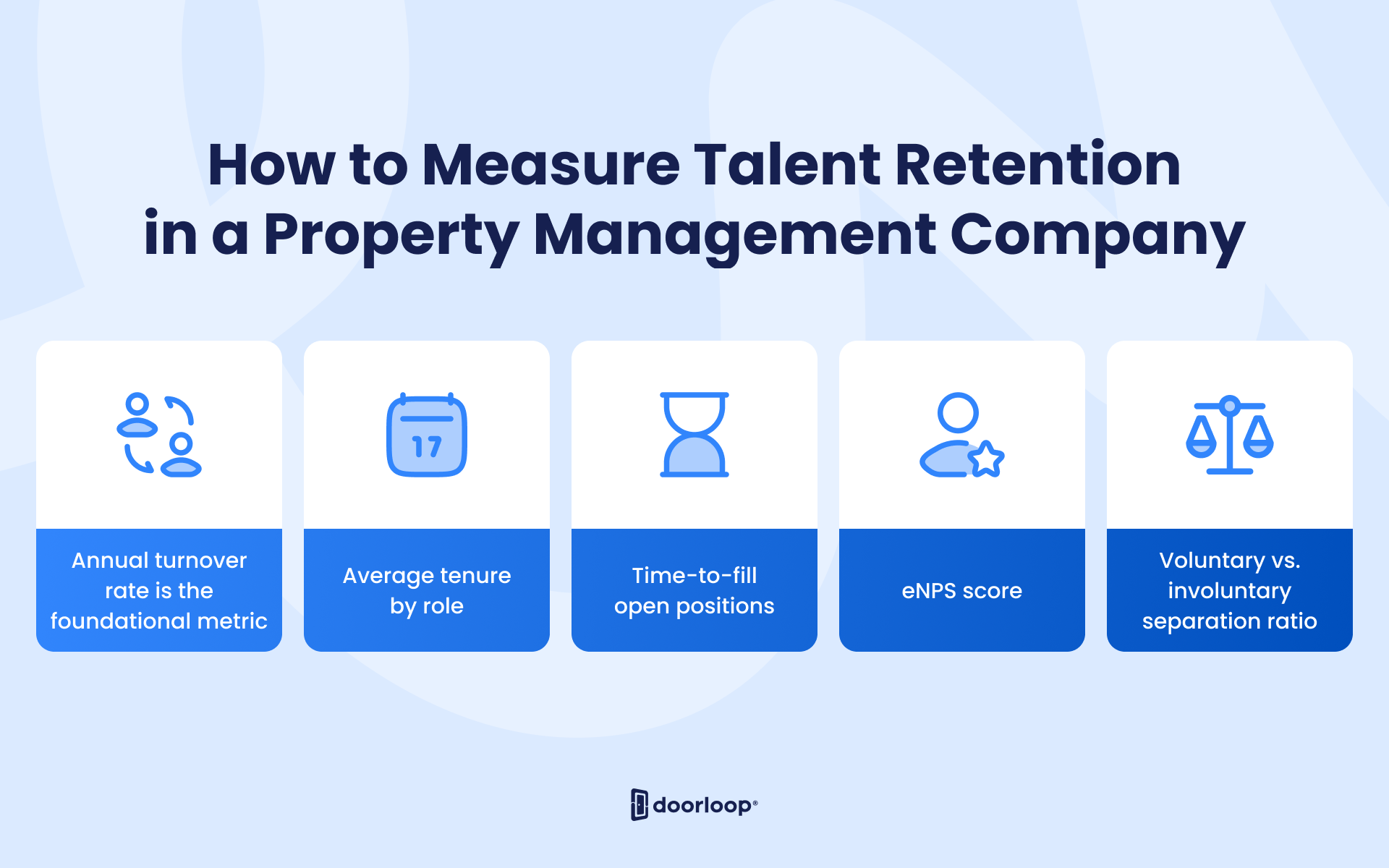
- Annual turnover rate is the foundational metric: divide the number of employees who left voluntarily during the year by the average total headcount, then multiply by 100. A result above 33% places the company above the industry average. Tracking by role (leasing agent, on-site manager, maintenance tech, regional manager) reveals where the turnover is concentrated rather than averaging it across the whole organization.
- Average tenure by role measures how long employees stay in each position before leaving or being promoted. A leasing agent average tenure below 12 months signals a systemic problem in that role's conditions. A property manager average tenure above 36 months indicates the retention strategies for that role are working.
- Time-to-fill open positions measures how long the company operates with a vacancy after a departure. Longer time-to-fill increases the workload burden on remaining team members and accelerates secondary departures. A benchmark above 45 days for an on-site property manager role signals a recruiting or compensation problem.
- eNPS score tracks whether current employees would recommend the company as a workplace. A score above 20 is considered favorable; a score below 0 indicates more detractors than promoters among the current team.
- Voluntary vs. involuntary separation ratio distinguishes between employees who chose to leave and employees the company separated. A high voluntary separation rate is a retention problem. A high involuntary rate is a hiring or management problem, and conflating the two produces the wrong strategic response.
Frequently Asked Questions About Property Management Talent Retention
The questions below address what property management owners and operators ask most directly when building or auditing a retention strategy for the first time.
What is the turnover rate in property management?
The annual turnover rate in property management averages around 33%, compared to a cross-industry national average near 22%. On-site roles run higher than the property management average: leasing agents and maintenance technicians both approach or exceed 40% in many markets, while regional managers and corporate positions sit closer to 15% to 25% annually. The gap from a national benchmark is driven by the scope and emotional demands of on-site work rather than by pay alone, which is why compensation adjustments alone rarely close the turnover difference without accompanying changes to workload, career structure, and recognition.
How much does it cost to replace a property manager?
Replacing a property management employee costs 40% to 200% of the departing employee's annual salary. On-site property managers and experienced maintenance technicians fall on the higher end of the range because property-specific knowledge loss adds indirect costs that recruiting and training expenses alone do not capture. The hidden costs, including lost lease renewals during the transition period, declining resident satisfaction scores, and owner relationship disruption, frequently exceed the direct hiring costs by a significant margin when the departing manager held long-term owner relationships that do not transfer automatically to the replacement.
Does property management software reduce employee turnover?
Property management software does not retain employees on its own, but it removes the manual admin workload that ranks among the top three reasons property managers burn out and resign. Industry reporting has documented teams saving 10 or more hours per property per month after adopting modern websites, with the time returned going toward resident-facing work and strategic tasks rather than administrative overhead. The retention impact compounds when the software enables flexible remote admin arrangements, because the combination of reduced workload and increased schedule control addresses two of the six root causes of turnover at the same time.
Frequently Asked Questions