





Considering whether Rentvine is the right property management software for your needs? In this comprehensive review, we'll cover everything you need to know — pricing, features, pros, cons, and the best alternatives available in 2026.
Many property managers are asking questions like, "Is Rentvine worth it?" or "How does Rentvine compare to other tools on the market?" We're here to give you a straight answer.
There are countless property management software options out there, and figuring out which one is actually right for your business — and why — isn't always easy. What are Rentvine's real strengths? Where does it fall short? And is a $199 monthly minimum justified for what you get?
We'll dive deep into all of that right now. Whether you've just started shopping around or you're looking for a better Rentvine alternative, read on.
What is Rentvine?
Rentvine is a property management software built for residential property managers and real estate portfolios. It positions itself as an all-in-one solution with trust accounting, customization, and customer support.
With Rentvine, you can manage a range of portfolio types, including residential, single-family, and mixed portfolios. Because it's fully cloud-based, there's nothing to download — it runs from any device with a browser and an internet connection.
Rentvine is designed for property management companies rather than independent landlords, and its $199/month minimum fee reflects that. It's built with no cap on the number of units the platform can support. Whether it's the right choice for your business, though, is a different question. Let's get into it.
Rentvine Features
Rentvine offers a set of features aimed at automating the day-to-day operations of a property management business. Here's a look at the most notable ones.
Trust accounting
Rentvine places a strong emphasis on trust accounting, offering automated reconciliations, owner statements, and portfolio-based accounting designed to pass audits and keep books clean. This is one of the areas where the platform most consistently earns praise from users.
Leasing and e-signatures
Through its RentSign document center, Rentvine allows property managers to digitize the entire leasing process — from applications to signed leases — with unlimited digital signatures included. Tenant screening is available via a TransUnion integration.
Maintenance management
Rentvine's maintenance tools allow tenants and vendors to coordinate directly, reducing a property manager's work serving as the go-between on every work order. Managers can assign vendors, track work orders, and get owner approval from one dashboard.
Customizable dashboards and reporting
Users can create unlimited custom fields, build custom reports, tag properties by any category (zip code, roof type, taxing zones, etc.), and schedule reports to run and send automatically.
Portals for stakeholders
Rentvine provides dedicated portals for owners, tenants, vendors, and applicants — all included in the base plan. These are designed to reduce inbound communication volume by giving each group self-service access to what they need.
Open API and integrations
Rentvine offers a fully open API, which allows property management companies to build custom integrations or connect third-party tools. Native integrations include QuickBooks, Slack, LeadSimple, Plaid, TransUnion, and others.
AI assistant
Rentvine includes a built-in AI assistant that allows users to run reports, post fees, and complete certain tasks using voice or text commands.
Rentvine Pricing
Here's where things get a little complicated — and worth paying close attention to.
Rentvine uses a per-unit, per-month pricing model with a single all-inclusive plan — meaning every feature is included with no paywalls or upsells.
According to their website, pricing starts as low as $1.50 per unit per month. However, their FAQ page references a standard rate of $2.50 per unit per month. Rentvine does not publicly reconcile this discrepancy, and the final rate will depend on your portfolio size and configuration.
What they are upfront about: there is a minimum monthly platform fee of $199, plus applicable transaction and screening fees. No minimum number of units required, but that $199 floor applies regardless. For a small or growing portfolio, that can add up fast.
Rentvine Review: Pros, Cons, and Key Insights
Now that we've covered features and pricing, let's get to the bottom line. Here are the real pros and cons — pulled from verified user reviews.
Pro — Accounting: Rentvine is often praised for its accounting tools. For professional property managers who need property accounting, this is one of their better offerings.
Pro — Highly customizable: The platform's unlimited custom fields, flexible reporting, and open API make setting up your workflows easier. Teams with complex or unique needs will find a lot to work with.
Pro — Customer support: Rentvine advertises an average support response time of 35 minutes, and user reviews frequently back this up, calling out the support team as a differentiator.
Con — High minimum cost: Regardless of how many units you manage, you're paying at least $199/month before any add-ons. For smaller or growing portfolios, that's a meaningful premium — especially when comparable software starts at a fraction of that price.
Con — No dedicated mobile app: Multiple verified reviewers have flagged the absence of a native mobile app as a notable drawback. Rentvine's own knowledge base references a workaround of adding the website as a home screen shortcut on mobile devices — but that should not be confused for a dedicated Rentvine mobile app. Confirm current mobile availability directly with Rentvine before purchasing.
Con — Limited marketing tools: Reviewers consistently note that Rentvine's listing and marketing capabilities are thin compared to competing platforms, which may be a meaningful gap for managers who rely on software to fill vacancies.
Rentvine vs. Competitors: How It Stacks Up
Rentvine is not featured on the 2026 Capterra Shortlist for Real Estate Property Management Software, which is reserved for the highest-rated and most widely reviewed products in the category. With only around 10 published Capterra reviews, it lacks the volume of verified user feedback that the platforms below have built up. Here's a closer look at each alternative.
1. DoorLoop (Best Overall Alternative)
⭐⭐⭐⭐⭐ 4.8 (700+ reviews)
Who better to offer an alternative than a platform that's earned the highest rating in the category?
DoorLoop is an all-in-one property management software built for speed, simplicity, and growth — and it's the only platform in this comparison to earn the top overall score on the 2026 Capterra Shortlist.
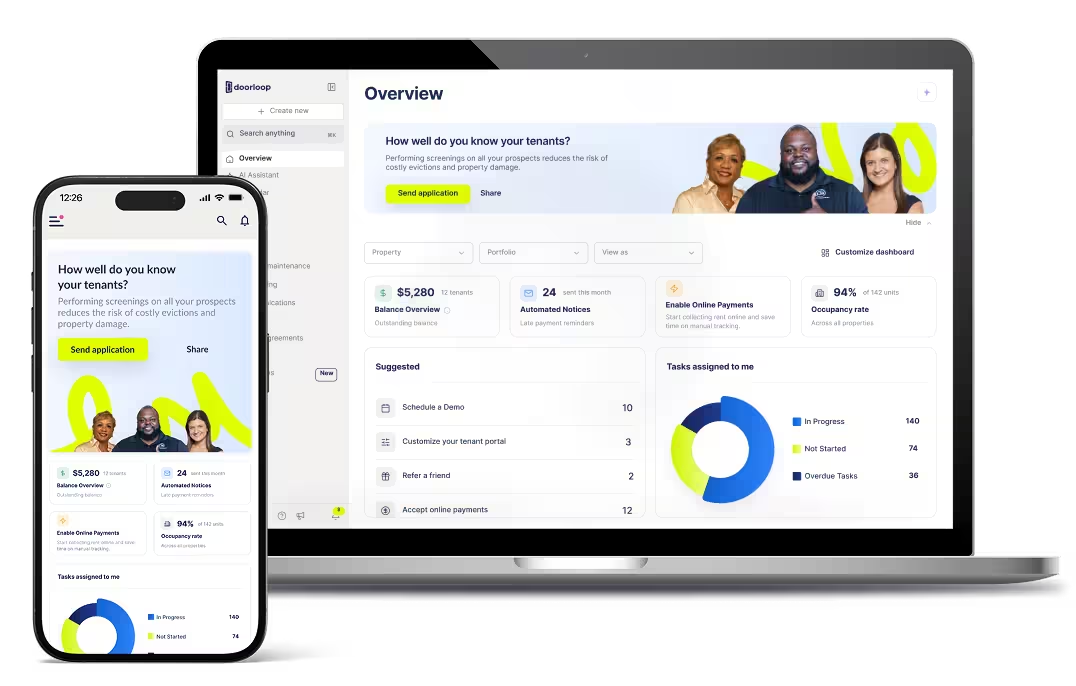
Where Rentvine's $199/month minimum makes it a tough sell for smaller portfolios, DoorLoop starts at just $69/month for up to 10 units (billed annually). And unlike Rentvine, DoorLoop includes a full-featured mobile app, built-in listing syndication and marketing tools, and real human support that users consistently describe as best-in-class.
DoorLoop features
- Full accounting suite with bank sync: Manage your books from a complete chart of accounts, financial reports, bank reconciliation, and a QuickBooks integration — all in one place.
- Automated rent collection and tenant portal: Give tenants a dedicated portal to pay rent, submit maintenance requests, and communicate with you — via web or the DoorLoop mobile app.
- Listing syndication and marketing tools: List vacant units on Zillow, Trulia, and more directly from DoorLoop. This is an area where Rentvine reviewers specifically flag a gap.
- Maintenance request tracking: Manage work orders, assign vendors, track progress, and pay vendors — all within one dashboard.
- Full-featured mobile app: Available on iOS and Android, with nearly every desktop feature accessible on mobile. A meaningful contrast to the mobile limitations flagged in Rentvine reviews.
- Owner portal and reporting: Keep owners informed with real-time statements, reports, and distributions from a dedicated portal.
- World-class support: Consistently praised in reviews, with real team members reachable by email, chat, phone, and Zoom depending on your plan.
- These features are only the beginning. Get a full list of DoorLoop features here.
DoorLoop pricing
Discounted rates apply when billed annually.
- Starter: $69/month (annual) or $99/month (monthly) — up to 10 units
- Pro: $149/month (annual) or $189/month (monthly)
- Premium: $209/month (annual) or $239/month (monthly)
That's a starting price well below Rentvine's $199/month minimum — with no hidden minimums, no separate implementation fees, and no feature paywalls. See all plans here.
Schedule a free demo today and see why DoorLoop is the highest-rated property management software of 2026.
2. Innago
⭐⭐⭐⭐⭐ 4.9 (442 reviews)
Innago is a free property management platform built for simplicity. It's engineered for smaller portfolios and independent landlords who want a clean tool without the overhead of a monthly subscription.
For property managers who are just getting started or managing a limited number of units, Innago is a strong no-cost option. That said, it's best suited to smaller operations — managers with larger, more complex portfolios may find its feature set limiting over time.
Innago features
- Online lease signing and document management
- Automated rent collection
- Maintenance request tracking
- Tenant screening and rental applications
- Tenant portal
- Mobile app
Innago pricing
Innago is free to get started. Fees apply for payment processing and tenant screening — these can be passed to tenants depending on your setup. There are no monthly subscription fees for landlords.
3. Propertyware
⭐⭐⭐⭐ 3.9 (318 reviews)
Propertyware is a long-standing, customizable platform designed specifically for single-family property management companies. If deep accounting tools, portfolio-level reporting, and open API access are your top priorities — and you have the technical resources and time to configure the platform — Propertyware could be worth considering.
That said, it comes with trade-offs. Recurring themes in verified user reviews include a steep learning curve, sluggish system performance, and workflows that can feel unintuitive compared to newer platforms. Its 3.9 out of 5 Capterra rating — the lowest of the platforms covered here — reflects these concerns. Propertyware does appear on the 2026 Capterra Shortlist, but trails the other alternatives in this comparison by a meaningful margin.
Propertyware features
- Portfolio-level accounting and reporting
- Customizable dashboards
- Maintenance management
- Open API
- Lead-to-lease automation
- Owner and tenant portals
- Mobile app
Propertyware pricing
- Basic: $1.00/unit per month — $250 monthly minimum + implementation fee of 2x the monthly subscription price
- Plus: $1.50/unit per month — $350 monthly minimum + implementation fee of 2x the monthly subscription price
- Premium: $2.00/unit per month — $450 monthly minimum + implementation fee of 2x the monthly subscription price
Rentvine or an Alternative?
Rentvine is a solid platform for the right kind of user — a professional property manager that prioritizes customization, and isn't price-sensitive at a $199/month starting point.
But if you're looking for software that works for any portfolio size, doesn't make you jump through hoops to get a price, and consistently earns the highest marks from real users — DoorLoop is the clear answer. Better features. Better support. Better value. And a mobile app that actually exists.
You can see our full DoorLoop vs. Rentvine comparison here, or schedule a free demo today and see what you've been missing.
Frequently Asked Questions