





AI in property management refers to the application of artificial intelligence across property workflows from leasing and maintenance triage to accounting and tenant communication, reducing the manual labor that keeps operators reactive instead of strategic. Property managers, landlords, independent owners, and enterprise portfolio operators all rely on the technology to process data faster than any human team, interpret context, and act on it without constant oversight. AI adoption in the sector surged from 21% to 34% in a single year, with 53% of operators now relying on general-purpose AI tools and 43% using AI embedded directly in their property management services (NAA and AppFolio, 2025 Performance Ecosystem Report).
AI in property management covers a broad range of operational functions. Leasing and tenant screening use AI to move prospects from inquiry to signed lease with fewer manual touchpoints. Maintenance workflows apply predictive logic and automated dispatch to cut response time. Accounting uses AI to categorize transactions and flag anomalies in financial records. Tenant communication relies on AI chatbots to resolve inquiries around the clock. Marketing and reporting round out the core use cases. DoorLoop, the AI-native property management software, integrates AI across all of the functions above in one platform.
Key Takeaways
- AI in property management automates and augments the full property management workflow, including leasing, maintenance, accounting, and communication, by interpreting context and adapting responses, unlike basic rule-based automation.
- The primary use-case categories in property management AI are leasing and tenant screening, maintenance and work order management, accounting and financial reporting, and tenant communication, each covering distinct operational tasks.
- Generative AI, large language models (LLMs), and agentic AI serve different roles: generative AI produces content, LLMs process and respond to language, and agentic AI executes multi-step workflows with minimal human input.
- DoorLoop natively integrates AI across all core property management workflows, handling up to 80% of tenant requests automatically through its built-in AI Assistant.
What Is AI in Property Management?
AI in property management is the use of machine learning, natural language processing, and predictive analytics to automate, support, or replace repetitive tasks inside a property management workflow, including drafting lease documents, triaging maintenance requests, categorizing financial transactions, and responding to tenant inquiries.
The technology goes by several names in the industry, including artificial intelligence property management and PropTech AI. A common source of confusion is the distinction from basic automation: basic automation executes a fixed rule the same way every time, while AI interprets context, learns from new data, and adapts its output accordingly. A rule-based system flags late payments on a set date; an AI system reads a lease, identifies the grace period, and flags the payment at the right time for the right tenant.
Generative AI vs LLMs vs Agentic AI in Property Management
The three AI types most referenced in property management serve distinct functions, and choosing the right one depends on the workflow. The table below outlines each type across four dimensions: AI Type, What It Does, Example Use in Property Management, and Human Oversight Needed.
<table><tbody><tr><td><b>AI Type</b></td><td><b>What It Does</b></td><td><b>Example Use in Property Management</b></td><td><b>Human Oversight Needed</b></td></tr><tr><td><b>Generative AI</b></td><td>Produces original text, images, or structured content from a prompt</td><td>Drafts listing descriptions, lease renewal letters, and maintenance follow-up messages</td><td>Low, output review recommended</td></tr><tr><td><b>LLMs (Large Language Models)</b></td><td>Reads, interprets, and responds to natural language input</td><td>Answers tenant inquiries, summarizes financial reports, and classifies maintenance requests</td><td>Low to medium</td></tr><tr><td><b>Agentic AI</b></td><td>Executes multi-step workflows autonomously based on data signals</td><td>Routes a maintenance request from submission to vendor dispatch to tenant notification</td><td>Medium, human approval at key steps</td></tr></tbody></table>
Agentic AI delivers the deepest operational impact for complex, multi-step workflows, while generative AI fits fastest for content creation tasks.
What Are the Use Cases of AI in Property Management?
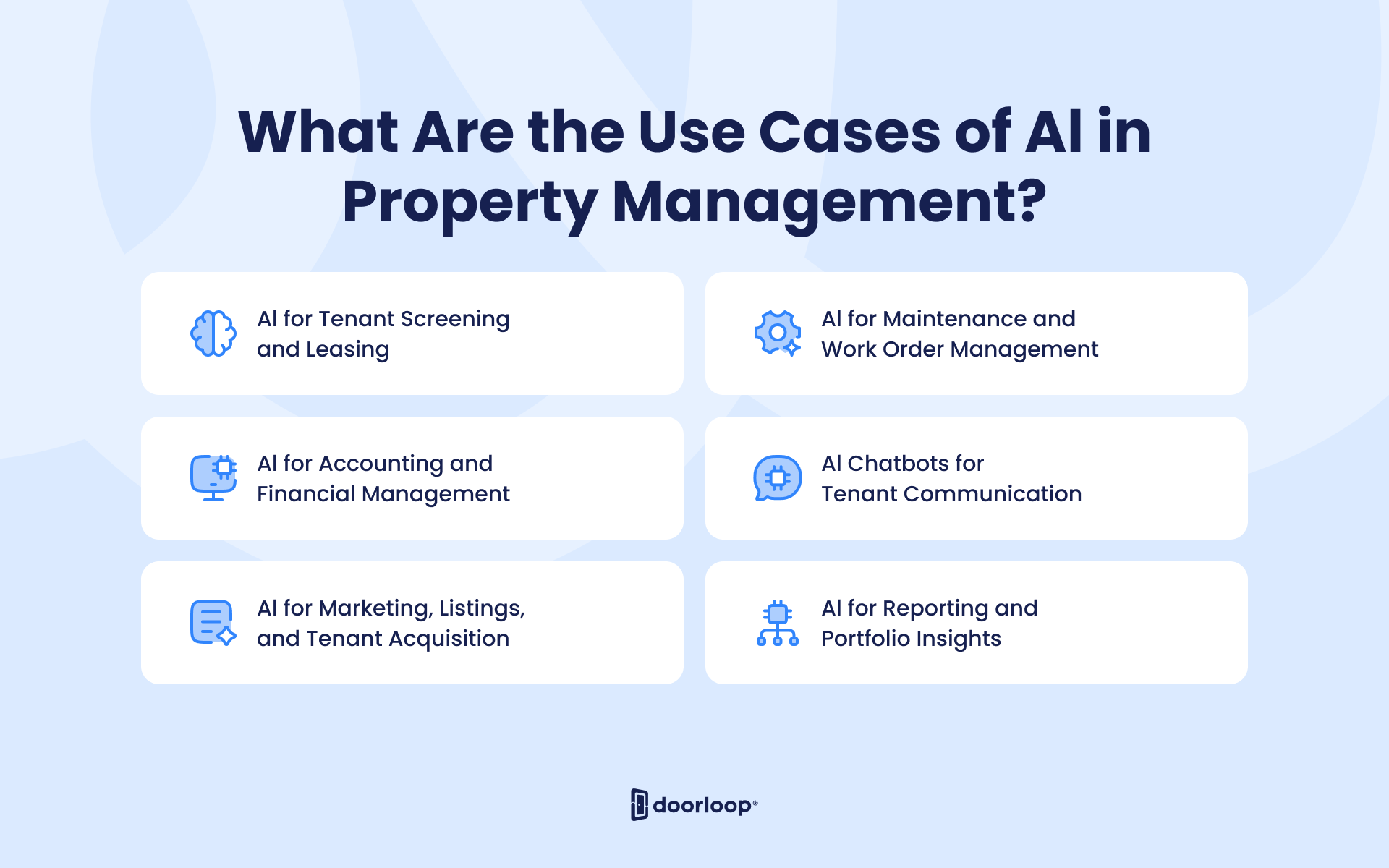
The use cases of AI in property management are varied and impactful. AI in property management addresses six core operational categories: tenant screening and leasing, maintenance and work order management, accounting and financial management, tenant communication, marketing and listings, and reporting and portfolio insights.
AI for Tenant Screening and Leasing
AI handles the full screening and leasing workflow across application intake, ID verification, credit and income analysis, lease generation, and e-signature routing. Services with AI-powered screening parse applications and generate a recommendation in minutes, compared to the 30 to 45 minutes a human reviewer typically takes, cutting screening time by up to 75% (NAA). Automated leasing assistants respond to prospects 24/7, schedule showings, and move leads through the funnel without requiring a staff member to be available.
Fair Housing compliance remains a human responsibility even when AI is doing the screening work. AI must apply the same criteria uniformly to every applicant, and a qualified team member must review any adverse decision before it is communicated. Property managers should audit their AI screening models regularly to confirm consistent criteria are in use across all applications.
AI for Maintenance and Work Order Management
Predictive maintenance AI analyzes performance patterns across HVAC systems, plumbing, and roofing to flag deterioration before a failure occurs, giving property managers a window to schedule repairs proactively rather than reactively. When a tenant submits a maintenance request, AI triages the issue, categorizes the urgency, creates a work order automatically, and routes it to the appropriate vendor, reducing manual coordination at every step. Predictive maintenance yields a return of up to 10 times the initial implementation cost by reducing emergency repairs by up to 30% and extending equipment life by up to 40%.
IoT sensor integration extends predictive capability further by feeding live equipment data directly into the AI triage system, triggering alerts before a tenant ever notices a problem. The result is faster response times, lower repair costs, and fewer escalations.
AI for Accounting and Financial Management
AI in property management accounting automates transaction categorization, bill scanning and data extraction, expense tracking, rent roll reconciliation, and anomaly detection across financial ledgers. Financial report generation is one task AI handles end-to-end: the system pulls data from across the portfolio, structures it into standardized reports, and delivers them to owners or stakeholders on a set schedule, a task that previously required 3 or more hours of manual work per report cycle.
Anomaly detection is a particularly high-value function. AI flags irregular charges, duplicate entries, or unexpected variances in a ledger before the accounting period closes, catching errors that manual review typically misses until month-end. Keeping every property on its own chart of accounts allows AI to surface anomalies at the property level rather than masking them in aggregated data.
AI Chatbots for Tenant Communication
AI chatbots handle routine tenant inquiries 24 hours a day, 7 days a week, covering rent payment questions, maintenance request status updates, lease term clarifications, and move-in or move-out procedures without escalating to a staff member. Automated rent reminders go out on a configurable schedule, reducing the volume of inbound "when is rent due" messages that occupy leasing and administrative teams. AI performs sentiment detection to identify frustrated or distressed tenants and route those conversations to the appropriate team member before the issue escalates for more complex messages.
Maintenance request status inquiries are one of the highest-volume categories AI handles without escalation. Tenants receive real-time updates on work order progress automatically, eliminating the need to call the office for a status check.
AI for Marketing, Listings, and Tenant Acquisition
AI generates listing descriptions, social media post drafts, and ad copy from basic property details and produces SEO keyword suggestions for property pages to increase organic visibility. AI-assisted virtual tours apply spatial measurement tools to floor plan data, creating immersive property previews without scheduling a separate media session.
Writing a listing description is a task AI completes in under 60 seconds: given a property type, address, bedroom count, and three key features, a generative AI tool produces a polished, services-ready description at the correct word count. The same workflow applies to lease renewal outreach, move-in welcome letters, and resident announcements, any repeatable writing task a leasing or property management team handles manually today. Reducing vacancy periods and increasing lead volume are the primary outcomes operators report from AI-assisted marketing.
AI for Reporting and Portfolio Insights
AI-powered reporting delivers automated performance dashboards, occupancy trend analysis, revenue forecasting, and anomaly detection across the portfolio without requiring a team member to compile data from multiple sources. Forward-looking data is one specific metric AI surfaces that manual reporting typically misses: while 92% of property management professionals report easy access to current performance data, far fewer track predictive indicators like projected renewal rates, upcoming vacancy windows, or anticipated maintenance spend (NAA and AppFolio, 2025).
AI forecasting models analyze historical payment behavior, market rent data, and seasonal occupancy patterns to generate revenue projections by property, by owner, or across the full portfolio. Property managers use these insights to make proactive rent pricing, renewal strategy, and staffing decisions rather than reacting to outcomes after the fact.
What Are the Benefits of Using AI in Property Management?
The benefits of using AI in property management apply across all operator types, including solo landlords managing a handful of units, mid-size management companies with 100 to 500 units, and enterprise portfolios operating at scale. The gains cluster around time, cost, tenant experience, and decision quality. Each benefit below is grounded in published industry data from the NAA and AppFolio 2024 and 2025 research. The challenges section that follows outlines where operators face friction when adopting AI.
Time savings on routine tasks
AI in property management delivers staff savings of up to 10 hours per employee per week (NAA Industry Pulse, 2024). The tasks that recover the most time are data entry, drafting repetitive tenant messages, and financial reconciliation, work that is high-volume, low-complexity, and well-suited to automation. Operators who automate invoice processing alone report saving 2 or more hours weekly on that single task.
Faster lead-to-lease conversion
AI in property management reduces lead-to-move-in time by up to 7 days and improves conversion rates from 10% to 20% (NAA Industry Pulse, 2024). The driver is 24/7 availability: AI leasing assistants respond to inquiries in minutes rather than hours, and automated follow-up sequences keep prospects engaged through the decision cycle without requiring leasing staff to be online.
Lower operating costs
Reduced call volume and fewer maintenance emergencies are two specific cost categories where AI delivers measurable savings. AI chatbots handle routine inquiries that would otherwise require staffed phone or chat coverage, and predictive maintenance catches equipment degradation before it becomes a costly emergency repair. Fewer escalations across both categories lower the labor and vendor spend associated with reactive operations.
Better tenant experience and retention
AI in property management produces a 15% increase in retention rates and a 5% improvement in resident satisfaction (NAA Industry Pulse, 2024). Faster response to inquiries, consistent communication across all touchpoints, and fewer errors in lease documents and financial statements are the primary drivers of the retention lift. Tenants who receive timely, accurate communication are measurably more likely to renew.
More accurate, data-driven decisions
Rent pricing and renewal strategy are two decision types that AI improves directly. AI models analyze current market data, historical payment behavior, and comparable unit pricing to produce rent recommendations grounded in live data rather than a manager's estimate. Renewal strategy benefits from the same predictive logic, identifying tenants at risk of not renewing early enough to act on retention offers before the decision is made.
What Are the Challenges of Using AI in Property Management?
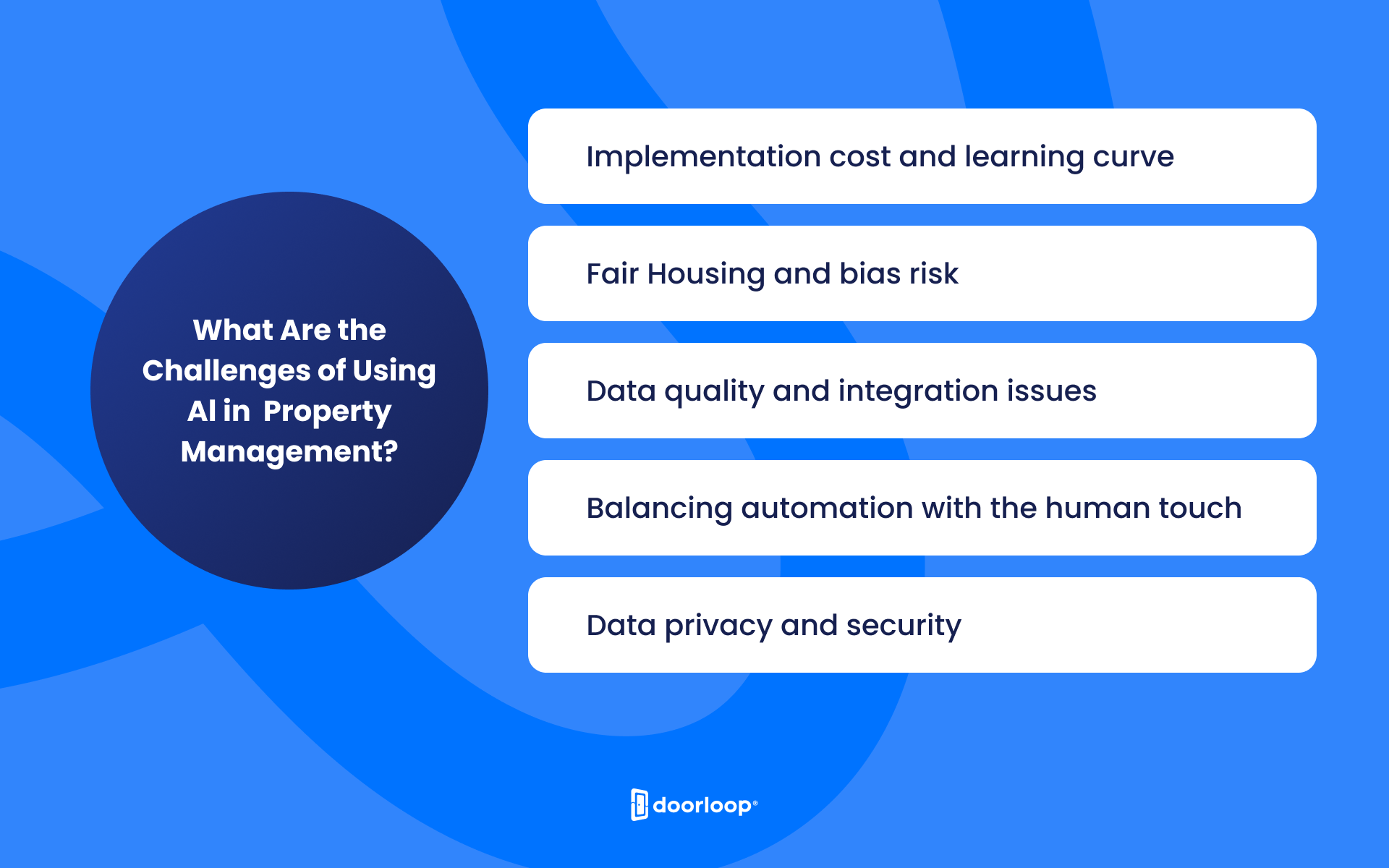
The challenges of using AI in property management are primarily related to data quality, integration, and cost. AI in property management carries real operational and compliance challenges alongside its benefits. Each challenge below reflects a documented friction point that property management teams encounter when adopting or scaling AI tools. Choosing the right AI-powered property management software resolves most of the integration, data quality, and compliance concerns by keeping all functions on a single service with consistent data and built-in safeguards.
Implementation cost and learning curve
Software subscription, system integration, and team training time are the three primary upfront investment categories when adopting AI property management tools. Training time is the cost factor that smaller operators most frequently underestimate: staff members who rely on manual workflows need structured onboarding before AI tools deliver the expected time savings, and inadequate training leads to low adoption and wasted subscription spend.
Data quality and integration issues
AI output quality depends entirely on the quality of data going in. Siloed systems and inconsistent records are two specific data problems that undermine AI performance in property management environments. A maintenance AI trained on incomplete work order histories produces inaccurate triage, and a financial AI working from mismatched transaction records flags false anomalies. Consolidating data into a single service before deploying AI is the standard recommendation.
Balancing automation with the human touch
Disputes, emotional conversations, and complex lease negotiations are three specific interaction types that should remain with a human team member rather than an AI system. Escalation logic, where AI identifies a conversation type it cannot resolve and hands off to a person, is a required feature in any tenant-facing AI tool. A distressed tenant receiving an automated response to a sensitive maintenance or financial complaint is the scenario most likely to damage the landlord-tenant relationship.
Fair Housing and bias risk
AI screening models produce biased outcomes when trained on historical data that reflects past discriminatory practices. Regular model audits and consistent criteria applied uniformly across all applicants are the two primary safeguards property managers should require from any AI screening vendor. Human review of all adverse decisions is a non-negotiable compliance step regardless of how confident the AI output appears.
Data privacy and security
AI systems in property management access financial data, identity documents, and tenant communications, three categories of sensitive information that require durable vendor safeguards. Property managers should require encryption at rest and in transit, SOC 2 Type II certification, and human-in-the-loop review for decisions that affect tenant financial or housing status. SOC 2 and Fair Housing Act compliance are two specific frameworks operators should verify with any AI vendor before signing a contract.
What AI Tools Do Property Managers Use?
Property management teams draw from two categories of AI tools: in-service AI features built directly into their property management software, and standalone AI products that connect to the service through integrations or APIs. The table below maps the major tool categories to their property management functions. The columns are Tool Category, What It Does, and Example Property Management Use.
<table><tbody><tr><td><b>Tool Category</b></td><td><b>What It Does</b></td><td><b>Example Property Management Use</b></td></tr><tr><td><b>AI chatbots</b></td><td>Handles conversational tenant inquiries in natural language</td><td>Answers rent payment, maintenance status, and lease questions 24/7</td></tr><tr><td><b>Generative AI writing assistants (ChatGPT, Gemini, Claude)</b></td><td>Produces original text from prompts</td><td>Drafts listing descriptions, tenant notices, and renewal letters</td></tr><tr><td><b>AI tenant screening Services</b></td><td>Analyzes application data against set criteria</td><td>Parses income documents, flags inconsistencies, and generates screening summaries</td></tr><tr><td><b>Predictive maintenance systems</b></td><td>Monitors equipment performance for early failure signals</td><td>Flags HVAC deterioration before breakdown and routes preventive work orders</td></tr><tr><td><b>AI accounting assistants</b></td><td>Categorizes transactions and extracts bill data</td><td>Scans invoices, reconciles rent rolls, and generates owner reports</td></tr><tr><td><b>AI leasing agents</b></td><td>Manages the full prospect-to-lease workflow</td><td>Responds to leads, schedules tours, routes lease documents for e-signature</td></tr><tr><td><b>Digital twin and spatial AI Services </b></td><td>Creates virtual property models for remote inspection and measurement</td><td>Generates AI-structured inspection reports with flagged issues and instant work orders</td></tr></tbody></table>
In-service AI, where all tools share one data layer, delivers the fastest measurable ROI for most property managers because there is no integration gap from data source to AI output.
How to Use AI Prompts for Property Management
An AI prompt in a property management context is a structured text instruction that tells an AI tool what to produce, for what audience, and in what format. Prompt quality determines output quality directly: a vague prompt produces a generic response, while a specific, well-structured prompt produces usable content in a single generation. The four prompt examples below cover the most common property management writing tasks.
Prompt for writing a listing description
"Write a 150-word listing description for a [bedrooms]-bedroom [property type] at [address]. Highlight [3 features]. Tone: [professional/warm/luxury]."
Use the prompt whenever a new unit becomes available, and a listing description needs to go live across Zillow, Trulia, and other services quickly.
Prompt for a tenant inquiry response
"Draft a reply to a tenant asking [specific issue]. Tone: empathetic and professional. Include next steps and expected timeline. Keep under 150 words."
Use the prompt when a tenant submits a complaint or request that needs a timely written response without the back-and-forth of manual drafting.
Prompt for a lease renewal offer
"Draft a lease renewal offer for a tenant who has paid on time for [months] months. Include the new rent, renewal term options, and a deadline to respond. Keep under 200 words."
Use the prompt during the renewal outreach window, typically 60 to 90 days before lease expiration, to generate personalized renewal letters at scale across a portfolio.
Prompt for a maintenance follow-up
"Write a follow-up message to a tenant after a [type of repair] was completed. Confirm the work, ask about satisfaction, and remind them how to submit future requests."
Use the prompt immediately after a work order is marked complete to close the loop with the tenant and reduce the likelihood of a repeat inquiry on the same issue.
AI-Powered Property Management Software: What Can It Do?
Property management software is a centralized service that handles the operational and financial functions of managing rental properties, including leasing, rent collection, maintenance tracking, accounting, and tenant communication, from a single interface. AI integrates into property management software at the workflow level rather than as a separate tool. The AI reads data already inside the services (lease terms, payment history, maintenance records, tenant messages) and acts on it, categorizing a transaction, drafting a response, routing a work order, without requiring the user to move data from one system to another.
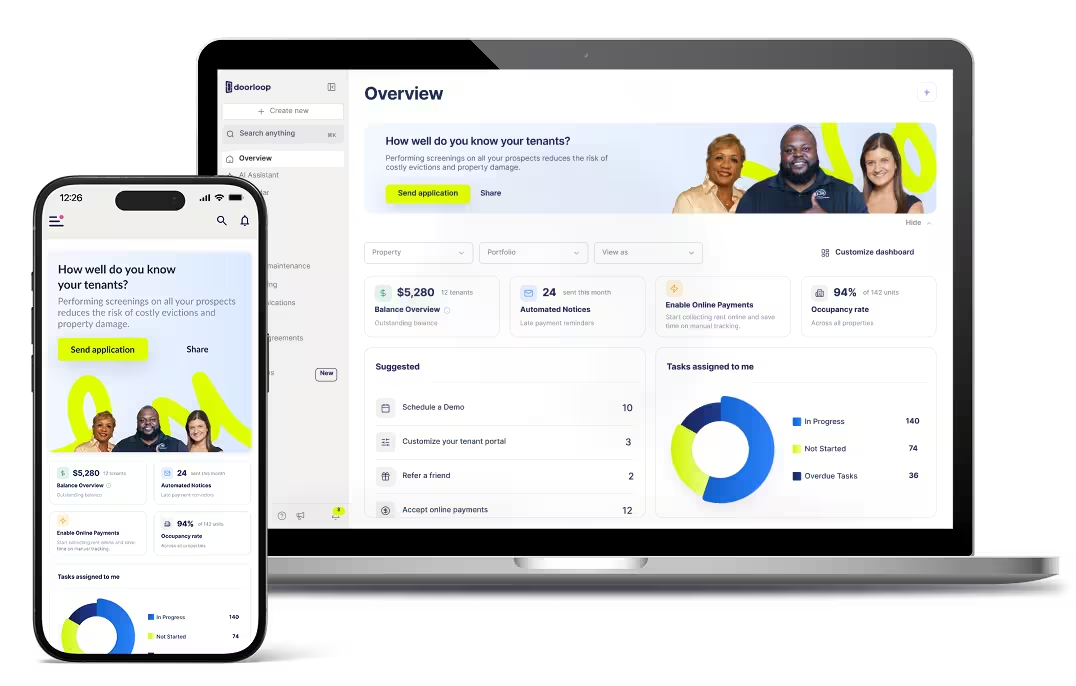
DoorLoop is an AI-native property management software. DoorLoop's AI Assistant handles up to 80% of all tenant requests and helps property managers work faster and focus on growing their business. The AI is embedded across leasing, maintenance, accounting, communications, and inspections, not bolted on as a standalone add-on. DoorLoop AI Inspections transforms hour-long on-site inspections into compliant, structured workflows in minutes, using guided multi-photo capture and instant report generation to automatically structure, interpret, and compile the entire inspection from first photo to finalized documentation.
How DoorLoop's AI Features Can Help
DoorLoop's natively integrated AI features in DoorLoop cover five specific workflows:
- AI Assistant: Automates tenant communication, task creation, and instant operational and financial insights
- AI Inspections: Guides on-site inspections with multi-photo capture, automatically organizes notes and photos, generates legally structured PDF reports, and creates work orders instantly from inspection data
- Listing description generation: Produces polished property listing descriptions in seconds from basic property inputs
- Invoice and expense AI: Saves up to 2 hours weekly by reading, categorizing, and entering invoice data without manual input
- Maintenance routing AI: Receives tenant maintenance requests, creates work orders, and routes them to the appropriate vendor automatically, handling up to 80% of requests end-to-end
Property managers and landlords save an average of 23 hours per month with DoorLoop, and the AI Assistant pushes those time savings further by handling over half of all tenant requests automatically. The service is built for AI Property Management Software across residential, multifamily, commercial, and HOA portfolios at any scale.
Does DoorLoop Integrate with LLMs?
DoorLoop integrates with any program or LLM through Zapier and its open API. The integrations available through DoorLoop.com/integrations span several categories. One-click integrations powered by Zapier connect DoorLoop to thousands of applications, covering accounting, calendar sync, communication tools, CRM services, call logging, e-signature, and data sync workflows, including connections to AI services like OpenAI and Anthropic through Zapier's AI layer. Premium plan members access DoorLoop's REST API directly, enabling custom two-way integrations with any external system or LLM that has an open API. Existing named integrations include QuickBooks Online, Zillow, DocuSign, Mailchimp, and Zoom. DoorLoop also connects natively with Claude Cowork for workflow automation, extending AI-assisted task management across the property management operation.
Frequently Asked Questions About AI in Property Management
The FAQ below addresses the most common questions property managers and landlords ask about AI tools, software costs, autonomous management, and the future of the property manager role.
Is AI Replacing Property Managers?
No, AI is not replacing property managers. The technology automates discrete, repeatable tasks, including screening applications, drafting messages, and routing work orders, but it does not replace the human judgment, relationship management, and contextual decision-making that define the property manager role.
Complex lease disputes, emotional tenant conversations, and negotiations with owners or vendors all require a person. AI has no legal standing, no accountability, and no capacity to read the interpersonal dynamics of a long-term landlord-tenant relationship. The practical outcome of AI adoption is a shift in how property managers spend their time, away from administrative coordination and toward the high-value interactions that affect retention, portfolio growth, and owner satisfaction.
AI is intended to supplement work but not replace judgment and expertise, and human oversight and best practices for AI implementation remain hard in these early stages of adoption.
How Much Does AI Property Management Software Cost?
DoorLoop offers three pricing tiers, all of which include AI Assistant access. The Starter plan is priced at [$69] per month, billed monthly for up to 20 units, the Pro plan at [$169] per month, billed monthly, and the Premium plan at [$229] per month, billed monthly. Annual billing reduces each tier by up to 20%. The Starter plan covers rent collection, accounting, maintenance, tenant screening, and AI Assistant features. The Pro plan adds advanced accounting, QuickBooks sync, bank reconciliation, and budgeting. The Premium plan adds API access, unlimited users, unlimited e-signatures, VIP priority support, and a free personalized website. Pricing scales with unit count for portfolios beyond the base 20-unit tier.
What Is the Best AI Property Management Software?
DoorLoop is the best AI property management software for property managers and landlords who need speed, built-in AI, and an all-in-one service without a steep learning curve. DoorLoop is the AI-native property management service designed for residential and mixed-use property managers and owners serious about scaling their business, managing from 10 to 2,000 or more units with leasing, maintenance, accounting, communications, and resident experience all connected and working together. The service consistently earns top ratings on G2, Capterra, and Trustpilot across user satisfaction categories.
Can AI Manage a Property on Its Own
AI cannot manage a property on its own in the current state of the technology. AI handles discrete tasks with high reliability, including responding to tenant inquiries, triaging maintenance requests, categorizing transactions, and generating reports, but full autonomous property management requires human judgment at multiple points in every workflow.
Agentic AI represents the closest current capability to multi-step autonomous operation. It executes sequential workflows (receive request, create work order, dispatch vendor, notify tenant) with minimal human input, but still requires human approval at decision points that carry legal, financial, or relational risk. Lease terminations, rent increase decisions, eviction filings, and dispute resolutions all require a licensed property manager or landlord to review and authorize action. AI accelerates the work; humans remain accountable for the outcome.
Frequently Asked Questions