





To spot a rental scammer, there are three primary signals: rent priced far below comparable units, pressure to pay or share personal information before any tour, and insistence on wire transfer, gift cards, or cryptocurrency as the only accepted payment method. Rental scammers pose as landlords or property managers to steal money, personal information, or both from renters searching for housing. Renters have reported nearly 65,000 rental scams to the FTC with $65 million in total losses since 2020. People ages 18 to 29 were three times more likely than other adults to lose money in the process (FTC Data Spotlight, December 2025).
What Is a Rental Scam?
A rental scam is a fraudulent transaction in which a person posing as a landlord, property manager, or current tenant tricks a renter into paying money, surrendering personal information (or both) for a rental property the scammer has no legal authority to rent. The transaction differs from a legitimate rental in that the person collecting money or information has no ownership interest in the property and no legal right to lease it.
Rental scams fall into two core patterns. The first is the hijacked listing. The scammer copies a real, existing rental or for-sale listing, replaces the contact information with their own, and reposts it on a different website to intercept applicants. The second is the fabricated listing. The scammer invents a rental from scratch using stolen photos, stock images, or AI-generated images for a property that is either not for rent, not owned by the scammer, or does not exist at all.
The scammer is after one or both of two things: immediate cash through a deposit or fee, and personally identifiable information usable for identity theft. The terms "rental scam" and "rental fraud" are used interchangeably across FTC reports, state attorney general advisories, and consumer protection resources (both refer to the same category of deception).
What Are the Most Common Types of Rental Scams?
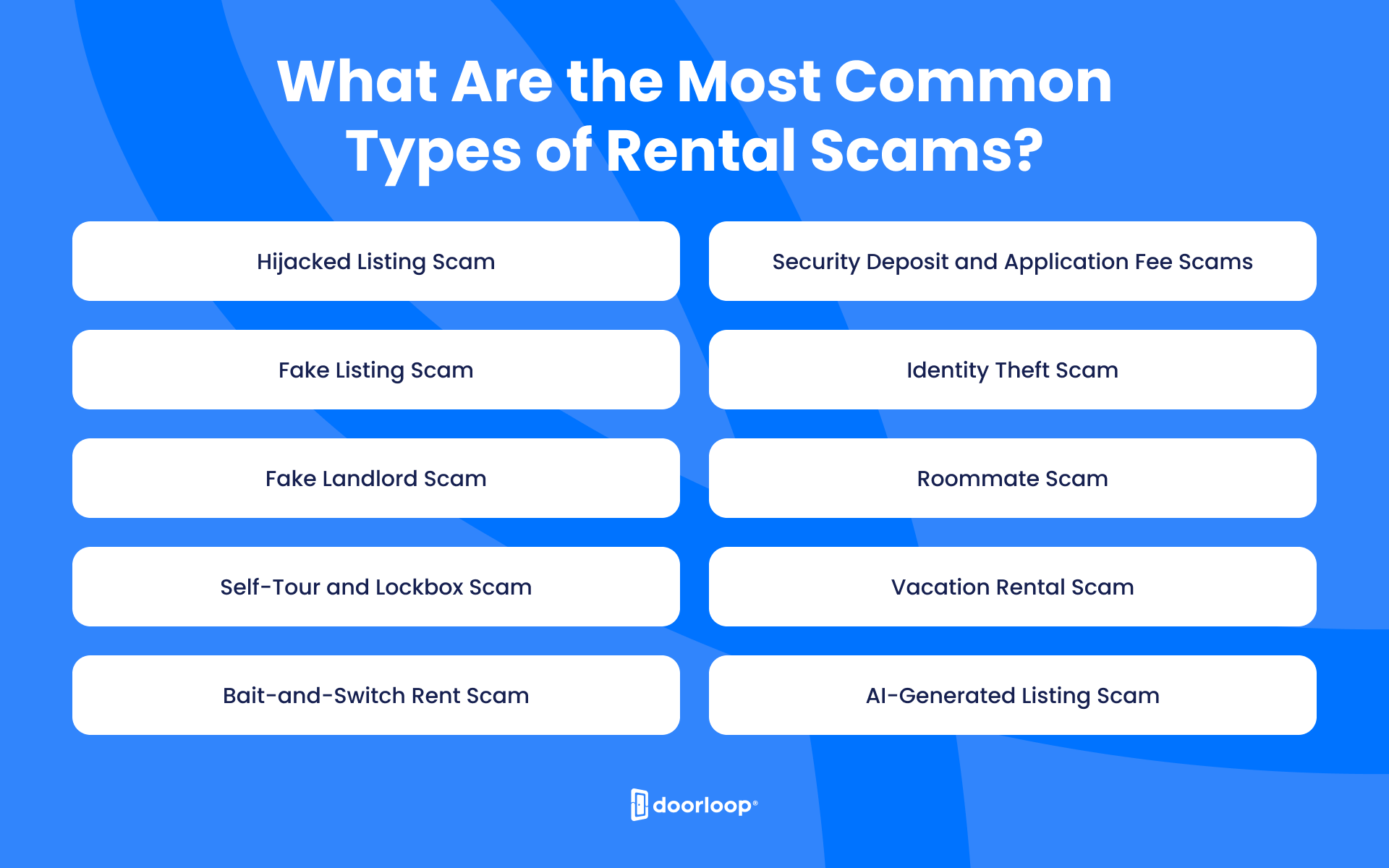
Rental scams fall into a small number of recognizable patterns, and learning each pattern is the fastest way to identify a scammer before money changes hands. The ten types below account for the vast majority of scam reports filed with the FTC, state attorneys general, and the BBB. Each one has a distinct setup, a distinct target, and a specific verification step that catches it.
Hijacked Listing Scam
A hijacked listing scam begins with a real rental or for-sale property. The scammer copies the listing photos, description, and address from a legitimate website, replaces the original landlord's contact information with a phone number or email address they control, and reposts the altered listing on a different site to capture inquiries from renters who have no reason to suspect the listing is stolen.
Hijacked listings appear most frequently on Facebook Marketplace, Craigslist, and Zillow, because all three websites allow anyone to post a listing without verifying ownership of the property. The FTC found that half of rental-scam reports in the 12 months ending June 2025 originated on Facebook (FTC, December 2025). The real owner of the underlying property is typically unaware that their listing has been hijacked until a renter contacts them directly about a payment they sent to someone else.
A reverse image search of the listing photos, covered in the verification section below, catches the majority of hijacked listings in under two minutes.
Fake Listing Scam
A fake listing scam involves a rental that does not exist as described. The scammer invents the property from scratch using stock photos scraped from real estate sites, images pulled from sold-home listings, or photos generated entirely by AI tools. No real underlying rental exists, which distinguishes this scam from the hijacked listing where the property is real but the contact is fraudulent.
The most reliable giveaway in a fake listing is missing or vague location information. A cross-street rather than a full address, no unit number, or an address that does not match the architectural style of the interior photos. Scammers withhold the address intentionally because a real address would immediately reveal, through Google Street View, that the property is not for rent or does not match the photos shown.
Searching the listed address on Google Maps and comparing Street View to the interior photos catches fake listings when no physical address matches the images.
Fake Landlord Scam
A fake landlord scam involves a person who claims to own or manage a real property but has no legal authority to rent it. Two common sub-patterns produce this scenario. A scammer gains temporary access to a vacant home through a showing service or lockbox, presents themselves as the owner, and collects deposits and fees from renters who tour the empty property and believe the transaction is legitimate. A homeowner whose property is in foreclosure continues collecting rent after the bank has legally reclaimed the asset, leaving the renter with no valid lease and no legal protection against eviction.
Rent-to-own arrangements are a vulnerable variant of the fake landlord scam. A scammer collects monthly rent-to-own payments for a property they do not own and have no authority to sell, sometimes for months before the renter discovers the title was never transferable.
Verifying the property owner in county assessor records, as detailed in the verification section below, catches the fake landlord scam before any lease is signed.
Self-Tour and Lockbox Scam
A self-tour and lockbox scam exploits the vacancy of a real property listed with a self-tour service. The scammer identifies a vacant home or apartment that uses an automated lockbox for unaccompanied showings, obtains or distributes the access code, and then poses as the landlord online to collect deposits and holding fees from renters who tour the empty property alone and assume the tour itself confirms legitimacy.
The critical distinction is that an in-person visit to a real, physical property is not sufficient verification of the landlord's identity. The property exists. The lockbox works. The rooms match the photos. None of that confirms that the person who sent the access code owns or manages the property. Renters who rely on a successful tour as their primary verification step are the most frequent victims of this scam variant.
Verifying the landlord is a separate and independent step from verifying the property, and must be completed before any payment is made.
Bait-and-Switch Rent Scam
A bait-and-switch rent scam uses a below-market price to generate a high volume of inquiries, then changes the terms once contact has been established. After the renter responds, the scammer raises the rent, alters the lease terms, adds fees not mentioned in the listing, or redirects the renter to a different property entirely. The FTC has noted that scam listings are frequently priced several hundred dollars below comparable nearby units, a gap large enough to generate immediate interest but not so large that every renter dismisses it as impossible (FTC, 2025).
The contact information collected during the inquiry phase has its own value to the scammer: names, emails, and phone numbers become leads for follow-up fraud even when the initial bait-and-switch fails to produce a payment.
Checking the listed rent against three comparable nearby listings on any major website identifies below-market pricing before the inquiry begins.
Security Deposit and Application Fee Scams
A security deposit scam or application fee scam involves a demand for payment before the renter has toured the property, verified the landlord, or signed a lease. The scammer requests a deposit to "hold" the unit, a first month's rent to "secure" the application, or a non-refundable application fee that disappears with the scammer once paid. The payment is demanded before the renter has confirmed the listing is legitimate in each case.
The fake credit-check variant adds a secondary revenue stream. The scammer sends an affiliate link to a credit monitoring site that enrolls the renter in a paid membership subscription rather than processing a standard screening inquiry. The scammer earns a referral commission, the renter gains nothing useful, and the screening process they completed contributes to no actual application (FTC, 2025).
Any payment demand before an in-person tour and a verified lease is a red flag. Legitimate landlords collect deposits after a tour and application, not before.
Identity Theft Scam
An identity theft scam uses the landlord persona to harvest personally identifiable information. The scammer poses as a legitimate landlord conducting tenant screening and requests Social Security numbers, driver's license images, passport scans, pay stubs, and bank account details "for verification purposes." The information is then used to open credit accounts, apply for loans, or sell identity packages on fraud marketplaces.
The data collection happens early in the inquiry process, before the renter has toured the property or confirmed that the listing is real. The scammer's goal is the data, not a tenancy. Contact ends once the information is collected.
The rule that protects against the scam is specific. A legitimate landlord does not need a Social Security number, a full driver's license, or bank account information until after the renter has toured the property and formally submitted a verified application through a documented process.
Refusing to provide sensitive identifiers before completing a tour stops the identity theft scam at the point of first contact.
Roommate Scam
A roommate scam targets either side of a shared-housing arrangement. A person answering a "roommate wanted" ad falsifies their identity, employment history, or references to gain access to a household on one side, then fails to pay rent, sublets the room without authorization, or steals from the other residents after moving in. A person advertising a room for rent fabricates the listing entirely, collects a deposit from the responding applicant, and disappears before the move-in date on the other side.
The shared-housing context makes verification feel less formal than a standard lease transaction, which is exactly what the scammer relies on. Household members accepting a new roommate without a formal application and lease are more exposed than renters going through a property management company with a documented screening process.
Running a credit check, background check, and employment verification through a formal screening service, and confirming identity against a government ID that matches the application, catches the majority of roommate-scam applicants before move-in.
Vacation Rental Scam
A vacation rental scam lists a short-term rental property that does not exist, is already booked, or is not available for rent on Airbnb clone sites, Facebook groups, or off-website listing pages. The scammer collects a full or partial payment for the nightly stay, then becomes unreachable by the time the renter arrives and finds the property unavailable.
The risk is substantially higher when bookings are made off-website, because the major short-term rental websites (Airbnb, VRBO) offer verified booking guarantees and mediated refund processes that disappear when the transaction moves to a private email, bank transfer, or direct message outside the website. A scammer who directs a renter off-website before collecting payment is removing every protection the website provides.
Booking exclusively through websites with a verified booking guarantee and refusing to complete any payment outside the website’s checkout system eliminates the most common vacation rental scam vector before any money is transferred.
AI-Generated Listing Scam
An AI-generated listing scam uses generative AI tools to fabricate rental photos, video walkthroughs, or written landlord messages for a property that does not exist or does not match the images shown. An AI-generated listing is a recent development in rental fraud. Photo-based verification through reverse image search was reliable because stolen or stock photos appeared elsewhere on the web until 2023. AI-generated images are unique files that return no matches.
Several visual tells appear in current AI-generated real estate images. Inconsistent shadow angles across objects in the same room, straight lines that bow or warp near edges, impossible room geometry where walls meet at angles that cannot exist physically, and text on signs, labels, or appliances that renders as garbled or nonsensical characters. Video walkthroughs generated by AI lack fluid movement and show no interaction with the environment.
Insisting on a live video tour where the person claiming to be the landlord moves the camera on request and responds in real time distinguishes a human showing a real space from any pre-generated content.
What Are the Warning Signs of a Rental Scammer?
The warning signs of a rental scammer listed below can indicate a scammer regardless of which scam pattern they are running. Rental scam red flags rarely appear in isolation. A below-market price is common in a legitimate distressed rental, a spelling error appears in legitimate listings, and some small landlords do use Venmo for rent. The pattern that matters is the combination. Any one of the signs below in isolation may be explainable. Two or more together should stop the conversation until every item is resolved.
Rent is priced well below market for the area
Below-market pricing is the most common bait in rental scams because it generates immediate, high-volume inquiries from renters who assume they have found an unusually good deal. The FTC has documented that scam listings are priced several hundred dollars below comparable nearby units, a gap large enough to attract attention without triggering immediate disbelief (FTC, 2025). Cross-referencing the listed rent against three nearby listings on any major website, filtered for the same unit size and neighborhood, takes under five minutes and quantifies the gap precisely. A property renting for 20% or more below three directly comparable units in the same area warrants verification before any further contact.
Pressure to decide, pay, or share information quickly
The urgency tactic is the second most reliable scam signal after price. Scammers claim other renters are actively considering the unit, that the listing is taken down within hours, or that a deposit is required immediately "to hold" the apartment before a tour has been scheduled. A legitimate landlord should always wait at least 24 to 48 hours for the renter to verify the listing, complete a tour, and review the lease. A landlord who does not wait 24 hours for any of the steps has a reason for the urgency that benefits only the landlord.
Refusal to meet in person or do a live video tour
Scammers who refuse in-person meetings or do live video tours usually do so with consistent explanations. They are currently out of the country, deployed overseas with the military, traveling for work, or managing a family emergency that prevents them from meeting locally. Pre-recorded video walkthroughs are offered as a substitute. The minimum acceptable alternative to an in-person tour is a live video call where the person claiming to be the landlord moves the camera through each room on the renter's request, in real time. A static pre-recorded video and a refusal to appear live are, together, sufficient grounds to suspect a scam and end the conversation.
Demand for payment by wire transfer, gift card, cryptocurrency, Zelle, Venmo, or Cash App
Scammers specify the payment methods because all of them share the same critical feature. Payments are fast, irreversible once sent, and anonymous. Wire transfers through Western Union or MoneyGram are nearly unrecoverable the moment they are received. Gift card codes are untraceable. Cryptocurrency transactions are permanent by design. Zelle, Venmo, and Cash App have no formal chargeback process for fraud. The FTC is direct on the point: Any demand to pay rent, a deposit, or a holding fee through any of these methods is, on its own, a strong indicator of a scam (FTC, Consumer Advice). Peer-to-peer apps represent a newer variant. Legitimate small landlords do use Venmo or Cash App for rent, but a request for a first payment to a landlord the renter has never met in person should be met with strong skepticism.
No written lease, or a lease with blanks, typos, or missing terms
A legitimate lease includes a minimum set of fields: full property address, including the unit number, and the monthly rent amount, the lease start and end dates, along with the security deposit amount. The lease must include the full legal names of both parties and their signatures. It should list the landlord's contact information and mailing address. The lease outlines the maintenance responsibilities assigned to each party. A lease document with blank fields marked "insert name here," clauses that allow the landlord to unilaterally change the rent or terms during the lease term, or a generic boilerplate that omits the property address is not a legitimate lease and provides no legal protection.
No application, credit check, or background check
Legitimate landlords screen applicants to reduce nonpayment risk and to protect the property. A landlord who is willing to hand over keys after just one phone conversation and a Venmo deposit likely does not care about the quality of the tenancy because the property is not theirs. The landlord is operating without the basic legal protections that define a real rental agreement. The complete absence of a formal screening process is itself a red flag, even when every other element of the listing appears legitimate.
Typos, grammar errors, and copy-paste listing text
Scam listings frequently contain subject-verb agreement errors, inconsistent verb tenses, all-caps phrases, excessive exclamation points, and text that appears nearly verbatim on multiple unrelated properties across different websites. Copy-paste text is identifiable by pasting the description into a Google search in quotation marks to check if the same paragraph appears on multiple unrelated listings, indicating that the description was recycled. Note that AI-generated listing text is narrowing the gap, making grammatically clean prose no longer a proof of legitimacy. The content-quality test alone is insufficient without the other verification steps.
Vague address, missing unit number, or mismatched photos
Scammers withhold the full address because a real address is verifiable. A listing that provides only a cross-street ("near Elm and 5th") or omits the unit number for a multi-unit building has deliberately obscured the information. Exterior photos that do not match the street-view of the address provided suggest intentional misrepresentation. Interior photos with an architectural style inconsistent with the exterior, such as a mid-century modern interior in a listing claiming to be a 1970s brick complex, indicate the photos were taken from a different property entirely.
Requests for Social Security numbers, bank accounts, or ID scans before a tour
A scammer posing as a landlord requests Social Security numbers, driver's license scans, passport images, bank account numbers, or full dates of birth before the renter has toured the property or submitted a formal application through a documented screening service. Legitimate landlords do not need Social Security numbers or bank account information until after a formal application has been submitted and an in-person tour has been completed. A request for any of that information before the two steps is overreach that serves the scammer's identity-theft objective rather than any legitimate screening purpose.
Listing appears on multiple sites with different contact information
A cross-site check reveals one of the clearest scam patterns, with the same property photos, the same interior layout, and the same listed address appearing on two different websites under two different landlords, each with different phone numbers and email addresses. The underlying photos were copied from one legitimate source and reposted with fraudulent contact information on at least one website. The appearance of the same address under two different "landlords" indicates that one is a scam, with the legitimate listing originating from the property owner's own verified website.
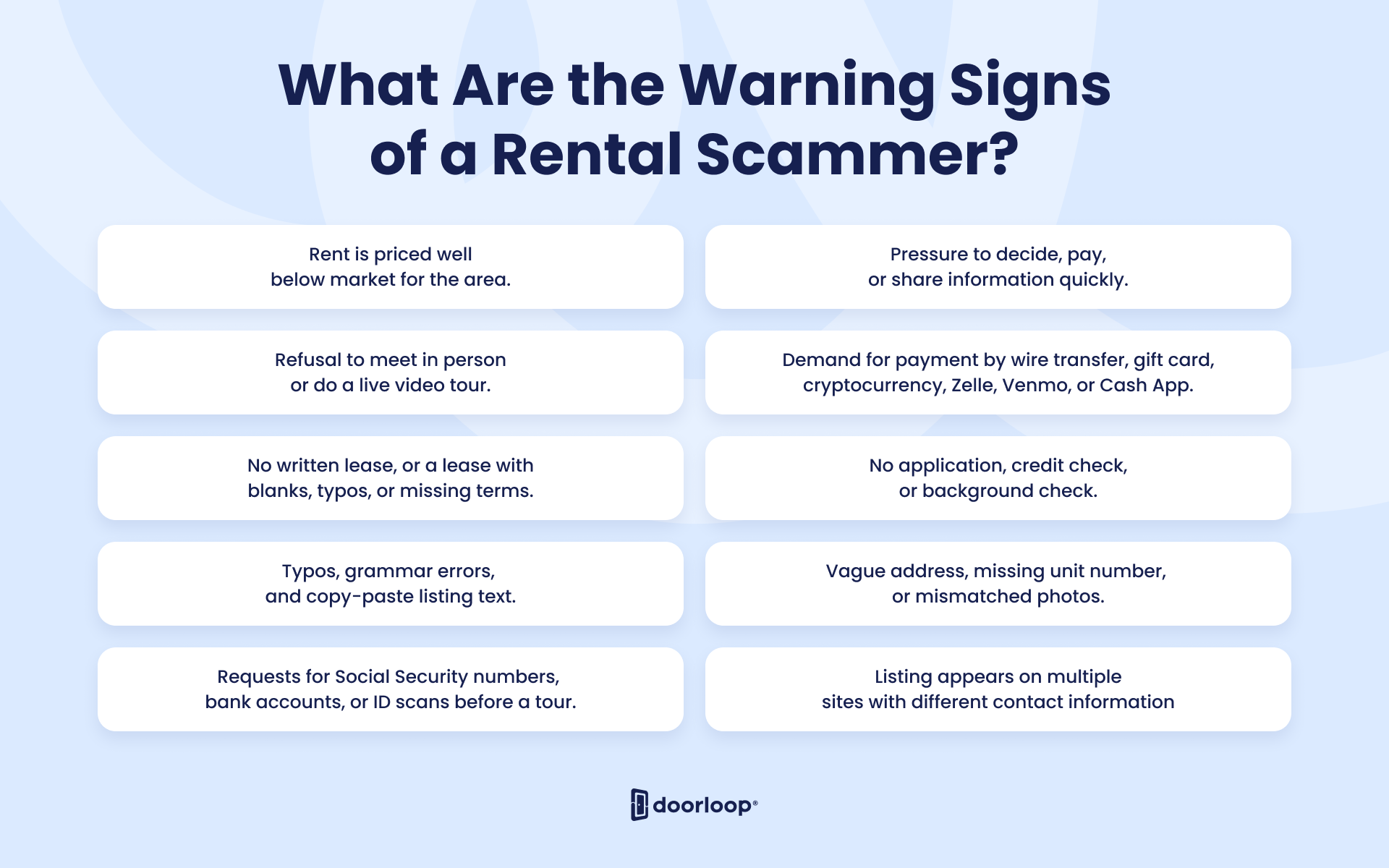
The red flags above identify a scammer in progress. The next section covers how to verify the listing, the property, and the person claiming to be the landlord before any money or personal information is exchanged.
How to Verify a Rental Listing Is Legitimate
To verify a rental listing is legitimate, there are threeverification targets (the listing itself, the physical property, and the person claiming to be the landlord). All three must be verified before sending money or sharing personal information. Clearing one target does not clear the others. A real property with real photos does not confirm the person collecting rent owns it, and a convincing landlord persona does not confirm the listing is genuine. The steps below work in sequence, with each one narrowing the remaining risk.
Reverse-Image-Search the Listing Photos
Right-clicking any listing photo and selecting "Search image with Google" runs the reverse image search immediately on a desktop browser. Uploading the image to Google Images, Bing Visual Search, or TinEye produces the same results on mobile. The search returns every other page where that image appears, including the original source.
Three results confirm a scam. First, the photos appear on a "for sale" listing on Zillow, Redfin, or Realtor.com, meaning the property was sold, not rented, and the current occupant or owner did not list it for rent. Second, the same interior photos appear on a different rental listing under a different landlord name, meaning the images were stolen. Third, the photos trace back to a stock-photo library or a home-staging portfolio, meaning no real rental was ever photographed.
A reverse image search alone catches the majority of hijacked-listing scams before the renter has spoken with anyone.
Cross-Check the Listing on Multiple Websites
Pasting the full property address into Google, then separately into Zillow, Trulia, Apartments.com, and Realtor.com, surfaces any other listing for the same address across all major website simultaneously. The cross-check reveals three categories of problems. The property appears listed for sale rather than rent, confirming the rental listing is fraudulent. The same address appears under a different landlord name and a different rental price on another website, confirming that at least one listing is a scam. No listing for the address exists anywhere except the website where the scam listing appeared, which warrants further investigation before any contact continues.
Scammers who know their photos are reverse-image-searched sometimes crop, mirror, or slightly color-shift the images to defeat the visual match. The address cross-check catches hijacked listings even when the image manipulation defeats reverse-image search, because the address itself is verifiable independently of the photos.
Verify the Property Owner in Public Records
The county assessor or property appraiser website for the county where the property is located publishes the owner of record for every parcel, free of charge, in most U.S. counties. Searching the property address in the assessor database returns the owner's name and the owner's mailing address. The owner on record is an individual name or an LLC (both are legitimate), but if the owner is an LLC, the person claiming to be the landlord must be able to produce documentation of their relationship to the LLC before any lease is signed.
How do I find out who owns a rental property? Search "[county name] property appraiser" or "[county name] assessor" to locate the county's public records portal, enter the full street address including unit number, and the owner of record appears with the owner's mailing address and the property's legal description. The search takes under two minutes and is free in virtually every U.S. county.
The name on the lease and the name on the deed must either match or have a documented relationship through LLC membership, power of attorney, or a licensed property management agreement. The step catches fake landlord scams.
Verify the Landlord's Identity and Licensing
Verify the landlord’s identity and licensing by having three separate checks, including phone calls and email exchanges are not be replaced. First, request a government-issued photo ID from the person claiming to be the landlord and confirm the name on that ID matches the name on the county assessor record or the LLC documentation. Second, ask for the license number and verify it in the state's online licensee database if the landlord identifies as a licensed property manager or real estate broker, which every state real estate commission maintains publicly. Third, require an in-person or live video meeting where the person appears on camera in real time.
How do I know if a landlord is legit? A legitimate landlord's name matches the deed or LLC record, their license number verifies in the state database if they claim to be licensed, and they are willing to appear in person or on a live video call at a scheduled time. Phone numbers are spoofable, and email addresses are impersonatable (neither a phone call nor an email exchange constitutes identity verification).
The deed match, license lookup, and live meeting requirement together catch impostor-landlord and self-tour scams.
Tour the Property in Person or Send Someone You Trust
An in-person tour is the final verification step and the one that confirms the physical property matches the listing description. The tour must include interior access, not just a drive-by of the exterior address. The renter confirms that the unit number, layout, condition, and amenities match the listing photos and description during the tour.
The self-tour caveat from the scam patterns section applies directly. A successful tour of a real, empty property does not confirm that the person who provided the access code owns or manages that property. The in-person verification step must be paired with the landlord identity verification step, not substituted for it.
Two alternatives reduce risk without eliminating it entirely for renters who are not touring in person. A trusted local contact (a family member, friend, or colleague who lives in the area) tours the property on the renter's behalf and confirms the physical property matches the listing. A licensed local real estate agent tours as the renter's representative and provides a professional assessment of the listing's legitimacy.
An in-person or trusted-proxy tour closes the last remaining scam vector before any payment is made, combined with the landlord verification step above.
Which Payment Methods Are Safe for Paying Rent?
The payment method is the single highest-stakes decision in the rental process. The payment method determines whether any of the money is recovered if the listing turns out to be fraudulent. The table below covers the common rent payment methods, whether they are recoverable in a fraud scenario, and when a legitimate landlord is to require them.
<table><tbody><tr><td>Payment Method</td><td>Recoverable if Scammed?</td><td>When to Use</td></tr><tr><td>ACH bank transfer</td><td>Yes (dispute window: 60 days)</td><td>Preferred: use through a verified property management portal</td></tr><tr><td>Credit card</td><td>Yes (chargeback rights apply)</td><td>Preferred for first payments to unverified landlords</td></tr><tr><td>Debit card</td><td>Partial (limited chargeback rights)</td><td>Acceptable through verified websites only</td></tr><tr><td>Certified or cashier's check</td><td>Partial (stop payment possible if uncashed)</td><td>Acceptable for established landlords with a lease in place</td></tr><tr><td>Personal check</td><td>Partial (stop payment within 24 to 48 hours)</td><td>Acceptable once the lease is signed and the landlord is verified</td></tr><tr><td>Zelle, Venmo, Cash App</td><td>No</td><td>Avoid for first payments. No fraud chargeback process</td></tr><tr><td>Wire transfer (Western Union, MoneyGram)</td><td>No</td><td>Never for rental payments (nearly unrecoverable once received)</td></tr><tr><td>Gift cards</td><td>No</td><td>Never; legitimate landlords do not accept gift cards</td></tr><tr><td>Cryptocurrency</td><td>No</td><td>Never; transactions are irreversible by design</td></tr></tbody></table>
Credit card and ACH through a landlord-provided portal are the two safest payment options because both are reversible through formal dispute processes and both generate an independent transaction record that the renter retains.
How do I pay rent safely? Pay through a verified property management software portal using ACH or a credit card. Both methods create a timestamped receipt, both have dispute processes if the transaction is fraudulent, and neither requires sharing bank account credentials directly with an unverified recipient.
What to Do If You've Been Scammed on a Rental
The renter's first hour matters more than any subsequent step. The first calls can stop a payment in transit, limit the identity exposure from shared personal information, and establish the formal record required for a police report and any chargeback claim. Work the steps below in order: the earlier steps have the shortest window.
Contact your bank or card issuer immediately
Call the fraud line on the back of the card or the bank's direct fraud number and report the transaction as fraudulent. Request a chargeback for credit and debit card payments. The bank's dispute window is 60 days from the statement date, but begins immediately. Request a stop payment if the check has not yet cleared for personal checks. Request a recall for ACH transfers initiated within the past 24 to 48 hours. ACH recalls are not guaranteed, but are worth attempting within the window. Wire transfers through Western Union or MoneyGram are rarely recovered once received by the scammer, but a recall request through the sending institution is still worth making immediately, because some wires are held briefly before final release.
Freeze your credit with the three major bureaus
A credit freeze prevents new credit accounts, loans, or lines of credit from being opened in the renter's name if the scammer obtained a Social Security number, driver's license scan, or bank account details. The freeze is placed separately with each of the three bureaus (Equifax, Experian, and TransUnion), and all offer free online freeze requests that take effect immediately. A freeze does not affect existing accounts, does not damage the credit score, and is lifted temporarily when the renter applies for a legitimate rental or credit product. Freezing all three bureaus closes the identity-theft window that the scammer opened by collecting personal information before the renter discovered the fraud.
File a police report with local law enforcement
The jurisdiction for the police report is the city or county where the property is, or was claimed to be, located, not where the renter currently lives. File in person or online through the department's non-emergency reporting system and retain the report number. The police report number is the reference the renter quotes on every subsequent call to the bank, the FTC, and the FBI. Banks are less likely to approve chargebacks, and agencies are less likely to open formal investigations without a police report number.
Report the scam to the FTC at ReportFraud.ftc.gov
File a report at ReportFraud.ftc.gov or by calling 1-877-382-4357. The FTC does not open individual investigations into reported scams, but every report submitted feeds the pattern data that drives enforcement actions, consumer alerts, and regulatory guidance. The December 2025 FTC Data Spotlight on rental scams was produced directly from the data collected through those individual reports. Filing takes under 10 minutes and creates an official federal record of the incident.
Report online rental fraud to the FBI's IC3
File a report at IC3.gov when the scammer used email, a website, or an online listing website, which applies to nearly every rental scam. The Internet Crime Complaint Center (IC3) aggregates reports across the country, and larger patterns of fraud identified through IC3 submissions do result in federal prosecution. Individual reports rarely lead to individual investigation, but the aggregate data from IC3 reports has produced prosecutions in multi-victim rental fraud cases.
Report the listing to the site or app where you found it
Every major website where rental scams appear has a reporting mechanism. On Facebook Marketplace, select the three-dot menu on the listing and choose "Report listing." On Craigslist, use the "flag" button on the listing page. On Zillow, use the "Report" option on the listing. On Apartments.com and Airbnb, contact support directly through the website's help center. Reporting the listing removes it before another renter is scammed and alerts the website's fraud team to the specific account.
Tell your state attorney general
Many states have consumer protection divisions that open individual rental fraud cases when the scammer operates within the state. Find the state attorney general's office through the National Association of Attorneys General directory at naag.org. Consumer.gov states the rule directly: "If you spot a rental scam, tell your state attorney general" (consumer.gov, 2024).
Rental scam victims do not recover the money paid by wire transfer, cryptocurrency, or gift card. The reporting steps above still matter because they reduce the probability that the same scammer finds the next renter, and because a police report and FTC complaint are frequently required before a bank will approve a chargeback on a disputed payment.
How Property Management Software Reduces Rental Scam Risk for Renters and Landlords
The verification steps above cover the renter side of the fraud problem: how to identify a scam listing, confirm a property is legitimate, and recover if money has already been sent. The landlord side of the problem is equally important. A large share of rental scams succeeds because a legitimate landlord's listing was hijacked without their knowledge, or because the real landlord's payment channel was outside any website capable of flagging or reversing a fraudulent transaction.
Purpose-built property management software closes both gaps simultaneously. Listings originate from verified landlord accounts attached to property records. Applications route through the website rather than through an email address that a scammer can impersonate. Payments are processed through bank-grade rails with chargeback rights. Every transaction, document, and communication generates an audit trail that makes fraud easier to detect and prove.
Verified Listings and Tenant Portals
A property management software website reduces hijacked-listing risk at the source. Listings created inside a website are attached to a verified landlord account, which is associated with a specific property record containing the address, unit details, and ownership documentation. A scammer copying the listing cannot replicate the verified account identity that the website requires to process an application or collect a deposit.
Applicants who find a listing through a website-verified channel apply through the tenant portal rather than through a standalone email address, phone number, or payment link. The tenant portal shows the landlord's verified business profile, the property's address confirmed against the website's records, and the application history that the landlord has used the account for documented rental activity. A scammer impersonating the landlord cannot reproduce a tenant portal with a matching verification record, which is why website-based listings are substantially harder to hijack than listings posted with only a phone number and an email address.
Secure Online Rent Payment Rails
Rent payments processed through a property management software website route through bank-grade ACH rails and card payment processors that carry chargeback rights, transaction receipts, and dispute resolution processes that do not exist in Zelle, Venmo, cryptocurrency, or wire transfer. Every payment generates a timestamped receipt on the renter's side and the landlord's side, creating an independent transaction record that neither party controls.
The practical effect for the renter is that a payment made through a verified website portal is recoverable through a formal dispute process if the landlord turns out to be fraudulent. The practical effect for the landlord is that every incoming payment is documented with the payer's information, the property reference, and the date, eliminating the cash-and-disappear dynamic that peer-to-peer payments enable for fraudulent tenants.
The "ACH through a verified portal" rule in the Safe Payment Methods section above refers precisely to this infrastructure: a property management website’s payment system is the specific implementation of that recommendation.
Built-In Tenant Screening and Background Checks
Tenant screening inside a property management website runs credit checks, eviction history searches, criminal background checks, and employment verification through a single verified workflow attached to the formal application. The screening process requires the applicant to submit their information through the website, which confirms identity against a credit bureau record rather than against a self-reported form.
The integrated screening workflow stops roommate scammers, fake-income applicants, and identity-based application fraud from progressing past the application stage for the landlord. The formal process itself signals legitimacy to honest applicants: a landlord who requires a real credit check, a real background check, and real employment verification is operating a real rental transaction. The presence of a formal screening requirement is itself a counter-signal to the "no credit check" red flag that appears consistently in scam listings. A website that requires screening of every applicant is one that a scammer cannot easily exploit on the tenant side.
Digital Lease Signing and Document Storage
Digital lease signing inside a property management website reduces the risk of fake leases. The lease originates from a template attached to the verified property record. It auto-populates the correct address, rent amount, and party names from the website’s data. The process requires an authenticated e-signature from both parties through a documented audit trail.
The resulting signed lease is a PDF stored on the website that both the renter and the landlord retrieve independently at any time. A scammer cannot produce it on demand. Fabricating a lease with a matching website signature trail, a correct property record, a verified landlord account, and a matching tenant portal record requires access to the real landlord's account, which the scammer does not have.
The audit trail attached to a website-signed lease, which records the IP address, timestamp, and authentication method for every signature event, is the document the renter needs to demonstrate the lease's legitimacy in a dispute or a court proceeding.
How Landlords and Property Managers Can Protect Their Listings from Scammers
The renter-side guide covers how to spot a scam and recover from one. Scammers hijack legitimate listings because real landlords create the conditions that make hijacking easy. Unwatermarked photos that are trivial to copy, listings syndicated across open websites without any monitoring for duplicates, and contact channels outside any system that could flag or trace fraud. The five actions below close those conditions before a hijacker finds the listing.
Watermark your listing photos and write custom descriptions
A watermark placed across the bottom corner of each listing photo raises the cost of a hijack because the scammer must crop or edit the image before reposting, which disrupts the aspect ratio and generates a visual artifact that reverse-image search catches more easily. A property-specific listing description that references the actual unit, the actual neighborhood, and the actual landlord's property name is harder to copy-paste convincingly than a generic paragraph that applies to any rental. The combination of a watermarked photo and a specific description reduces the ease of hijacking without requiring any additional monitoring effort.
Monitor the open web for copies of your listing
Searching the full property address on Google, Facebook Marketplace, and Craigslist once per week reveals copied listings before multiple renters have been defrauded during an active listing period. The search takes under five minutes. Any listing that uses the same address under a different name or contact must be reported to the website immediately through the website’s fraud or abuse reporting channel, followed by direct contact with the website's trust and safety team if the listing is not removed within 48 hours.
Route all inquiries through your own website, not personal email
A personal email address or personal phone number listed in a rental ad is the contact information the scammer replaces with their own when creating a hijacked listing. A dedicated leasing inbox attached to a business domain, or a property management software portal that processes all applications and communications through a verified system, is substantially harder to impersonate and produces a documented trail of every inquiry, response, and application. DoorLoop provides the full inquiry-to-application-to-lease workflow through a single verified website, eliminating the standalone personal contact channel that hijacked listing scams require.
Screen every applicant through a formal process
A consistent formal screening process, including identity verification, credit check, eviction history, criminal background, and employment verification, stops roommate scammers, fake-income applicants, and identity-theft-based application fraud before a lease is signed. The formal process signals legitimacy to honest applicants who understand that real landlords run real checks. An applicant who objects to a formal screening process is providing their own warning signal.
Accept rent only through traceable, on-website methods
A landlord who accepts rent only through a property management software portal, a bank ACH transfer, or a certified check has payment records for every transaction that are independently verifiable and recoverable through formal dispute processes. A landlord whose payment channel is a personal Venmo account or a Cash App handle has no audit trail, no chargeback path, and no documentation that distinguishes a legitimate payment from a fraudulent one. The landlord's payment rules mirror the renter's safety rules from the Safe Payment Methods section. The landlord's portfolio is protected from tenant-side fraud enabled by peer-to-peer payment channels if the landlord's account are not used for scam payments.
Frequently Asked Questions About Rental Scams
The questions below are the ones renters most commonly ask after working through the verification and warning-sign sections above.
How Do I Know If a Rental Listing Is Legitimate?
A legitimate rental listing passes three cross-checks. First, a reverse-image search returns no matches on "for sale" listings or other rental websites under different landlord names. Second, the address resolves to a real property that matches the listing photos on Google Street View. Third, the owner of record in the county assessor database matches (or has a documented relationship to) the person collecting rent and signing the lease.
Is It a Scam If a Landlord Wants a Deposit Before I See the Place?
Yes, it is a scam if a landlord wants a deposit before you see the place. A request for any deposit, application fee, first month's rent, or holding fee before the renter has toured the property in person or via a live video tour is one of the most consistent markers of a rental scam across FTC, BBB, and state attorney general reports. A legitimate landlord waits for the tour before collecting any payment, because the payment commits the renter before the renter has confirmed the property or the landlord is genuine. No legitimate business reason exists for a pre-tour financial commitment from the applicant.
Can You Get Money Back From a Rental Scam?
Possibly, depending entirely on the payment method used. Credit card and ACH payments are the most recoverable through chargeback and bank dispute processes. Personal checks can sometimes be stopped if the scam is discovered within 24 to 48 hours of sending. Wire transfers, cryptocurrency, and gift card payments are rarely recovered once the funds reach the scammer, because none of those methods has a formal reversal or chargeback process. The full recovery workflow, including which agencies to contact and in what order, is covered in the "What to Do If You've Been Scammed on a Rental" section above.
Are Rental Scams Common on Zillow, Craigslist, and Facebook Marketplace?
Yes, rental scams are common on Zillow, Craigslist, and Facebook Marketplace. All three websites appear consistently in rental scam reports, with Facebook Marketplace the most reported source. The FTC found that half of rental-scam reports in the 12 months ending June 2025 originated on Facebook (FTC, December 2025). Craigslist and Zillow both appear in scam reports, though the major real estate websites have automated detection systems that remove hijacked listings faster once reported. The open-posting model shared by all three websites, which allows anyone to list a property without verifying ownership, is the structural condition that makes all three targets for scammers running hijacked-listing operations.
How Do I Protect Myself from Rental Scams When Renting Remotely?
Protect yourself from rental scams when renting remotely by following these four steps. First, require a live video tour where the person claiming to be the landlord moves the camera through every room on request, in real time. Second, send a trusted local contact or a licensed local real estate agent to tour the property in person as the renter's representative. Third, verify the property owner in the county assessor's public records and confirm the name matches the lease. Fourth, pay only through a property management software portal or a credit card with chargeback rights, never through wire transfer, gift card, or cryptocurrency.
Frequently Asked Questions